The best wireless in-ear monitor systems for churches help worship teams hear a consistent mix without filling the stage with monitor wedges. The right setup can improve focus, reduce stage volume, and give singers and musicians greater freedom to move.
This roundup compares 10 systems across UHF and 5.8GHz designs, from compact single-channel kits to multi-bodypack packages built for larger worship teams. Use the guide below to match channel count, operating range, and control features to your church’s needs.
Best 10 Wireless in Ear Monitor Systems for Churches Picks for 2026
Best Compact Pick
- Less than 5ms latency
- Six-channel 2.4GHz operation
- Up to five hours of battery life
Best For: Small worship teams needing a portable single-receiver system
Best Multi-Performer Setup

- Four UHF channels and receivers
- Separate mixes for each performer
- Rack-mountable integrated monitor station
Best For: Worship teams needing up to four individual mono mixes
Best High-Resolution Option

- 5.8GHz true diversity wireless
- Channel Scan mode
- 24-bit/48kHz audio with up to 100-foot range
Best For: Single performers seeking detailed audio and modern wireless features
Best Long-Range Value

- Up to 300 feet of stated coverage
- Four included bodypack receivers
- Two UHF channels with adjustable frequencies
Best For: Church stages needing extended range and several receivers
Large-Team Value Pick

- Eight bodypacks for worship teams
- 40 preset UHF frequencies
- More than 300 feet of stated range
Best For: Churches monitoring large worship teams
Durable Two-Person Pick
Phenyx Pro PTM-22 Wireless IEM

- Two UHF bodypack receivers included
- 100 selectable frequencies total
- Metal transmitter with LCD display
Best For: Small worship teams and church rehearsals
Full Worship-Team Kit

- Eight bodypacks from one transmitter
- Under-5ms stated latency
- Multiple 3.5 mm, 6.35 mm, and USB inputs
Best For: Large worship teams needing low-latency monitoring
Best Flexible Digital Pick

- 5.8GHz system with four selectable channels
- Stereo/mono switching and cue talkback support
- One transmitter can serve multiple receivers
Best For: Worship teams needing flexible shared monitoring and cue communication
Best Multi-Bodypack Mono System
- Includes five bodypack receivers
- 40 selectable UHF frequencies
- Up to 300 feet of stated range
Best For: Church stages needing mono monitoring for multiple performers
Best Stereo Rackmount Package
- Four bodypacks with stereo/mono monitoring
- 89 tunable 900MHz frequencies
- Includes rack kit and carrying case
Best For: Worship teams wanting stereo control and a complete rack-ready package
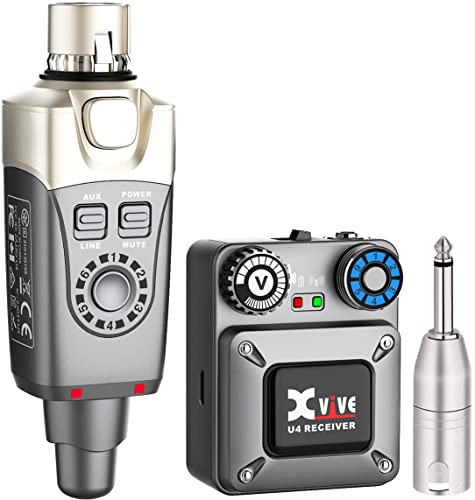
Best Compact Pick – Xvive U4 Wireless IEM System
For churches seeking wireless in ear monitor systems for churches without a complicated setup, the Xvive U4 offers a compact 2.4GHz transmitter-and-receiver system. Its low latency, six-channel operation, and roughly 90-foot range suit small worship spaces, rehearsals, and stage monitoring.
Best For: Small churches, worship teams, and performers who need a simple single-receiver monitoring setup.
Pros:
- Less than 5ms latency supports distraction-free performance.
- Six channels allow multiple systems to operate together.
- Rechargeable transmitter and receiver provide up to five hours of battery life.
- Compact metal construction and included adapter and carrying bag simplify transport.
Cons:
- The approximately 90-foot range is better suited to small venues than large sanctuaries.
- This set includes one transmitter and one receiver, so additional performers require more receivers.
- It uses 2.4GHz wireless, which may be less suitable where that band is crowded.
The U4 is a practical entry point for churches that value portability and quick setup. Its five-hour battery rating and single-bodypack configuration make it especially convenient for smaller teams.
Best Multi-Performer Setup – Phenyx Pro PTM-33-4B
The Phenyx Pro PTM-33-4B is designed for churches comparing wireless in ear monitor systems for churches that need several independent mixes. Its integrated four-channel station accepts four left/right inputs and loop outputs, while four supplied UHF receivers support simultaneous monitoring for a worship team.
Best For: Worship bands with up to four performers who need separate mixes and a rack-mountable transmitter.
Pros:
- Four channels and four bodypack receivers support multi-performer monitoring.
- Four standalone mixes help each musician hear the desired balance.
- UHF operation provides a stated 140–164-foot interference-free line-of-sight range.
- IR sync, rack-mount hardware, antennas, earphones, and batteries are included.
Cons:
- This is a mono monitoring system rather than a stereo IEM solution.
- Thick walls, glass, and metal obstacles can reduce the operating distance.
- Its integrated four-channel design may be more equipment than a small team needs.
For a church worship team, the PTM-33-4B offers a fuller multi-user package than a basic one-receiver kit. Its four independent mixes and included rack hardware make it a strong choice when several performers need monitoring at once.
Best High-Resolution Option – Xvive U45 5.8GHz IEM System
The Xvive U45 is a good fit for churches evaluating wireless in ear monitor systems for churches that want 5.8GHz operation and high-resolution audio. It uses true diversity wireless, channel scanning, and a stated 100-foot range, with USB-C charging for convenient rehearsal and service-day use.
Best For: Churches and bands wanting a modern single-receiver system with channel scanning and detailed audio.
Pros:
- 5.8GHz true diversity wireless is designed for a solid connection over up to 100 feet.
- Channel Scan mode helps identify a suitable wireless channel.
- 24-bit/48kHz audio, 20Hz–20kHz response, and a 110dB signal-to-noise ratio support clear monitoring.
- USB-C charging and dual charging cables support simultaneous transmitter and receiver charging.
Cons:
- The package includes one transmitter and one bodypack receiver.
- Battery life is rated at up to five hours, so longer services may require recharging.
- The transmitter channel must be set manually to match the receiver after scanning.
The U45 balances straightforward operation with higher-resolution specifications and channel scanning. It is most compelling for a solo performer or small church team that wants a contemporary RF setup without moving to a multi-receiver system.
Best Long-Range Value – XTUGA RW2080 UHF IEM System
The XTUGA RW2080 stands out for churches comparing wireless in ear monitor systems for churches that need multiple bodypacks and broad coverage. Its UHF design offers a stated range of up to 300 feet, while the transmitter supports two channels and preset adjustable frequencies for flexible stage monitoring.
Best For: Larger worship stages, church productions, and teams needing four included receivers with extended coverage.
Pros:
- Up to 300 feet of stated wireless coverage, with typical range listed at 250–350 feet.
- Two-channel UHF operation includes 2×40 adjustable frequencies.
- Four bodypack receivers, earphones, cables, and antennas are included.
- Metal transmitter, limiter circuitry, LCD display, and rack-mount kit support professional use.
Cons:
- The system provides two channels rather than four separate mixes.
- Receivers use batteries, and the supplied details list a 20-hour battery charge time.
- At 4.9 pounds, the complete package is less compact than basic single-receiver systems.
The RW2080 is a strong value-oriented choice when coverage and included bodypacks matter more than portability. Its two-channel architecture can work well for church teams that can share mixes across multiple performers.
Large-Team Value Pick – 8-Bodypack Church IEM System
For churches equipping a full worship team, this wireless in ear monitor system for churches combines eight bodypacks with two channels, 40 preset frequencies, and a stated range of more than 300 feet. Its metal construction, dual-antenna reception, and built-in limiter make it a practical option for stage monitoring, rehearsals, or recording.
Best For: Worship teams, school bands, and church productions that need monitoring for up to eight performers.
Pros:
- Includes eight bodypack receivers for broad team coverage.
- Two-channel UHF design with 40 preset frequencies supports flexible setup.
- Dual antennas, digital signal processing, and a built-in limiter help support stable, cleaner monitoring.
- Metal transmitter housing and front-panel headphone monitoring add practical durability and convenience.
Cons:
- Each receiver requires two AA batteries, which are not included.
- The system provides mono monitoring rather than stereo.
- It is not water resistant.
This is a strong fit when a church needs one transmitter system to serve a large group at a comparatively long stated range. Confirm that mono monitoring and the required 6.35 mm headphone connection suit your existing setup.
Durable Two-Person Pick – Phenyx Pro PTM-22 Wireless IEM
The Phenyx Pro PTM-22 is a compact wireless in ear monitor system for churches that need a straightforward two-performer setup. It pairs a metal transmitter with two bodypacks, separate outputs, and 100 selectable frequencies across its dual-channel design for rehearsals, services, and smaller live stages.
Best For: Small worship teams, singers, and musicians who need two wireless monitor positions.
Pros:
- Includes two UHF bodypack receivers, earphones, batteries, and a rackmount kit.
- Two groups of 50 selectable frequencies provide useful channel flexibility.
- Metal transmitter construction and an LCD display support durable, manageable operation.
- Designed for use with mixers and other church or live-performance audio systems.
Cons:
- Its listed 164-foot operation is shorter than some larger-range systems.
- Only two bodypacks are included.
- The supplied details identify it as a mono monitoring system.
Choose this model when reliability and a rugged transmitter matter more than outfitting a large team. Its included accessories make it convenient for a small church setup, while the two-bodypack limit may require expansion for larger worship groups.
Full Worship-Team Kit – W IN-MIX 8-Bodypack IEM
For churches that want every performer on a personal monitor, the W IN-MIX system supplies eight bodypacks from a two-channel transmitter. It combines a stated 300-foot UHF range, 40 frequencies per channel, under-5ms latency, and multiple input options for live worship, rehearsals, or recording.
Best For: Larger worship teams, church sound engineers, and productions where timing and broad bodypack coverage are priorities.
Pros:
- Eight bodypacks can serve a full band or worship team simultaneously.
- Under-5ms stated latency and 50Hz–20kHz response support timing-sensitive monitoring.
- PLL technology and 40 preset frequencies per channel are intended to support stable UHF operation.
- 3.5 mm, 6.35 mm, and USB inputs offer flexible connections to mixers and audio equipment.
Cons:
- Each bodypack requires two AA batteries, supplied by the user.
- The system is specified for mono IEM operation.
- It is not water resistant.
This is the most feature-focused choice of the three for a larger church stage, especially when low latency and flexible connectivity are important. The included eight bodypacks reduce the need to purchase additional receivers, but battery planning remains part of regular use.
Best Flexible Digital Pick – SWIFF AUDIO WX520
For churches seeking wireless in ear monitor systems for churches, the SWIFF AUDIO WX520 is a flexible digital option for worship teams and group performances. Its 5.8GHz transmission, stereo/mono switching, cue microphone support, and multiple input formats make it adaptable to varied stage setups.
Best For: Worship teams and bands that need shared monitoring, cue communication, and flexible mixer connectivity.
Pros:
- Supports stereo/mono switching and a cue talkback microphone.
- Offers four selectable 5.8GHz channels with latency under 9.2ms.
- One transmitter can support multiple receivers on the same channel.
- Includes XLR, 1/4-inch, and 3.5mm connectivity plus a charging case.
Cons:
- Receiver battery life is listed at up to five hours.
- Passive noise cancellation may provide less isolation than sealed active-noise systems.
The WX520 stands out when a church values convenient communication and multi-user monitoring in a rechargeable package. Its four-channel design is useful, though larger or more complex installations may need additional frequency planning.
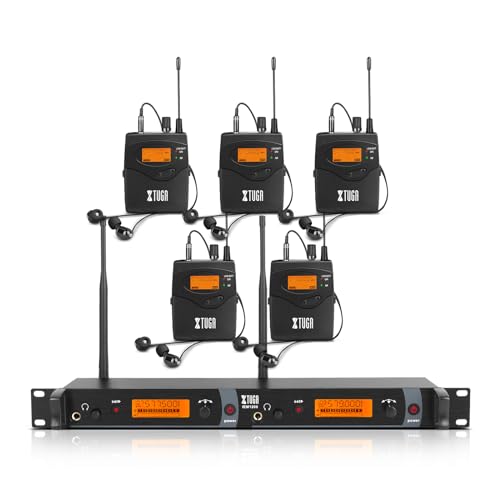
Best Multi-Bodypack Mono System – XTUGA IEM1200
The XTUGA IEM1200 is a practical choice among wireless in ear monitor systems for churches that need several bodypacks on a UHF setup. It provides 40 selectable frequencies, a rack-mountable transmitter, limiter circuitry, and a stated operating range of up to 300 feet.
Best For: Church stages and bands that need mono monitoring for up to five performers from one transmitter.
Pros:
- Includes one transmitter and five bodypack receivers.
- Provides 40 switchable UHF frequencies from 550–580 MHz.
- Offers a stated wireless range of up to 300 feet, with typical range of 250–350 feet.
- Metal housing, LCD displays, limiter circuitry, and rack-mountable design support stage use.
Cons:
- This is a mono monitoring system rather than a stereo IEM system.
- Bodypacks use two AA batteries instead of a rechargeable design.
- It is not water resistant.
The IEM1200 is oriented toward straightforward, multi-performer stage monitoring. Its five included bodypacks and broad frequency selection are useful for larger worship teams, while buyers wanting stereo mixes or rechargeable receivers should consider another format.
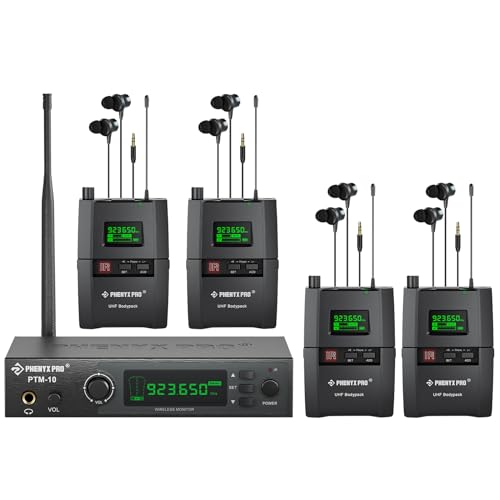
Best Stereo Rackmount Package – Phenyx Pro PTM-10
The Phenyx Pro PTM-10 is a well-equipped option for churches comparing wireless in ear monitor systems for churches with stereo mixing and multiple performers in mind. Its 900MHz UHF operation, 89 tunable frequencies, four bodypacks, and rack-mount kit suit organized stage or studio installations.
Best For: Worship teams that want stereo monitoring, adjustable system controls, and a complete four-performer package.
Pros:
- Includes four bodypack receivers and four in-ear earbuds.
- Offers stereo/mono modes, EQ, balance, limiter, PAD, and lock functions.
- Provides 89 tunable frequencies and supports up to five systems simultaneously.
- Includes a metal transmitter, rack-mount kit, carrying case, and hybrid XLR/6.3mm inputs.
Cons:
- Its stated operating range is up to 164 feet, shorter than some systems’ advertised ranges.
- The package uses eight AA batteries for the bodypacks.
- The supplied notes do not specify rechargeable bodypacks.
The PTM-10 is appealing when stereo control and installation accessories matter more than maximum range. Its four-bodypack bundle can simplify outfitting a worship team, while the 89-frequency tuning provides useful flexibility for multi-system setups.
How We Picked the Best Wireless in Ear Monitor Systems for Churches
We focused on the features that matter most in worship environments: the number of transmitters and bodypack receivers included, channel and frequency flexibility, operating range, mono or stereo operation, latency, setup convenience, and expansion potential. We also considered practical details such as rack-mount support, charging options, receiver durability, included earphones, and whether a package suits a small worship team or a larger stage production.
Because church stages vary widely, there is no single best configuration. UHF systems can offer useful frequency coordination and long-range performance, while 5.8GHz models may provide simpler setup and compact hardware. Always verify local frequency rules and coordinate wireless equipment with the rest of your audio system.
Quick Comparison
| Best For | What to Look For | Typical Advantage |
|---|---|---|
| Small worship teams | One transmitter and one or two receivers | Lower cost and simpler setup |
| Growing teams | Multiple frequencies or expandable channels | Room for additional musicians |
| Large worship stages | Four to eight bodypacks and coordinated channels | Efficient distribution to many performers |
| Permanent installations | Rack-mount hardware and reliable power | Neater, repeatable operation |
Key Buying Factors for Wireless In-Ear Monitor Systems for Churches
Channel Count and Bodypack Capacity
Count the performers who need independent monitoring, then allow room for growth. A multi-bodypack package can be more economical than adding individual receivers later, but confirm whether all users share one mix or need separate mixes. Two-channel systems may provide more flexibility than a single-channel kit when the band and vocal team require different monitor feeds.
Frequency Management and Range
UHF systems often provide selectable frequencies for coordination with microphones and other wireless devices. A larger frequency bank is useful in crowded venues, but it does not eliminate the need for proper frequency planning. For smaller rooms, a stated range of roughly 100 to 300 feet may be sufficient; concrete walls, antennas, and interference can reduce real-world performance.
Mono, Stereo, and Latency
Mono is often adequate for vocals, announcements, and simple worship mixes. Stereo can improve separation and musical detail, especially for musicians using click tracks or complex arrangements. Low latency is important for natural timing, so check the system’s stated delay and test it with your console before committing to a permanent setup.
Power, Mounting, and Daily Workflow
Look for clear battery indicators, dependable charging, and receivers that can survive frequent handling. Rack-mount kits are valuable when the transmitter will remain with the church’s main audio rack. Charging cases can simplify portable ministry setups, while replaceable batteries may be preferable for long events or quick swaps.
Who Should Buy Which Wireless in Ear Monitor Systems for Churches?
Choose a compact single-channel system if your church has one worship leader or a small band and wants an affordable introduction to in-ear monitoring. Select a dual-channel or multi-frequency UHF model when you need more routing flexibility, better coordination, or room to expand. For larger worship teams, prioritize packages with four or more bodypacks, stable frequency selection, and a transmitter that integrates cleanly with the church’s rack.
Portable teams should favor lightweight systems with straightforward pairing and convenient charging. Fixed-installation venues should prioritize rack mounting, dependable connectors, and frequency planning. Whichever system you choose, budget for quality earphones, proper volume limits, and time to build individual monitor mixes before the first service.