The best field recorders make it easier to capture clear audio away from a studio, whether you are filming, recording music, interviewing sources, or producing a podcast.
This roundup compares 10 portable options, from simple stereo recorders to advanced multitrack systems, so you can match your workflow, input needs, and budget to the right device.
Best 10 Field Recorders Picks for 2026
Professional Pick

- 32-bit float recording helps prevent clipping.
- Dual locking XLR/TRS inputs for secure connections.
- Low-noise preamps for demanding field conditions.
Best For: Filmmakers and musicians using professional microphones
Long-Recording Value

- Up to 68 hours of recording per charge.
- Large included storage capacity for extended sessions.
- One-click recording with noise reduction and voice activation.
Best For: Lectures, meetings, interviews, and everyday voice recording
Flexible 4-Track Choice
- Interchangeable capsules expand microphone options.
- Four-track simultaneous recording.
- Two XLR/TRS inputs with phantom power and pad.
Best For: Musicians and filmmakers needing expandable multitrack recording
Easy 32-Bit Float Option
TASCAM DR-05XP Portable Recorder

- 32-bit float recording plus 24-bit and 16-bit modes.
- Built-in stereo microphones support sources up to 125dB SPL.
- Works as a 2-in/2-out USB-C audio interface.
Best For: Music, podcasting, video, meetings, and stereo voice recording
Best Two-Input Field Recorder

- 32-bit/96kHz WAV recording
- Two locking XLR/TRS inputs
- OLED waveform level display
Best For: Two-source recording for filmmakers, musicians, and podcasters
Best Professional Field Recorder
- Eight inputs and 10 tracks
- 32-bit float recording
- Dual SD slots with redundancy
Best For: Multi-source film and location production
Best Compact Field Recorder

- Built-in X/Y stereo microphones
- 32-bit float clip-free recording
- USB microphone mode
Best For: Portable content, music, interviews, and everyday stereo audio
Best All-Around Choice
- 32-bit float and four-channel recording
- Adjustable A-B/X-Y stereo microphones
- Two XLR/TRS inputs and USB-C interface
Best For: Flexible music, video, and interview workflows
Best Guided 4-Track Recorder

- Four-track, 32-bit float recording
- Two XLR/TRS inputs plus stereo mics
- USB-C recording with SD-card backup
Best For: Musicians, podcasters, and filmmakers needing guided operation
Best for Flexible Stereo Capture

- Three microphones with nine patterns
- 32-bit float recording up to 96kHz
- USB microphone mode with SD backup
Best For: Portable mono, stereo, and soundscape recording
Professional Pick – Zoom F3 Field Recorder
The Zoom F3 is one of the more specialized field recorders for filmmakers and musicians who need reliable, clip-free capture in unpredictable conditions. Its 32-bit float recording, dual A/D converters, and locking XLR/TRS inputs are designed for demanding location work.
Best For: Run-and-gun filmmakers, location recordists, and musicians using professional microphones.
Pros:
- 32-bit float recording helps capture quiet dialogue and sudden peaks without constant level adjustments.
- Dual locking XLR/TRS inputs help keep microphone connections secure.
- Ultra-low-noise preamps support clean recordings in uncontrolled environments.
- Supports battery-powered, standalone, and USB workflows.
Cons:
- Requires external microphones for most recording applications.
- Its professional input and control setup may be more than casual users need.
- Uses two AA batteries rather than an included rechargeable battery.
The F3 is a strong choice when dependable audio matters more than having a simple built-in-microphone recorder. It is especially appealing for crews and recordists who cannot afford clipped takes.
Long-Recording Value – Tonfarb 136GB Voice Recorder
The Tonfarb A20 is a practical choice among field recorders for lectures, meetings, interviews, and everyday voice capture. It combines one-click recording with noise reduction, voice activation, a large storage capacity, and a rechargeable battery for extended sessions.
Best For: Students, journalists, interviewers, and users who prioritize long recording times and simple operation.
Pros:
- Includes 8GB of built-in storage and a complimentary 128GB TF card.
- Up to 68 hours of continuous recording on a charge.
- One-click recording and saving can be used even when the device is powered off.
- Voice activation, A-B repeat, password protection, and USB-C file transfer add useful convenience.
Cons:
- Built-in microphones are less suited to professional multi-microphone setups.
- Its listed 1.44-inch screen is smaller than the display on some dedicated recorders.
- Noise reduction and voice activation are geared toward speech rather than detailed music production.
For speech-focused recording, the Tonfarb offers an appealing mix of storage, battery life, and accessibility. It is better suited to personal and educational use than to advanced film or music rigs.
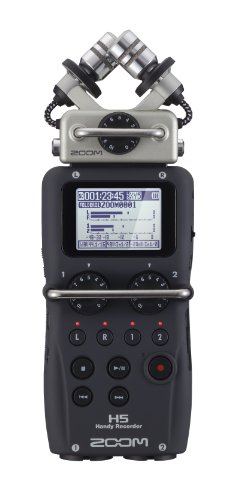
Flexible 4-Track Choice – Zoom H5 Handheld Recorder
The Zoom H5 is a versatile handheld field recorder for musicians and filmmakers who want expandable inputs without moving to a larger multitrack system. Its interchangeable capsule design, four-track recording, and two XLR/TRS inputs support a range of stereo and external-microphone setups.
Best For: Musicians, filmmakers, and audio-for-video users who need flexible multitrack recording.
Pros:
- Interchangeable input capsules allow the microphone configuration to be adapted to different projects.
- Records up to four tracks simultaneously.
- Two XLR/TRS combo inputs include selectable phantom power and a -20dB pad.
- Works as a multichannel or stereo USB audio interface for PC, Mac, or iPad.
Cons:
- Records to SD/SDHC cards up to 32GB, limiting storage compared with newer high-capacity options.
- Runs on two batteries and has a listed digital recording time of about 10 hours.
- Its interchangeable capsule system may add cost and setup complexity.
The H5 remains a compelling middle ground for buyers who need more than a basic stereo recorder but do not want a full-size production rig. Its capsule compatibility gives the setup room to grow.
Easy 32-Bit Float Option – TASCAM DR-05XP Portable Recorder
The TASCAM DR-05XP is an accessible option among field recorders for music, voice, meetings, audio-for-video, and podcasting. Its built-in stereo microphones, 32-bit float mode, and USB-C audio-interface function provide flexible recording without requiring an external microphone setup.
Best For: Musicians, podcasters, video creators, and users who want a compact stereo recorder with 32-bit float support.
Pros:
- Offers 32-bit float, 24-bit, and 16-bit recording modes along with multiple sample rates.
- Omnidirectional condenser microphones handle sources up to 125dB SPL.
- Functions as a 2-in/2-out USB-C audio interface for computer recording.
- Runs for up to 17.5 hours on two AA alkaline batteries.
Cons:
- SD card and batteries are not included.
- Built-in stereo microphones provide less input flexibility than models with multiple XLR connectors.
- Battery life is shorter than the Tonfarb recorder’s listed 68-hour runtime.
The DR-05XP is a straightforward pick for creators who want modern 32-bit float recording in a compact handheld format. It is particularly practical when built-in stereo microphones and USB-C connectivity are priorities.
Best Two-Input Field Recorder – Zoom H1 XLR
The Zoom H1 XLR is a practical choice among field recorders when you need flexible connections without moving to a larger multitrack setup. It records WAV audio at up to 32-bit/96kHz and includes two locking XLR/TRS combo inputs for microphones, instruments, and other sources.
Best For: Filmmakers, musicians, podcasters, and interview recording with two external sources.
Pros:
- 32-bit/96kHz recording supports detailed, clip-free audio.
- Two XLR/TRS combo inputs accommodate microphones and instruments.
- OLED waveform display provides an at-a-glance view of levels.
- Supports SDXC cards up to 1TB and offers 3.5mm input and headphone output.
Cons:
- Requires two AA batteries rather than the smaller AAA format.
- Its two-input design is less suited to larger location recording setups.
Choose the H1 XLR if you want a compact recorder with professional-style inputs and straightforward level monitoring. Its advertised 10-hour battery life and 6.4-ounce weight also make it practical for mobile sessions.
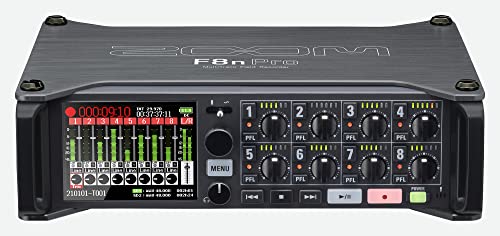
Best Professional Field Recorder – Zoom F8n Pro
The Zoom F8n Pro is built for demanding field recorders workflows, offering eight inputs, 10 tracks, and 32-bit float recording. Its high-gain preamps, accurate timecode, and redundant dual-SD recording are aimed at film and production crews working on location.
Best For: Professional film crews and field audio teams recording multiple sources with synchronized, redundant tracks.
Pros:
- Eight-channel, 10-track recording with 32-bit float and dual AD converters.
- Preamps provide up to 75dB of gain and -127dBu EIN.
- TCXO timecode accuracy is specified down to 0.2ppm.
- Dual SD slots support redundant recording, while USB operation provides an 8-in/4-out interface.
Cons:
- At 1.8 kg, it is substantially heavier than compact handheld recorders.
- Its listed battery life is approximately 8.5 hours.
- The professional feature set may be more than needed for simple interviews or casual recording.
The F8n Pro makes the most sense when input count, timecode, and recording redundancy matter more than portability. It is a production-oriented option for complex on-set or location sound work.
Best Compact Field Recorder – Zoom H1 Essential
The Zoom H1 Essential is a lightweight option among field recorders for creators who want cleaner stereo audio than a phone or camera can typically provide. Its X/Y microphones support content creation, interviews, music, ambience, and USB microphone use for calls or streaming.
Best For: Musicians, podcasters, content creators, and everyday stereo recording on the move.
Pros:
- 32-bit float recording helps provide clip-free audio.
- Built-in X/Y stereo microphones capture voices, music, and ambience.
- Can function as a USB microphone for streaming, meetings, calls, and voiceovers.
- Compact 92-gram design and approximately 10-hour recording time support portable use.
Cons:
- Built-in microphones are less flexible than a recorder with XLR inputs.
- It uses two AAA batteries, so users must carry spares for longer sessions.
- The stereo design is intended for simpler setups rather than multichannel production.
The H1 Essential is a sensible pick when portability and ease of use are priorities. It covers a broad range of creator tasks while adding USB microphone functionality for desktop or mobile recording.
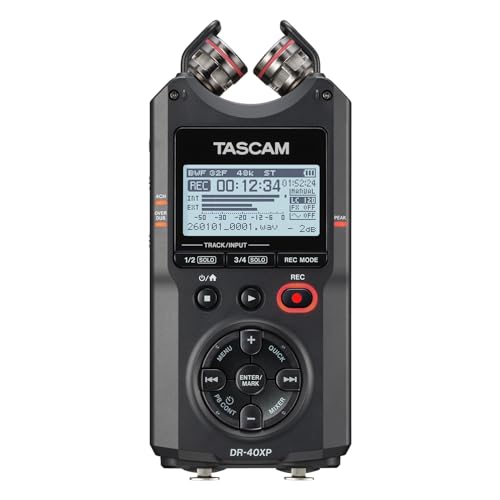
Best All-Around Choice – TASCAM DR-40XP
For musicians, video creators, and interviewers who need flexible field recorders, the TASCAM DR-40XP combines adjustable stereo microphones with two XLR/TRS inputs. Its 32-bit float recording, four-channel capability, and USB-C connectivity make it suitable for both location work and computer-based production.
Best For: Creators who want built-in microphones, external inputs, and four-channel recording in one portable recorder.
Pros:
- 32-bit float recording helps produce clip-free audio.
- Adjustable A-B or X-Y microphones support flexible stereo capture.
- Four-channel recording can combine built-in microphones and external inputs.
- Works as a 2-in/2-out USB-C audio interface.
Cons:
- microSD card and batteries are not included.
- The feature set may be more than needed for simple stereo recording.
The DR-40XP is a strong choice when your recording setup may change from project to project. Its input flexibility and four-channel design give it room to handle music, interviews, and audio for video without requiring a separate interface.
Best Guided 4-Track Recorder – Zoom H4 Essential
The Zoom H4 Essential is a practical pick among field recorders for musicians, podcasters, filmmakers, and interviewers who need four-track recording. It supports built-in stereo microphones, two XLR/TRS inputs, 32-bit float audio, and USB-C recording or streaming.
Best For: Creators who want a four-track recorder with external input flexibility and spoken menu guidance.
Pros:
- 32-bit float recording helps avoid distorted takes.
- Two XLR/TRS inputs accommodate microphones, instruments, mixers, or soundboards.
- Can record to an SD card while connected to a phone, tablet, or computer.
- Spoken menu guidance improves accessibility and navigation.
Cons:
- Requires two AA batteries.
- Its four-track design may be unnecessary for basic stereo recordings.
Choose the H4 Essential if you want a versatile recorder that can cover music, interviews, podcasts, and video audio. The ability to save to SD while using USB-C adds a useful backup option for important sessions.
Best for Flexible Stereo Capture – Zoom H2 Essential
The Zoom H2 Essential stands out among field recorders for its three built-in microphones and nine selectable recording patterns. It can capture mono, stereo, or surround-style recordings at up to 32-bit float/96kHz, while also working as a USB microphone and recording to an SD card.
Best For: Journalists, podcasters, musicians, and soundscape recordists who want varied microphone patterns without external inputs.
Pros:
- Three microphones and nine patterns support a wide range of recording perspectives.
- 32-bit float recording avoids the need to adjust gain during recording.
- Can function as a USB microphone while recording a backup to SD card.
- Bluetooth timecode can synchronize multiple H2 Essential units.
Cons:
- It uses built-in microphones rather than XLR/TRS inputs.
- Requires two AA batteries.
The H2 Essential is a focused option for users who value fast setup and microphone-pattern flexibility. Its built-in design is especially convenient for interviews, podcasts, and environmental recordings where carrying external microphones is less desirable.
How We Picked the Best Field Recorders
We focused on the features that matter most in real-world recording: audio quality, microphone and input flexibility, portability, power options, durability, file handling, and ease of use. The selection includes compact recorders for casual creators, models with XLR/TRS inputs for external microphones, and professional units designed for multitrack film or music production.
We also considered newer conveniences such as 32-bit float recording, USB-C connectivity, overdubbing, onboard microphones, and compatibility with computer-based workflows. Because no single recorder suits every project, the list covers several use cases rather than ranking products on specifications alone.
Quick Comparison
| Best For | What to Look For | Recommended Type |
|---|---|---|
| Simple voice notes and interviews | Easy controls, built-in microphone, long battery life | Compact stereo recorder |
| Music and content creation | Better microphones, USB connectivity, overdubbing | Advanced handheld recorder |
| Film production | External inputs, low-noise preamps, reliable monitoring | Multichannel field recorder |
| Unpredictable recording levels | 32-bit float capture and compatible editing software | 32-bit float recorder |
| Large productions | Multiple XLR inputs, time-saving routing, multitrack recording | Professional multitrack recorder |
Key Buying Factors for Field Recorders
Inputs and Microphone Support
Built-in microphones are convenient for ambient sound, rehearsals, and quick interviews. If you plan to connect shotgun, lavalier, condenser, or dynamic microphones, choose a recorder with the appropriate XLR or TRS inputs and phantom-power support. Count your sources before buying; two inputs may be enough for a solo setup, while film crews and bands may need four or more.
Recording Format and Headroom
Standard 24-bit recording delivers excellent quality when levels are set carefully. 32-bit float models provide more protection against clipping from sudden peaks, but they still require sensible microphone placement and post-production. Check that your editing software supports the format and that the recorder offers the file types and sample rates you need.
Portability, Power, and Monitoring
For fieldwork, size and battery life matter as much as specifications. Look for accessible gain controls, a clear display, headphone monitoring, wind protection options, and a power setup suited to your location. USB-C can simplify file transfers and let some recorders function as audio interfaces.
Track Count and Workflow
A stereo recorder is fast and simple, while a multitrack model gives each microphone its own editable channel. More tracks add flexibility but also increase setup time, storage needs, and post-production work.
Who Should Buy Which Field Recorders?
Choose a compact stereo model if you mainly record meetings, lectures, ambient audio, or occasional interviews. Musicians and podcasters should prioritize clean preamps, easy overdubbing, USB audio functionality, and inputs suited to their microphones. Filmmakers working with a boom and wireless microphones should look for multiple balanced inputs, dependable headphone monitoring, and strong level-management features.
For demanding productions, a professional multitrack field recorder is the best fit because it supports more simultaneous sources and offers better routing control. If recording conditions are unpredictable or you are still developing your level-setting technique, 32-bit float can provide valuable protection. Before buying, confirm the connector types, input count, battery requirements, storage media, and editing compatibility you will use most often.