The right capture card can make streaming, recording, and video production more reliable by handling video processing outside your computer’s CPU. Hardware encoding is especially useful when you want consistent performance while gaming, teaching, conferencing, or broadcasting.
We selected 10 capture cards and HDMI encoders covering high-refresh 4K setups, 1080p60 streaming, PCIe installations, portable USB use, and dedicated network workflows. Use the guide below to match features, connectivity, and resolution support to your setup.
Best 10 Capture Card with Hardware Encoder Picks for 2026
Premium HDMI 2.1 Pick

- 4K144 capture and passthrough
- HDMI 2.1 with VRR and HDR10
- Up to 1080p240 capture
Best For: High-refresh-rate PS5, Xbox, and PC setups
Standalone Streaming Encoder

- H.265/H.264 encoding at 1080p60
- Broad RTMP, RTSP, SRT, and HLS support
- Browser setup with no PC software
Best For: IP streaming, IPTV, events, and monitoring
Creator-Friendly HDR Choice
- 1440p60 and 4K30 capture
- 1440p144 and 4K60 HDR passthrough
- Built-in mixer and control dial
Best For: Windows OBS streamers using HDR consoles or PCs
Legacy PCIe Hardware Encoder

- H.264 hardware encoding at 1080p
- PCIe x1 internal installation
- Low-latency streaming with HDMI passthrough
Best For: Compatible older Windows desktop systems
Best Hardware-Encoding Pick

- Built-in H.264 hardware encoder
- 1080p60 capture and zero-lag pass-through
- Plug-and-play Windows and Mac support
Best For: Simple 1080p60 console streaming with lower CPU usage
Best Budget Audio-Ready Option

- 1080p60 capture with up to 4K30Hz input
- HDMI loop-out for low-latency monitoring
- 3.5mm mic input and headphone output
Best For: Affordable streaming setups needing external audio connections
Best Multicam PCIe Solution
ACASIS 4K HDMI PCIe Capture Card

- Four simultaneous 1080p60 HDMI inputs
- Ultra-low-latency PCIe capture
- Supports multicam streaming and production software
Best For: Desktop multicamera streaming and broadcasting workflows
Best Value Plug-and-Play Pick
VIXLW V316B 4K HDMI Capture Card

- 4K60 HDMI input and loop-out
- Captures up to 1080p60 over USB 3.0
- 3.5mm mic input and broad compatibility
Best For: Everyday console and camera streaming
Best for Dual-Source Streaming
Osee GoStream M2 Dual 4K Capture Card

- Two 4K60 HDMI inputs
- PIP/PBP layouts and source switching
- 1080p60 USB 3.0 output with audio I/O
Best For: Multi-camera streams and live presentations
Best Simple Gaming Setup
Redragon VC321 4K Capture Card
- 4K30 input with 1080p60 capture
- Zero-latency HDMI pass-through
- Plug-and-play Windows and macOS support
Best For: Single-console gaming and OBS recording
Premium HDMI 2.1 Pick – Elgato 4K X
The Elgato 4K X is a strong choice when you want a high-end capture card with hardware encoder-style, low-latency performance for modern consoles and PCs. Its HDMI 2.1 connectivity supports 4K144 capture and passthrough, while VRR and HDR10 features help preserve a smooth, responsive gaming experience.
Best For: PS5, Xbox Series X, and PC gamers who need HDMI 2.1, high refresh rates, and flexible streaming app support.
Pros:
- Supports up to 4K144 capture and passthrough.
- HDMI 2.1, VRR passthrough, and HDR10 support.
- Up to 1080p240 capture with USB 3.2 Gen 2 connectivity.
- Works with OBS, Streamlabs, Twitch Studio, Zoom, Teams, and other platforms.
Cons:
- Requires a USB 3.2 Gen 2 port for its full capabilities.
- System requirements call for a relatively modern computer and graphics card.
Choose the 4K X if high-refresh-rate passthrough and next-generation HDMI support matter more than basic 1080p streaming. It is especially well matched with current consoles and powerful gaming PCs.
Standalone Streaming Encoder – UNISHEEN 1080P60 Encoder
The UNISHEEN 1080P60 is a practical capture card with hardware encoder functionality for users who want to stream directly over a network without relying on PC software. Browser-based setup, H.265/H.264 encoding, and broad protocol support make it suited to dedicated streaming and IP video workflows.
Best For: Live events, IPTV, digital signage, remote monitoring, and network streaming setups that use RTMP, RTSP, SRT, HLS, or WebRTC.
Pros:
- Dedicated H.265/H.264 hardware encoding at 1080p60.
- Supports SRT, RTMP(S), RTSP, UDP, HTTP, HLS, WebRTC, and other protocols.
- Browser-based setup requires no PC software or drivers.
- Includes HDMI audio, 3.5mm audio input, and OSD overlays for text, logos, or timestamps.
Cons:
- Advanced configurations require basic networking knowledge.
- Limited to 1080p60 rather than higher-resolution capture.
- Uses a 12V DC power supply and is designed more for network workflows than simple USB capture.
This encoder is a better fit for network distribution than conventional creator-focused capture. Its compact design and low-power operation also make it suitable for longer-running installations.
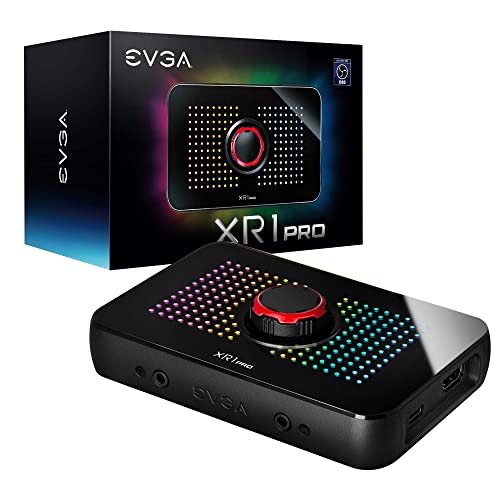
Creator-Friendly HDR Choice – EVGA XR1 Pro
The EVGA XR1 Pro combines 1440p capture with HDR passthrough and a built-in audio mixer. While it is not presented as a dedicated hardware encoder, its plug-and-play USB design and OBS certification make it a convenient option for streamers who want straightforward console or PC capture.
Best For: Windows streamers who want 1440p60 capture, high-refresh HDR passthrough, audio controls, and simple OBS setup.
Pros:
- Captures up to 1440p at 60fps or 4K at 30fps.
- Passes through 1440p at 144Hz HDR and 4K at 60Hz HDR.
- Built-in audio mixer and physical control dial.
- OBS certified, plug and play, and covered by a two-year warranty.
Cons:
- Requires Windows and a USB 3.1 interface.
- Capture resolution tops out at 1440p60 or 4K30.
- Its listed 0.45 kg weight is higher than some compact capture devices.
The XR1 Pro is appealing when passthrough quality and hands-on audio adjustment are priorities. It offers a balanced feature set for Windows-based OBS setups without requiring driver installation.
Legacy PCIe Hardware Encoder – AVerMedia Live Gamer HD
The AVerMedia Live Gamer HD is an older internal capture card with an H.264 hardware encoder designed to reduce CPU usage during 1080p recording and streaming. Its PCIe installation and Windows 8 requirements make it most appropriate for a compatible legacy desktop rather than a current laptop or compact setup.
Best For: Older Windows desktop systems that need PCIe-based 1080p capture, low-latency streaming, and reduced CPU load.
Pros:
- Uses H.264 hardware encoding for 1080p capture.
- Designed to reduce CPU usage during recording and streaming.
- Supports HDMI passthrough and 3.5mm stereo audio passthrough.
- Works with popular streaming software and supports platforms including YouTube and Twitch.
Cons:
- Requires an available PCIe x1 slot and a compatible desktop.
- Listed operating-system support is Windows 8.
- Does not offer modern 4K or high-refresh-rate capture features.
This card makes sense mainly as a budget-minded upgrade for a suitable older PC. Confirm the system, PCIe slot, graphics support, and software compatibility before choosing it over a newer external device.
Best Hardware-Encoding Pick – AVerMedia Live Gamer Mini
If you want a compact capture card with hardware encoder support, the AVerMedia Live Gamer Mini records up to 1080p at 60 fps while processing video and audio through its built-in H.264 encoder. Its zero-lag HDMI pass-through is useful for playing on a monitor while streaming or recording on a Windows or Mac computer.
Best For: Console gamers seeking simple 1080p60 capture with zero-lag pass-through and low CPU load.
Pros:
- Built-in H.264 hardware encoder reduces processing load on the computer.
- Supports 1080p60 capture and zero-latency 1080p60 HDMI pass-through.
- Plug-and-play UVC operation works with Windows 10/11 and macOS 12 without driver installation.
Cons:
- Capture resolution is limited to 1080p.
- Uses USB 2.0 rather than a faster USB interface.
The Live Gamer Mini is a straightforward choice when hardware encoding and reliable 1080p60 console streaming matter more than 4K capture. Its small design and broad console compatibility make it especially convenient for beginner setups.
Best Budget Audio-Ready Option – 1080p60 HDMI Capture Card
This capture card with hardware encoder-style plug-and-play operation supports up to 4K30Hz input and captures at 1080p60 over USB 3.0. It also adds 3.5mm microphone input and headphone output, making it practical for streamers who want external commentary without a separate audio interface.
Best For: Budget-conscious streamers who need 1080p60 capture, HDMI loop-out, and convenient microphone connectivity.
Pros:
- Captures Full HD video at 1080p60 and accepts up to 4K30Hz input.
- Includes 1080p60 HDMI signal loop-out for low-latency monitoring.
- Provides 3.5mm microphone input and headphone output.
- Works with PCs, consoles, cameras, and common Windows, Linux, and macOS systems.
Cons:
- Requires a direct USB 3.0 connection; hubs and extension cables are not recommended.
- Maximum output resolution is 1080p60.
- The supplied notes do not specify a dedicated hardware encoder.
Its strongest advantage is flexibility: the card combines 1080p60 capture, loop-out, and analog audio connections in a compact plug-and-play device. Verify your computer has an available USB 3.0 port before buying.
Best Multicam PCIe Solution – ACASIS 4K HDMI PCIe Capture Card
The ACASIS 4K HDMI PCIe capture card is built for desktop users who need multiple HDMI sources rather than a portable USB device. Its four HDMI inputs can capture four 1080p60 feeds simultaneously, with ultra-low latency and no compression according to the supplied specifications.
Best For: Multicam streaming, broadcasting, teaching, and video conferencing from a compatible desktop PC.
Pros:
- Four HDMI inputs support simultaneous 1080p60 capture.
- PCIe design offers ultra-low latency and uncompressed capture.
- Compatible with PCIe x4, x8, and x16 slots.
- Works with streaming and production software including OBS-related workflows, VLC, Wirecast, and VMIX.
Cons:
- Requires installation in a desktop PCIe slot.
- Maximum listed capture quality is 1080p60 rather than 4K capture.
- Compatibility details in the supplied notes emphasize older Windows versions and Linux.
This is the specialized choice for a fixed multicamera workstation. The four-input layout and ultra-low-latency PCIe connection are valuable for production workflows, but it is excessive for a single-console streamer and requires an appropriately configured desktop.
Best Value Plug-and-Play Pick – VIXLW V316B 4K HDMI Capture Card
If you need a capture card with hardware encoder features for straightforward console or camera streaming, the VIXLW V316B offers 4K60 HDMI input and loop-out while capturing up to 1080p at 60 fps. Its USB 3.0 connection, plug-and-play setup, and broad software compatibility make it a practical option for everyday streaming and recording.
Best For: Gamers and creators who want 4K pass-through, 1080p60 capture, and an external microphone input without installing drivers.
Pros:
- Supports 4K60 HDMI input and loop-out with up to 1080p60 capture.
- USB 3.0 connectivity offers low-latency capture without external power.
- Includes a 3.5mm microphone input and works with OBS, Streamlabs, XSplit, and other listed software.
- Compatible with consoles, cameras, Windows, macOS, Linux, and Android devices.
Cons:
- Does not support 4K120 or 4K144 input.
- The microphone input accepts a 3.5mm microphone headset and does not record party chat.
- Audio may require restarting OBS after setup.
The V316B is a versatile budget-oriented choice for single-source streaming. Its 4K60 loop-out is useful for playing on a TV while capturing through a computer, though buyers seeking higher-than-1080p60 capture should look elsewhere.
Best for Dual-Source Streaming – Osee GoStream M2 Dual 4K Capture Card
The Osee GoStream M2 stands out among capture card with hardware encoder options for users who need two HDMI sources. It accepts dual 4K60 inputs, records or streams at up to 1080p60, and adds PIP/PBP layouts for switching or displaying multiple feeds during gaming, presentations, and live events.
Best For: Streamers, presenters, and creators combining two cameras or gaming sources in one production.
Pros:
- Provides two 4K60 HDMI inputs for separate cameras or gaming devices.
- Supports 1080p60 output and USB 3.0 connectivity for low-latency capture.
- Offers PIP and PBP effects with multiple layouts and screen switching.
- Includes 3.5mm microphone and audio input/output connections.
Cons:
- Its stated capture and output resolution tops out at 1080p60 rather than 4K capture.
- The dual-source feature may be unnecessary for simple single-device streaming.
- Listed minimum operating-system support is Windows 7 or later, while compatibility also varies by software and device.
Choose the GoStream M2 when production flexibility matters more than a compact single-input design. Its dual HDMI architecture and built-in layouts make it the most suitable option here for multi-source broadcasts and live presentations.
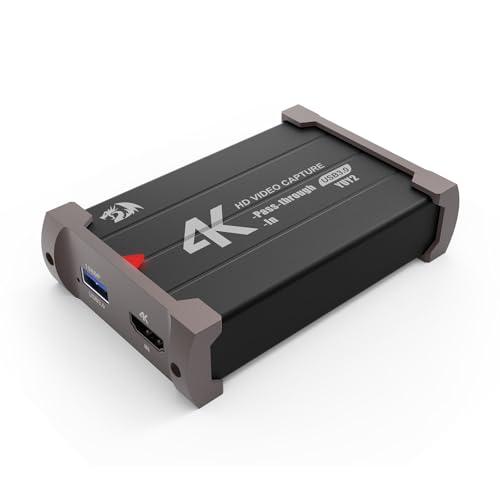
Best Simple Gaming Setup – Redragon VC321 4K Capture Card
For a simple capture card with hardware encoder-style streaming workflow, the Redragon VC321 combines 4K30 input with 1080p60 capture and HDMI pass-through. It is designed for plug-and-play use with Windows and newer macOS systems, making it a straightforward choice for console gameplay, camera feeds, and OBS recording.
Best For: Gamers and creators who prioritize zero-latency pass-through, easy setup, and simultaneous audio-video capture.
Pros:
- Captures up to 1080p60 from 4K30 HDMI input.
- Provides zero-latency HDMI pass-through for real-time gameplay.
- Requires no additional drivers or external power according to the supplied specifications.
- Supports Windows 7 and later, macOS 10.15 and newer, consoles, cameras, and DSLRs.
Cons:
- Supports 4K input only up to 30 fps.
- Capture resolution is limited to 1080p.
- Its listed compatibility is narrower than models that also support Linux or Android.
The VC321 keeps the setup uncomplicated while preserving smooth 1080p60 capture and pass-through gameplay. It is a good fit for single-source recording, but users needing dual HDMI inputs or broader operating-system support should consider another model.
How We Picked the Best Capture Card with Hardware Encoder
We focused on capture hardware that can reduce host-computer workload through built-in or dedicated encoding, while also considering supported resolutions, frame rates, passthrough, connection type, compatibility, latency, and practical streaming features. The selection includes USB and PCIe models, HDMI capture devices, and standalone encoders that can send video over network protocols.
Because product specifications vary by input, passthrough, recording, and streaming mode, check the manufacturer’s requirements before buying. A device advertised as 4K may capture at 1080p while offering 4K passthrough, so those capabilities should not be treated as interchangeable.
Quick Comparison
- Best for high-end HDMI 2.1 setups: Choose a model supporting high refresh rates and 4K passthrough, such as the Elgato 4K X.
- Best for straightforward 1080p streaming: USB capture cards with 1080p60 support are generally easier to install and use with OBS.
- Best for low CPU usage: Look for explicit H.264 or H.265 hardware-encoding support rather than relying only on software encoding.
- Best for permanent installations: A PCIe card can provide a clean internal connection and stable desktop performance.
- Best for network broadcasting: A standalone HDMI encoder with RTMP, RTSP, SRT, HLS, or WebRTC support can stream without depending entirely on a computer.
Key Buying Factors for a Capture Card with Hardware Encoder
Capture Resolution and Frame Rate
Match the card’s actual capture output to your content. 1080p60 remains a practical standard for live streaming, while 4K capture is better suited to high-detail recording and editing. If you play at 4K or above 60Hz, verify both capture and passthrough limits.
Hardware Encoding Format
H.264 offers broad platform compatibility and is commonly used for live streaming. H.265 can deliver similar quality at lower bitrates but may have narrower software and service support. Confirm which formats the device encodes internally and which modes still rely on your computer.
Passthrough and Latency
Passthrough lets you play on a monitor or television while the computer receives the captured signal. For responsive gaming, prioritize ultra-low-latency operation and passthrough that supports your console or PC’s target resolution and refresh rate.
Connection and Compatibility
USB models are portable and simple to move between systems, but they require an appropriate USB 3.x port and sufficient bandwidth. PCIe cards are better for dedicated desktops. Check operating-system support, OBS compatibility, audio handling, HDCP limitations, and included cables.
Who Should Buy Which Capture Card with Hardware Encoder?
Console streamers should prioritize HDMI passthrough, 1080p60 capture, low latency, and compatibility with PS5, Xbox, or Switch. PC creators with modern GPUs and high-refresh displays should consider a premium HDMI 2.1 model. Teachers, presenters, and video-call users may prefer a simple USB device with dependable plug-and-play operation. For production teams or camera systems, a PCIe card or standalone network encoder offers a more permanent workflow. Finally, choose an H.265-capable network encoder when bandwidth efficiency matters and your streaming platform supports the format.