The best homeschool board games turn practice into active learning, helping children build math, language, geography, and money skills without relying on worksheets alone.
We selected 10 games that cover different ages, subjects, player counts, and learning goals so families can find an engaging fit for lessons, review sessions, or family game night.
Best 10 Board Games for Homeschool Picks for 2026
Best Math Adventure
- Covers early arithmetic skills
- Two difficulty levels
- For 2–4 players ages 5+
Best For: Playful preschool and kindergarten math practice
Best Spelling Practice

- 200 spelling cards included
- Four ability levels
- Supports 2–8 players ages 8+
Best For: Group spelling practice for grades 3+
Best Multiplication Challenge

- Practices multiplication and division
- Timed spinner-based gameplay
- Designed for ages 8–12
Best For: Upper-elementary math fluency practice
Best Early Math Classic
Sum Swamp Addition & Subtraction

- Practices addition and subtraction
- Includes board and dice
- For 2–4 players ages 5–10
Best For: Kindergarten and early elementary math
Best Word-Building Pick

- Practices spelling and vocabulary
- Double-sided board supports progression
- For 2-4 players ages 5+
Best For: Young homeschool learners building early word skills
Best Money Skills Game
- Practices counting and comparing money
- Builds number sense and decision-making
- For 2-4 players around age 7+
Best For: Homeschool math and financial-literacy practice
Best Geography Group Game

- Reviews U.S. states and geography
- Uses grade-appropriate questions
- For 2-4 players ages 8+
Best For: Multi-grade homeschool geography practice
Practical Money Skills

- Practices subtraction and calculating change
- Includes 50 item cards, play money, and coins
- Designed for ages 5+ with 15-minute gameplay
Best For: Hands-on money math and subtraction practice
Early Language Builder

- Builds sentences with 120+ color-coded word tiles
- Introduces parts of speech and basic grammar
- Supports ages 5–8 and solo or group play
Best For: Early reading, vocabulary, and sentence practice
Active Number Practice

- Practices addition, subtraction, and even-and-odd numbers
- Includes dice, challenge cards, pieces, and a game board
- Offers 20-minute screen-free play for ages 5+
Best For: Interactive early arithmetic practice
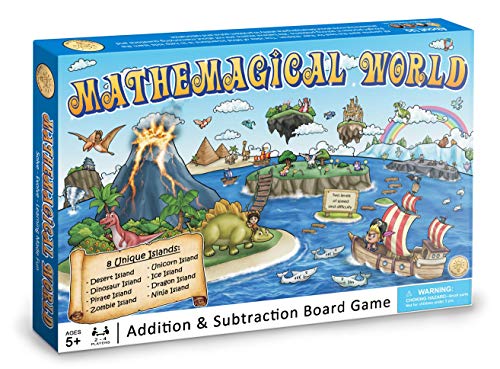
Best Math Adventure – Mathemagical World
For families comparing board games for homeschool, Mathemagical World offers an imaginative way to practice addition, subtraction, doubles, and halves. Its two difficulty levels and eight themed worlds can help keep early math practice engaging.
Best For: Preschool and kindergarten learners ages 5 and up who enjoy fantasy-themed math practice.
Pros:
- Practices addition, subtraction, doubles, and halves.
- Includes two difficulty levels and regular or speedy play.
- Supports 2–4 players across eight themed worlds.
Cons:
- Focused mainly on early arithmetic rather than broad subject coverage.
- Its larger board may need extra table space.
Choose this game when imaginative themes and adjustable pacing are more important than a traditional worksheet-style lesson. It is a flexible option for short, interactive arithmetic sessions.
Best Spelling Practice – SpellChecked Card Game
SpellChecked is a practical choice among board games for homeschool when spelling practice needs to feel more like a game than a drill. Color-coded decks and four ability levels let families select an appropriate challenge.
Best For: Learners ages 8 and up, especially grades 3 and above, studying spelling in groups of 2–8.
Pros:
- Includes 200 spelling cards and eight SpellChecker cards.
- Four ability levels support different skill ranges.
- Reinforces spelling patterns and critical-thinking strategies.
Cons:
- It is a card game rather than a board-based game.
- Players need to reach 30 points, so sessions may vary in length.
The image clues and multiple spelling choices make this a useful supplement for independent review, family play, or small-group homeschool lessons. It also packs conveniently for learning away from the main school area.
Best Multiplication Challenge – Matheroni Pepperoni
For homeschool families seeking board games for homeschool students in upper elementary grades, Matheroni Pepperoni turns multiplication and division practice into a fast-paced race. Players solve problems, spin for actions, and collect colored pepperonis for their pizza.
Best For: Kids ages 8–12, or roughly grades 3–6, who need repeated multiplication and division practice.
Pros:
- Targets multiplication and division fluency.
- Uses a timed, competitive format to encourage quick recall.
- Includes special actions such as Burnt Pepperoni and Wild Pepperoni.
Cons:
- The competitive format may not suit children who dislike time pressure.
- Its math focus is limited primarily to multiplication and division.
This is a strong fit for math centers, family game time, or short review sessions where older children benefit from repetition and a little unpredictability. The spinner adds variety without requiring batteries.
Best Early Math Classic – Sum Swamp Addition & Subtraction
Sum Swamp is a straightforward option for families building a collection of board games for homeschool. Kindergarten and first-grade learners roll number dice, use the operation die, and move through a colorful swamp while practicing addition and subtraction.
Best For: Children ages 5–10 who are beginning or reinforcing addition and subtraction skills.
Pros:
- Focuses directly on addition and subtraction.
- Includes a gameboard, four swamp creature pieces, and three dice.
- Supports 2–4 players with simple rolling-and-moving mechanics.
Cons:
- It offers less advanced math content than multiplication-focused games.
- The listed playing time can reach 60 minutes.
Families wanting an accessible introduction to arithmetic may appreciate Sum Swamp’s simple rules and multiplayer format. It works well as a hands-on supplement for kindergarten and early elementary math lessons.
Best Word-Building Pick – Scrabble Junior
Scrabble Junior is a practical choice when you want board games for homeschool that reinforce spelling and vocabulary through short, approachable play sessions. Its double-sided board supports letter matching for newer players and word creation as children progress.
Best For: Homeschool learners ages 5 and up who are developing spelling skills and enjoy word games.
Pros:
- Builds spelling and vocabulary through letter-matching play.
- Double-sided board provides a progression from beginner to advanced play.
- Supports 2-4 players with a 15-minute estimated playing time.
- Includes four character tokens and 105 letter tiles.
Cons:
- English-language play may be less suitable for learners practicing another language.
- Small parts require attention around younger children.
Choose this game for a compact, reusable spelling activity that can grow with a child’s word-building ability. It is especially useful when you want a short group lesson or an easy educational game for home.
Best Money Skills Game – Money Bags Math Game
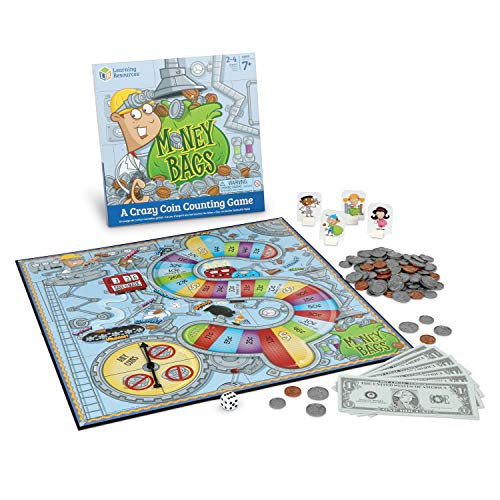
Money Bags Math Game fits homeschool lessons that connect counting, sorting, comparing, and basic financial literacy with hands-on play. Children move around the board, manage coins and bills, and make decisions as they work toward game outcomes.
Best For: Learners around age 7 who are beginning to practice money management and number sense.
Pros:
- Reinforces counting, sorting, and comparing values.
- Uses collecting and exchanging to connect money values with outcomes.
- Includes a board with built-in spinner, 100 plastic coins, play bills, markers, and a die.
- Works for 2-4 players with an estimated 30-minute playing time.
Cons:
- Its focus is specifically on money and basic math rather than broad subject coverage.
- The many coins and bills may require organized storage between lessons.
This is a strong addition to a homeschool math shelf when practical money skills are the goal. The board-game format gives children repeated opportunities to count, compare, and make simple decisions in an engaging setting.
Best Geography Group Game – Race Across the USA
Race Across the USA is a useful pick for board games for homeschool focused on U.S. geography. Players visit states, answer grade-appropriate questions, and race back home, creating a structured way to review states, capitals, landmarks, and regional knowledge.
Best For: Homeschool groups ages 8 and up that want an interactive geography review for 2-4 players.
Pros:
- Combines a race format with questions about U.S. geography.
- Questions are tailored to each player’s grade level.
- Encourages multi-grade play and shared learning.
- Estimated 20-minute playing time suits focused geography sessions.
Cons:
- The subject focus is limited primarily to U.S. geography.
- Requires at least two players for the listed gameplay format.
Consider this game when you want geography review to feel more social and active than a worksheet. Its grade-level question approach can help children at different stages participate together while practicing knowledge of the United States.
Practical Money Skills – Making Change Math Game
For families choosing board games for homeschool, eeBoo Making Change offers a focused way to practice subtraction and money handling through short, hands-on rounds. Players use item cards, play money, and coins to calculate change, making it a useful supplement to early math lessons.
Best For: Children ages 5 and up who need practice with subtraction, currency values, and practical money skills.
Pros:
- Uses 50 item cards plus play paper money and coins for concrete practice.
- Builds mental math, subtraction fluency, and strategic thinking.
- Includes colorful cards across 10 categories and supports individual or group play.
- Offers approximately 15-minute gameplay and uses FSC-certified paper with vegetable-based inks.
Cons:
- The activity centers specifically on money and making change, so it may not cover broader math topics.
- Play depends on handling paper money and small coins, which may require supervision for younger children.
This is a strong homeschool choice when you want a compact, targeted money-math activity rather than a general family board game. Its short format makes it easy to add to a daily lesson or math station.
Early Language Builder – Sentence Search
Sentence Search is a hands-on language activity for families looking for board games for homeschool that reinforce reading and grammar without relying on worksheets. Children draw color-coded word tiles and combine them with sentence-builder tiles to create and discuss sentences.
Best For: Learners ages 5 to 8, especially kindergarten through grade 2, who are developing vocabulary, grammar, reading, and communication skills.
Pros:
- Includes 120+ color-coded word tiles organized by parts of speech.
- Provides 20 wooden sentence-builder tiles, two cloth bags, and step-by-step instructions.
- Supports sentence formation, vocabulary, comprehension, planning, and critical thinking.
- Can be played with one or more learners and is portable for flexible indoor use.
Cons:
- Its age range and focus make it less suitable for advanced readers or older students.
- The activity emphasizes sentence construction rather than broader language arts coverage.
For early elementary homeschool lessons, this set works well as a guided literacy activity or an independent practice option. The color coding and included guide can help adults introduce basic grammar concepts in manageable steps.
Active Number Practice – Number Hunter Math Board Game
Number Hunter gives families a game-based way to add addition and subtraction practice to board games for homeschool. Players roll number and operation dice, move around the board, and complete math or action challenges, creating an interactive alternative to routine worksheets.
Best For: Children ages 5 to 7 who are building foundational addition, subtraction, and even-and-odd number skills.
Pros:
- Reinforces addition and subtraction through dice rolls and movement.
- Includes a board, five game pieces, two number dice, an operation die, and 50 challenge cards.
- Supports early STEM learning, problem-solving, critical thinking, and social play.
- Offers an approximately 20-minute, screen-free activity for two or more players.
Cons:
- It is primarily designed for early learners and may be too basic for students beyond the recommended range.
- The game includes small parts and carries a choking-hazard caution.
This is a practical pick for homeschool families wanting math practice that feels active and social. Its clear roll-and-move structure can fit a short lesson, classroom learning block, or family game night while keeping the focus on foundational arithmetic.
How We Picked the Best Board Games for Homeschool
We evaluated these Board Games for Homeschool based on educational focus, age range, player count, replay value, and how easily each game fits into a home learning routine. The selection includes focused practice for addition, subtraction, multiplication, division, spelling, sentence building, money skills, and geography. We also looked for games that encourage children to make decisions, explain answers, recognize patterns, or use skills in context rather than simply memorize facts.
Because homeschool families have different schedules and teaching styles, this list includes both short, skill-specific games and broader family games that can reinforce learning naturally. Always check the manufacturer’s recommended age and contents before purchasing, particularly when shopping for younger children.
Quick Comparison
For early math, consider Number Hunter, Sum Swamp, or Mathemagical World. Matheroni Pepperoni is aimed at older children practicing multiplication and division, while Money Bags and Making Change focus on identifying coins, counting money, and calculating change. SpellChecked, Scrabble Junior, and Sentence Search support spelling, vocabulary, and sentence construction. Race Across the USA adds geography practice through a more thematic format.
Key Buying Factors for Board Games for Homeschool
Age and Skill Level
Choose a game that matches the learner’s current ability, not only their chronological age. A game that is too easy may lose its educational value, while one that is too advanced can create frustration. Look for adjustable rules or multiple levels if siblings will play together.
Learning Objective
Identify the specific skill you want to reinforce. Math games vary widely: some teach basic operations, while others focus on money or multiplication. Word games may emphasize spelling, vocabulary, or sentence formation. A clear goal makes it easier to use the game as part of a lesson.
Player Count and Session Length
Two- to four-player games can work well for siblings, co-ops, or parent-child practice. Consider whether the game can be completed in 15 to 30 minutes, especially for younger learners or busy school days.
Replay Value and Setup
Games with changing questions, routes, cards, or strategies usually remain useful longer. Simple setup and easy-to-follow rules also matter when children need independent practice or when you want a quick educational activity.
Who Should Buy Which Board Games for Homeschool?
Families teaching early addition and subtraction should start with Sum Swamp, Number Hunter, or Mathemagical World. For upper-elementary multiplication and division, Matheroni Pepperoni is the more targeted choice. Money Bags suits learners practicing money values and transactions, while Making Change is a strong option for coin recognition and change-making.
Choose SpellChecked for dedicated spelling practice, Scrabble Junior for a familiar family word game, and Sentence Search for building complete sentences. Race Across the USA is best for children who enjoy travel themes and need geography reinforcement. If you want one versatile game for family learning, prioritize the option that matches your child’s current skill gap and preferred style of play.