The best accordion for a live performance needs more than comfortable keys or buttons. It should project clearly, stay manageable onstage, and match the musical style, repertoire, and amplification setup you use.
This roundup compares 10 performance-focused options, including speaker-equipped digital accordions, full-size piano-key models, and compact diatonic instruments for folk, regional, and traditional music.
Best 10 Accordions for Live Performances Picks for 2026
Best Digital Stage Companion
Roland FR-1XB-RD V-Accordion Lite

- Built-in 7 W x 2 speakers
- USB playback and data functions
- 16 accordion sets and orchestral sounds
Best For: Digital performers needing onboard amplification and flexible sounds
Best All-Skill Acoustic-Style Pick
White 37-Key 96-Bass Accordion

- 37 keys with 96 bass buttons
- Three left and seven right registers
- Includes straps and a backpack
Best For: Students and performers wanting a versatile traditional-style accordion
Best Lightweight Digital Option
Roland FR-1X-BK V-Accordion Lite

- 15-pound digital accordion design
- Built-in speakers for quick setup
- USB and multiple sound presets
Best For: Gigging musicians who value lighter weight and onboard amplification
Best Durable Black Traditional Pick
Black 37-Key 96-Bass Accordion

- 37 keys and 96 bass buttons
- Lambskin bellows with reinforced frame
- Includes backpack and two-year warranty
Best For: Players wanting a versatile traditional-style accordion for regular performance
Best Digital Choice

- Built-in 7 W x 2 speakers
- Broad digital sound library
- USB playback and data support
Best For: Portable live performance with flexible digital sounds
Best Full-Range Acoustic

- 37 keys and 96 bass buttons
- Ten register options for varied tones
- Backpack and straps included
Best For: Versatile acoustic playing from practice to stage
Best Button Accordion
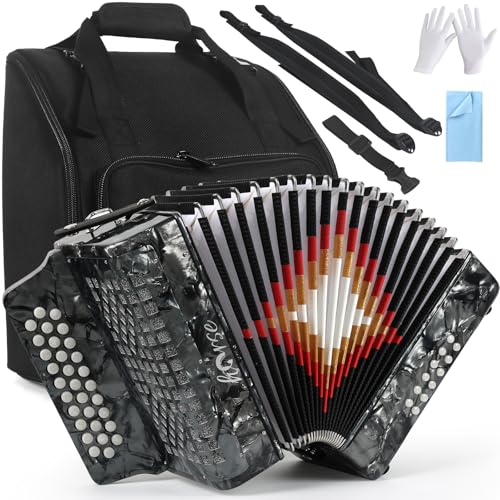
- Precisely tuned F/B/E reeds
- Noise-damping construction
- Accessories included for transport
Best For: Adult beginners and Cajun or European styles
Folk Performance Pick
31-Key F/B/E Diatonic Accordion

- Warm F/B/E folk tone with hand-tuned reeds
- Airtight bellows support stable pitch
- Carry case and performance accessories included
Best For: Folk musicians, festivals, street gigs, and daily practice
Versatile Adult Choice
- Rich C/G/F tones for solo or ensemble playing
- Noise-damping design reduces unwanted sounds
- Includes case, strap, cloth, and gloves
Best For: Adult beginners and performers in Cajun or European styles
Three-Row Performance Option
G/C/F 31-Key Diatonic Accordion

- Two treble reed sets create a robust tone
- G/C/F three-row layout suits varied styles
- Padded suitcase and adjustable strap included
Best For: Conjunto, Cajun, European music, and developing players
Best Digital Stage Companion – Roland FR-1XB-RD V-Accordion Lite
The Roland FR-1XB-RD is a practical choice for accordions for live performances when you want onboard amplification and flexible digital sounds. Its speakers, USB port, and multiple sound modes make it suitable for performers who need a compact electronic setup.
Best For: Performers seeking a red digital accordion with built-in speakers, USB features, and varied accordion and orchestral sounds.
Pros:
- Built-in 7 W x 2 speakers in a bass reflex box
- USB port supports Wave/MP3 playback, sound uploads, and data storage
- Includes Standard and Free Bass modes plus 16 Accordion Sets
- Offers orchestral sounds, Virtual Tone Wheel presets, and User Programs
Cons:
- At 21 pounds, it is not the lightest option in this roundup
- Its glossy plastic body may not suit players seeking a traditional acoustic instrument
The FR-1XB-RD stands out for stage-ready convenience rather than acoustic authenticity. Built-in sound and amplification reduce the need for extra equipment, while the USB functions add useful flexibility for rehearsals and performances.
Best All-Skill Acoustic-Style Pick – White 37-Key 96-Bass Accordion
This white 37-key, 96-bass accordion is designed for learners and experienced players who need a versatile instrument for practice, ensembles, and accordions for live performances. Its lambskin bellows, register options, straps, and backpack support regular transport.
Best For: Students, hobbyists, and performers wanting a traditional-style 37-key accordion with broad tonal flexibility and included carrying accessories.
Pros:
- 37 keys and 96 bass buttons suit beginner through professional use
- Lambskin bellows and reinforced steel edges are designed for frequent use
- Three left-hand and seven right-hand registers provide tone choices
- Includes adjustable straps and a storage backpack
Cons:
- At 20 pounds, it may feel substantial during extended transport
- The supplied warranty description is listed as “Other” rather than specifying coverage
With its broad register selection and portable accessory set, this model can cover lessons, rehearsals, solo work, and stage use. It is a sensible general-purpose option for players who want one instrument for multiple settings.
Best Lightweight Digital Option – Roland FR-1X-BK V-Accordion Lite
The black Roland FR-1X-BK combines digital versatility with a relatively light 15-pound design, making it a strong candidate for accordions for live performances. Built-in speakers, USB connectivity, and programmable sound options help simplify stage and rehearsal setups.
Best For: Gigging musicians who prioritize a lighter digital accordion with onboard amplification and multiple sound presets.
Pros:
- 15-pound weight is lighter than the other listed models
- Built-in 7 W x 2 speakers provide onboard amplification
- USB supports Wave/MP3 playback, sound uploads, and data management
- Includes 16 Accordion Sets, orchestral sounds, and User Programs
Cons:
- Included components are listed as not included
- Its plastic body may appeal less to players seeking acoustic construction
The FR-1X-BK is a convenient choice for musicians moving between rehearsals and gigs. Its lighter weight and integrated electronics are especially useful when portability and quick setup matter.
Best Durable Black Traditional Pick – Black 37-Key 96-Bass Accordion
This black 37-key, 96-bass accordion offers a full traditional-style layout for practice, ensemble playing, and accordions for live performances. Its lambskin bellows, reinforced construction, register choices, and included backpack make it well suited to regular use and travel.
Best For: Players seeking a black 37-key accordion with multi-register tone, reinforced construction, and a two-year manufacturer warranty.
Pros:
- 37 keys and 96 bass buttons support varied playing levels
- Lambskin bellows are designed for smooth airflow and steady tone
- Three left-hand and seven right-hand registers support tonal changes
- Includes adjustable straps and a backpack; two-year manufacturer warranty listed
Cons:
- At 20 pounds, it may be demanding to carry for long distances
- The supplied notes do not specify the exact included accessory contents beyond straps, accordion, and backpack
This model is a practical fit for players who want a versatile acoustic-style instrument with travel accessories and stated warranty coverage. Its register layout supports everything from lessons to band performances without adding electronic complexity.
Best Digital Choice – Roland FR-1X V-Accordion Lite
For performers seeking versatile accordions for live performances, the Roland FR-1X combines portable piano-style playability with onboard amplification and a broad selection of digital sounds. Its 21.2-pound design and USB connectivity make it practical for gigs where setup flexibility matters.
Best For: Live performers who want a compact digital accordion with varied tones and built-in speakers.
Pros:
- Full-range 7 W x 2 speakers provide clear onboard projection.
- Includes accordion, orchestral, Virtual Tone Wheel, and user-program sounds.
- USB supports Wave/MP3 playback, sound uploads, and data storage.
- Advanced bellows-pressure technology supports responsive expression.
Cons:
- Its 26-key layout may offer less range than larger acoustic models.
- Digital controls and features may be more involved than a traditional accordion.
The FR-1X is a strong choice when portability, sound variety, and built-in amplification are more important than a fully acoustic setup.
Best Full-Range Acoustic – 37-Key 96-Bass Accordion
This 37-key, 96-bass model is built for players who need a fuller acoustic range for accordions for live performances. Its lambskin bellows, multiple registers, reinforced construction, and included backpack support rehearsal, travel, and stage use.
Best For: Beginners through experienced performers who want a versatile acoustic accordion for lessons, ensembles, and gigs.
Pros:
- 37 keys and 96 bass buttons provide an expansive playing layout.
- Three left-hand and seven right-hand registers enable quick tone changes.
- Lambskin bellows and reinforced edges are designed for regular use and travel.
- Includes adjustable straps and a storage backpack.
Cons:
- At 20 pounds, it may be less convenient than smaller performance models.
- The larger layout can be demanding for beginners accustomed to compact instruments.
With its broad range and layered sound options, this accordion is a practical fit for performers who value traditional acoustic capability across varied musical settings.
Best Button Accordion – 31-Key FBE Button Accordion
Players looking for compact accordions for live performances may prefer this 31-key, 12-bass button design. Precisely tuned reeds, noise-damping technology, and a polished wood-and-ABS build deliver a warm, full-bodied sound suited to solo playing and ensembles.
Best For: Adult beginners and performers focused on Cajun and European musical styles.
Pros:
- Precisely tuned F/B/E reeds produce a rich, powerful tone.
- Noise-damping technology helps reduce unwanted sounds.
- Adult-sized polished keys are designed for comfortable maneuverability.
- Includes a suitcase box, adjustable bass strap, cleaning cloth, gloves, and bag.
Cons:
- The 12-bass configuration offers less accompaniment range than larger models.
- Its diatonic design may be less versatile for players needing a chromatic layout.
This model is a focused option for players who want a portable button accordion with clear, crisp projection for traditional styles and group performance.
Folk Performance Pick – 31-Key F/B/E Diatonic Accordion
For accordions for live performances, this 31-key, 12-bass F/B/E diatonic model focuses on a warm folk tone, stable airflow, and travel-ready accessories. Its responsive buttons and hand-tuned reeds make it a practical option for festivals, street gigs, lessons, and regular practice.
Best For: Beginner and adult folk musicians playing Irish, polka, bluegrass, or country music in outdoor and casual live settings.
Pros:
- F/B/E tuning and hand-tuned reeds provide a balanced, mellow folk sound.
- Airtight bellows help maintain consistent airflow and intonation during extended playing.
- Includes a carry case, shoulder straps, gloves, and polishing cloth.
- Responsive 31 treble keys and 12 bass buttons require minimal pressing force.
Cons:
- Its F/B/E diatonic layout is more specialized than a chromatic accordion.
- At about 7.99 kg, it may feel heavy for some performers during long sets.
The airtight bellows, included carry equipment, and folk-oriented tuning make this a well-equipped choice for players who need a portable instrument for informal performances and practice.
Versatile Adult Choice – 31-Key GCF Button Accordion
Among accordions for live performances, this 31-key, 12-bass button accordion is designed for solo and ensemble use. Its precisely tuned reeds, noise-damping technology, and polished adult-sized keys support a clear, robust sound while keeping operation comfortable.
Best For: Adult beginners and professionals performing Cajun, European, or mixed group repertoire in solo and ensemble settings.
Pros:
- 31 treble buttons and 12 bass/chord buttons offer a familiar full-size playing layout.
- Precisely tuned reeds deliver a rich sound in C/G/F tones.
- Noise-damping technology helps reduce unwanted sounds.
- Includes a suitcase box, adjustable bass strap, cleaning cloth, and gloves.
Cons:
- The supplied sound profile and tuning may not suit players seeking a different key configuration.
- The notes identify the included case and strap, but do not specify a detailed case construction.
With comfortable keys, reduced incidental noise, and a versatile C/G/F setup, this model is a sensible option for adult players who want one instrument for practice, solo work, and ensemble performance.
Three-Row Performance Option – G/C/F 31-Key Diatonic Accordion
For players comparing accordions for live performances, this 31-key, 12-bass, three-row G/C/F diatonic accordion emphasizes a robust tone and straightforward operation. Its padded suitcase and adjustable bass strap also make it practical for transporting to rehearsals and gigs.
Best For: Beginners through professionals who play conjunto, Cajun, European, or other styles suited to G/C/F diatonic tuning.
Pros:
- G/C/F tuning and two sets of treble reeds produce a rich, robust tone.
- Noise-damping technology helps limit unwanted instrument sounds.
- Simple controls are suited to both learners and experienced players.
- Comes with a well-padded suitcase box and adjustable bass strap.
Cons:
- As a diatonic accordion, its three-key system is less flexible than a fully chromatic instrument.
- The package includes fewer maintenance accessories than some competing kits.
This model stands out for players who prioritize G/C/F versatility, strong projection, and basic transport protection without needing an extensive accessory bundle.
How We Picked the Best Accordions for Live Performances
We evaluated these accordions by looking at the features that matter most during rehearsals, gigs, and stage setup: keyboard or button layout, bass configuration, portability, built-in amplification, playability, included accessories, and suitability for different musical traditions. We also considered whether each model is better suited to beginners, experienced performers, or musicians who need a flexible backup instrument.
Because accordion designs vary substantially, the list includes both digital and acoustic-style instruments. A piano-key V-Accordion may be the better choice for players who need broad tonal control and easy amplification, while a 31-key, 12-bass diatonic accordion may be more appropriate for regional or folk repertoire.
Quick Comparison
| Accordion type | Best for | Primary advantage | Important trade-off |
|---|---|---|---|
| Digital V-Accordion | Versatile stage performers | Multiple sounds and direct output | Higher cost and electronic complexity |
| 37-key, 96-bass piano accordion | Broad repertoire and traditional performance | Expanded range and full bass system | Heavier and less compact |
| 31-key, 12-bass diatonic accordion | Folk, regional, and traditional styles | Portable, focused, and expressive | More limited harmonic range |
Key Buying Factors for Accordions for Live Performances
Keyboard or Button Layout
Choose piano keys if you already play keyboard instruments or need a familiar layout. Button accordions can offer a compact, style-specific approach, but the correct tuning and button arrangement are essential. Check whether the instrument is diatonic and confirm its key configuration before buying.
Range and Bass System
A 96-bass accordion provides considerably more chord and bass options than a 12-bass model. That extra range is useful for varied setlists, accompaniment, and solo arrangements, but it also increases size and weight. Smaller bass systems are often easier to carry and may be ideal for focused regional styles.
Amplification and Stage Connectivity
Built-in speakers are convenient for practice and small venues, while a digital accordion with direct audio output can simplify connection to a mixer or PA system. For acoustic models, plan for a suitable microphone or pickup and check how easily it can be mounted without interfering with bellows movement.
Weight, Straps, and Protection
Live playing involves standing, walking, and repeated loading. Look for adjustable straps, balanced weight distribution, and a case that protects the corners, keys, buttons, and bellows. A thickened suitcase or padded carry case can be especially valuable for frequent transport.
Reed Response and Sound Character
Acoustic accordions deliver the character of their reeds and tuning, while digital models provide selectable voices and consistent output. Listen for responsive bellows control, clean articulation, and a sound that fits your ensemble rather than choosing solely by appearance.
Who Should Buy Which Accordions for Live Performances?
Choose a Digital Roland Model If You Need Versatility
Digital V-Accordions are strong choices for performers who play multiple genres, need dependable amplification, or want to access several accordion-style sounds without carrying multiple instruments.
Choose a 37-Key, 96-Bass Model for Maximum Traditional Range
These instruments suit experienced players who need a fuller keyboard and bass layout for complex arrangements, accompaniment, and varied live programs.
Choose a 31-Key, 12-Bass Diatonic Model for Portability and Regional Styles
Compact diatonic accordions are practical for folk and regional performers who prioritize a focused tuning system, manageable weight, and straightforward transport. Verify the key combination—such as F/B/E or G/C/F—before ordering.