Large rooms can swallow low frequencies, leaving music and movie soundtracks feeling thin even when the rest of your system is capable. The right subwoofer adds the output, extension, and control needed to make bass sound full across a wider listening area.
This roundup compares 10 powered subwoofers across several sizes, designs, and budgets. Use the guide below to match driver size, amplifier power, cabinet type, and placement flexibility to your room and listening goals.
Best 10 Subwoofers for Large Rooms Picks for 2026
Room-Filling Precision

- 12-inch high-excursion driver
- 325W RMS with 820+W peak power
- App-based DSP room tuning
Best For: Precise, adjustable bass in home theater or music systems
Movie-Ready Impact

- 12-inch front-firing woofer
- 400W dynamic all-digital amplifier
- Line/LFE inputs and phase control
Best For: Large-room home theater with impactful bass
Studio-Controlled Low End

- 8-inch driver reaches 30Hz
- Bluetooth 5.0 and flexible inputs
- Adjustable highpass and lowpass filters
Best For: Desktop studios and accurate nearfield listening
Compact Theater Bass

- 10-inch front-firing IMG woofer
- 300W peak, 150W continuous power
- RCA/LFE inputs with adjustable controls
Best For: Space-conscious home entertainment systems
Balanced Room-Filling Bass

- 10-inch woofer with Advanced YST II
- Twisted flare port supports tight bass
- 100W powered floor-standing design
Best For: Yamaha-focused home theater setups
High-Output Home Theater Bass
Klipsch SUB-120 12-inch Subwoofer

- 12-inch front-firing Cerametallic woofer
- 200W continuous, 400W dynamic power
- Compatible with almost any AV receiver
Best For: Large home theater rooms and bass-heavy content
Compact Powered Bass

- Compact 6-inch front-firing subwoofer
- 210W powered output
- RCA and auxiliary connections
Best For: Space-conscious home audio and gaming setups
Room-Filling Power
Klipsch R-120SW 12-Inch Subwoofer

- 12-inch high-excursion woofer
- 400W peak power and 116 dB maximum output
- Bass-reflex cabinet with rear-firing port
Best For: Large-room home theater and music systems
Flexible Bass Upgrade
Polk Audio PSW10 10-Inch Subwoofer
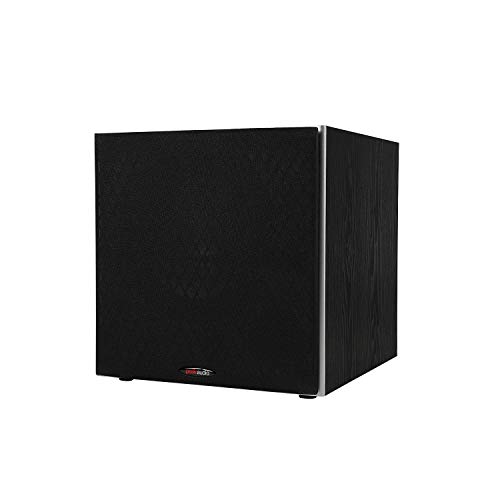
- 10-inch Dynamic Balance woofer
- 100W maximum output with 50W RMS amplifier
- Adjustable crossover and multiple wired inputs
Best For: Flexible home theater and music integration
Compact Low-End Support
Yamaha NS-SW050BL 8-Inch Subwoofer

- Compact 8-inch powered design
- 100W dynamic power with Advanced YST II
- Twisted flare port for clear, tight bass
Best For: Space-conscious home theater and music setups
Room-Filling Precision – SVS SB-1000 Pro
SVS SB-1000 Pro Subwoofer (Black Ash) | 12-in Driver, 325 Watt RMS, Sealed Cabinet
Check Price On AmazonThe SVS SB-1000 Pro is a strong choice among subwoofers for large rooms when you want controlled, room-filling bass from a relatively compact sealed cabinet. Its 12-inch driver, 325-watt RMS amplifier, room-tuning DSP, and app-based controls make it practical for dialing in performance across different listening spaces.
Best For: Home theater and music listeners who want powerful, precise bass with convenient app-based tuning.
Pros:
- 12-inch high-excursion driver delivers substantial output with controlled performance.
- 325 watts RMS and 820-plus watts peak power provide considerable headroom.
- DSP and smartphone app support detailed in-room adjustment and custom presets.
- Rigidly braced sealed cabinet helps reduce unwanted resonance.
Cons:
- Sealed-cabinet design may not provide the same ported impact some movie-focused listeners prefer.
- It is wired for power, so placement requires access to an outlet.
For a large room, the SB-1000 Pro stands out for balancing output, precision, and setup flexibility. Its compact dimensions also make it easier to place than many high-output alternatives.
Movie-Ready Impact – Klipsch R-12SW
The Klipsch R-12SW is a practical pick among subwoofers for large rooms, pairing a 12-inch front-firing woofer with a 400-watt dynamic amplifier. Its line/LFE inputs and adjustable crossover and phase controls make it straightforward to integrate with most home theater receivers.
Best For: Home theater setups seeking energetic bass for movies and music with simple receiver compatibility.
Pros:
- 12-inch copper-spun woofer is designed for powerful front-firing bass.
- All-digital amplifier delivers up to 400 watts of dynamic power.
- Line/LFE inputs support compatibility with most receivers.
- Low-pass crossover and phase controls help with system integration.
Cons:
- Its larger 20-by-20-by-17.75-inch footprint requires substantial floor space.
- Connectivity is wired rather than wireless.
The R-12SW emphasizes straightforward, high-impact performance. It is especially suitable when a large room and home theater system call for a substantial cabinet and strong movie-bass presence.
Studio-Controlled Low End – PreSonus Eris Sub 8BT
The PreSonus Eris Sub 8BT is a compact studio subwoofer that can serve smaller or carefully configured spaces, but it is less suited to filling a very large room than the larger models here. Its 8-inch driver, 100-watt design, Bluetooth 5.0, crossover controls, and multiple inputs make it useful for desktop monitoring, music listening, and multimedia work.
Best For: Desktop studios, content creators, and listeners who prioritize accurate, adjustable bass over maximum room-filling output.
Pros:
- Reaches down to 30 Hz for extended low-frequency response.
- Highpass and lowpass controls support cleaner integration with main monitors.
- Bluetooth 5.0 plus balanced TRS, RCA, and front-panel auxiliary inputs offer flexible connectivity.
- Front headphone output and built-in amplifier simplify monitoring.
Cons:
- Its 8-inch driver and 100-watt design are not the most suitable match for very large rooms.
- Studio-focused controls and connections may be more than a basic home theater setup needs.
The Eris Sub 8BT is best viewed as a precision-oriented desktop or nearfield solution rather than a maximum-output large-room subwoofer. Its crossover and tuning controls are valuable when accurate integration matters most.
Compact Theater Bass – Klipsch R-100SW
The Klipsch R-100SW is a compact option among subwoofers for large rooms, using a 10-inch front-firing woofer and 300 watts of peak amplifier power. It offers volume, low-pass crossover, phase, and auto-power controls, plus RCA and LFE inputs for common television and home theater connections.
Best For: Multi-purpose home entertainment systems that need a straightforward, space-conscious bass upgrade.
Pros:
- 10-inch spun-copper IMG woofer provides deep bass in a relatively compact cabinet.
- 300 watts peak power and a 150-watt continuous rating support energetic playback.
- RCA and LFE inputs offer broad receiver and source compatibility.
- Auto power-on, phase, volume, and low-pass controls simplify operation.
Cons:
- Its 10-inch driver and lower power rating may have less headroom than larger 12-inch models in a very large room.
- It uses wired RCA connectivity rather than wireless connection.
The R-100SW makes sense when cabinet size and installation simplicity matter. In a genuinely large room, it may be better suited to moderate listening levels or systems where a compact subwoofer is easier to place.
Balanced Room-Filling Bass – Yamaha NS-SW100BL
For shoppers comparing subwoofers for large rooms, the Yamaha NS-SW100BL offers a straightforward powered design with a 10-inch cone woofer and 100 watts of maximum output. Its twisted flare port and Advanced YST II technology are designed to support clear, tight bass for home theater systems.
Best For: Home theater listeners who want a floor-standing Yamaha subwoofer with a 10-inch driver and a stylish black finish.
Pros:
- 10-inch cone woofer with Advanced YST II technology
- Twisted flare port contributes to clear, tight bass
- Floor-standing design with a 2-year limited warranty
Cons:
- 100-watt maximum output is lower than the larger models in this roundup
- Its 10-inch driver may offer less low-end impact than a 12-inch alternative
- Wired connectivity may be less convenient for some setups
The NS-SW100BL is a sensible option when you want Yamaha’s bass-focused technology in a conventional powered enclosure. For especially demanding large-room systems, compare its 100-watt rating with higher-output alternatives.
High-Output Home Theater Bass – Klipsch SUB-120 12-inch Subwoofer
Among subwoofers for large rooms, the Klipsch SUB-120 stands out with a 12-inch front-firing driver and 200 watts of continuous power, with up to 400 watts of dynamic power listed. It is built for home theater use and can connect to almost any AV receiver.
Best For: Home theater owners who want a larger front-firing woofer and strong rated output for movies, gaming, and other bass-heavy content.
Pros:
- 12-inch spun copper front-firing Cerametallic woofer
- 200 watts continuous and 400 watts dynamic power
- Removable grille and contemporary black finish
- Three-year parts-and-labor warranty
Cons:
- Large 23.7-inch-deep cabinet requires substantial floor space
- Connection wires are not included
- Floor-standing placement may be less suitable for compact rooms
The SUB-120 is the strongest fit here for listeners prioritizing a larger driver and higher output. Its sizeable cabinet and corner-placement recommendation should be considered when planning a large-room layout.
Compact Powered Bass – Audioengine S6 Mini Subwoofer
The Audioengine S6 takes a different approach to subwoofers for large rooms: it uses a compact 6-inch front-firing driver with 210 watts of powered output. Its small footprint makes it easier to place in modern living areas, while RCA and auxiliary connections support a range of home audio sources.
Best For: Listeners who need a space-conscious subwoofer for home theater, gaming, music, or desktop audio.
Pros:
- Compact 9.92-by-8.74-by-9.96-inch enclosure
- 210 watts of powered output from a front-firing design
- RCA and auxiliary connectivity
- Compatible with the Audioengine W3 wireless adapter
Cons:
- 6-inch driver is smaller than those in the Yamaha and Klipsch models
- Its compact design may be less suited to maximum room-filling bass
- Listed frequency response begins at 33 hertz
The S6 is best viewed as a flexible, compact bass upgrade rather than a traditional large-room powerhouse. Choose it when placement convenience matters as much as output and you want a small enclosure for a versatile audio system.
Room-Filling Power – Klipsch R-120SW 12-Inch Subwoofer
For shoppers comparing subwoofers for large rooms, the Klipsch R-120SW stands out with a 12-inch high-excursion spun-copper woofer and up to 400 watts of peak amplifier power. Its bass-reflex design and rear-firing port are suited to home entertainment systems that need substantial low-end output.
Best For: Large-room home theater and music setups that benefit from powerful, room-filling bass.
Pros:
- 12-inch high-excursion woofer supports deep, powerful bass.
- Up to 400 watts of peak power and a listed maximum output of 116 dB.
- Wood enclosure, bass-reflex design, and included grille and power cord.
Cons:
- Its 31-pound, floor-standing cabinet requires more space than compact models.
- Wired RCA connectivity may be less convenient for wireless-focused systems.
With its larger driver and higher output than the other options here, the R-120SW is the strongest match for buyers prioritizing impact and coverage in a spacious listening area.
Flexible Bass Upgrade – Polk Audio PSW10 10-Inch Subwoofer
The Polk Audio PSW10 is a practical choice for shoppers seeking subwoofers for large rooms while still wanting a relatively compact cabinet. Its 10-inch Dynamic Balance woofer, directed port, and built-in amplifier add bass depth to compatible home theater and music systems.
Best For: Buyers who want an easy-to-integrate wired subwoofer with adjustable crossover and speaker-level connection options.
Pros:
- 10-inch woofer provides extra bass and punch for music and movies.
- Continuously variable 80–160 Hz crossover helps blend the subwoofer with other speakers.
- Offers speaker and line-level inputs, speaker-level outputs, and a phase toggle switch.
Cons:
- Its 100-watt maximum output is lower than the Klipsch model.
- The supplied notes describe it as ideal for small-to-mid-size rooms, so it may be less suitable for very large spaces.
The PSW10 is a versatile, straightforward upgrade with useful integration controls, but shoppers with especially large rooms may prefer a higher-output model for more headroom.
Compact Low-End Support – Yamaha NS-SW050BL 8-Inch Subwoofer
The Yamaha NS-SW050BL offers a compact way to add low-frequency support to a home theater or music setup. Its 8-inch cone woofer, Advanced YST II technology, and twisted flare port are designed to contribute clear, tight bass without the footprint of a larger subwoofer.
Best For: Buyers who need a space-conscious wired subwoofer for a home theater, television, or music-player setup.
Pros:
- Compact 8-inch design measures 12 by 14 by 12 inches.
- Twisted flare port is designed to contribute clear and tight bass.
- Advanced YST II technology and 100 watts of dynamic power.
Cons:
- The 8-inch woofer and 100-watt rating provide less output potential than the larger Klipsch model.
- Wired connectivity may not suit shoppers seeking a wireless setup.
The NS-SW050BL is the most compact option in this group. It can add useful bass where space is limited, though buyers furnishing a very large room may want a larger driver and more output.
How We Picked the Best Subwoofers for Large Rooms
We focused on powered models with the practical output needed for medium-to-large listening spaces, while including a range of sizes and prices. Our comparison considers driver diameter, amplifier rating, cabinet design, connectivity, and the product’s likely role in a home theater, stereo system, desktop setup, or compact living room.
Specifications such as RMS power and driver size are useful starting points, but they do not tell the whole story. Room dimensions, placement, crossover settings, and the distance between the subwoofer and listeners strongly affect perceived bass.
Quick Comparison
| What to Compare | Best Starting Point | Why It Matters |
|---|---|---|
| Driver size | 10–12 inches | Usually provides more effortless output for larger spaces. |
| Amplifier power | 100–325 watts RMS | Helps maintain headroom at higher listening levels. |
| Cabinet design | Sealed or ported | Sealed cabinets favor control; ported designs often deliver stronger output. |
| System type | AV receiver, stereo, or desktop | Determines which inputs and integration features you need. |
Key Buying Factors for Subwoofers for Large Rooms
Driver Size and Output
A 12-inch subwoofer is often the safer choice when you need room-filling bass, especially for action movies or music played at higher levels. A capable 10-inch model can work well in a moderately large room, while 8-inch and compact designs are better suited to near-field listening or smaller spaces.
Power and Headroom
Look at continuous or RMS power rather than relying only on peak ratings. More headroom lets a subwoofer reproduce demanding bass with less strain. If the room is open-plan, heavily furnished, or used for frequent high-volume listening, prioritize stronger amplification and a larger driver.
Placement and Calibration
Subwoofer placement can change bass dramatically. Try the front wall, a corner, and positions along the side walls, then listen for evenness rather than simply maximum volume. Use your receiver’s room correction when available, and set the crossover so the subwoofer blends smoothly with the main speakers.
Connectivity and Cabinet Type
Confirm that the inputs match your system. Line-level and LFE connections are common for home theater, while stereo systems may require left/right inputs. Sealed cabinets can sound tight and compact; ported cabinets typically offer more output in the deepest bass but require adequate space around the port.
Who Should Buy Which Subwoofers for Large Rooms?
For Large Home Theaters
Choose a 12-inch model with substantial continuous power. It will generally provide better impact and maintain composure when several people are listening across the room.
For Music-Focused Stereo Systems
Prioritize clean integration, adjustable crossover controls, and enough output to complement—not overpower—your main speakers. A sealed design may appeal if you value compact dimensions and controlled bass.
For Apartments, Offices, and Desktop Setups
A compact 8-inch or mini subwoofer is easier to position and less likely to overwhelm the room. These models make sense when listening distance is short and extreme low-frequency output is not the priority.
For Budget Upgrades
A modestly priced 10-inch subwoofer can deliver a substantial improvement over speaker-only systems. Just verify the available connection, leave room for adjustment, and avoid choosing based on peak wattage alone.