Starting a podcast does not require a complicated studio, but the right recorder can make recording, monitoring, and managing multiple microphones much easier. The best podcast recorders for beginners combine straightforward controls with dependable sound and useful connectivity.
This roundup includes compact handheld recorders, dedicated podcast stations, phone-friendly kits, and complete audio bundles. Use the buying guide below to match features, workflow, and budget to the way you plan to record.
Best 10 Podcast Recorders for Beginners Picks for 2026
Best for Multi-Person Shows

- Four XLR mic inputs with phantom power
- Four headphone outputs with individual volume
- Phone, remote, and USB recording options
Best For: Multi-person podcasts and remote interviews
Best Complete Starter Kit

- Includes two mics, headphones, stands, and cables
- Two-channel interface with 48V phantom power
- Works with computers and mobile devices
Best For: Two-person podcasts and portable recording
Best for Flexible Field Recording

- Built-in stereo mics for quick recording
- Two XLR/TRS inputs for external gear
- 32-bit float and four-track recording
Best For: Podcasts, interviews, music, and field audio
Best for Live Streaming Effects

- Includes mixer, condenser mic, and accessories
- Built-in and recordable sound effects
- Supports two people and multiple platforms
Best For: Live podcasts, streaming, and interactive content
Best Versatile Pick

- Two XLR/TRS combo inputs
- 32-bit/96kHz recording
- OLED waveform level display
Best For: Beginners planning flexible podcast, interview, or music recording setups
Best for Everyday Use
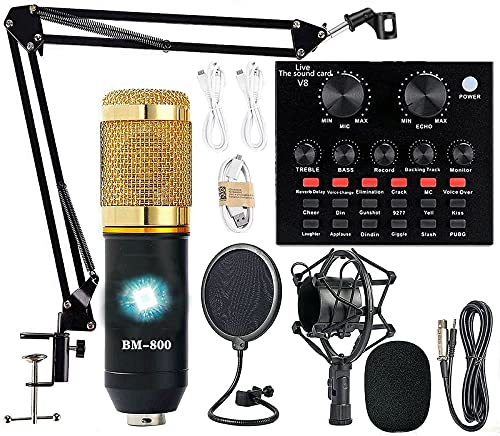
- Includes mic and studio accessories
- Live sound card with voice effects
- Works with computers and mobile devices
Best For: Beginners building a desk-based podcast or livestream setup
Best Simple Portable Pick

- Built-in X/Y stereo microphones
- 32-bit float clip-free audio
- USB-C microphone mode
Best For: Beginners recording podcasts, interviews, music, and mobile content
Best Beginner Bundle

- Complete two-microphone starter setup
- Voice effects and noise reduction
- Compatible with phones, PCs, and consoles
Best For: New creators recording interviews, livestreams, or gaming content
Best Portable Recorder

- Four XLR inputs with phantom power
- Four independent headphone outputs
- Supports TRRS and USB call-ins
Best For: Interviews and small-group podcasts
Best Mixer Upgrade

- Eight-channel digital mixer/recorder
- Includes mic, headphones, and tripod
- USB and XLR connectivity
Best For: Beginners building a flexible desktop recording setup
Best for Multi-Person Shows – Zoom PodTrak P4
For beginners comparing podcast recorders for beginners, the Zoom PodTrak P4 is a practical choice for recording a group show. It provides four XLR microphone inputs, four individually controlled headphone outputs, and dedicated options for phone and remote interviews.
Best For: Beginners recording multi-person podcasts, call-in interviews, and remote conversations.
Pros:
- Four XLR inputs with phantom power support multiple microphones.
- Four headphone outputs include individual volume control.
- Automatic mix-minus supports phone and remote interviews through TRRS or USB.
- Battery powered and capable of up to 3.5 hours on two AA batteries.
Cons:
- Battery life is limited to about 3.5 hours on two AA batteries.
- Its four-input feature set may be more than a solo podcaster needs.
The P4 stands out when your beginner setup needs to grow beyond one or two speakers. Sound pads, multitrack recording, and USB interface mode add flexibility without requiring a separate mixer.
Best Complete Starter Kit – Movo PodPro Bundle
The Movo PodPro is a convenient entry point for anyone seeking podcast recorders for beginners without assembling every component separately. This bundle includes a dual-channel USB interface, two XLR dynamic microphones, two stands, two headphones, cables, and a travel case.
Best For: Two-person podcasts and creators who want a portable, mostly complete recording setup.
Pros:
- Includes two microphones, two tabletop stands, two headphones, and XLR cables.
- The interface has two XLR inputs with 48V phantom power and two headphone outputs.
- USB-A, USB-C, and Lightning cables support computers, iPhones, iPads, and Android devices.
- Battery operation provides up to eight hours, or up to three hours with phantom power enabled.
Cons:
- The two-channel interface is not designed for larger group recordings.
- The supplied interface lists a maximum sample rate of 16 kHz.
As a bundle, the PodPro reduces setup decisions for new creators and covers two-person recording immediately. Its included travel case and device-specific cables are especially useful for mobile recording.
Best for Flexible Field Recording – Zoom H4 Essential
The Zoom H4 Essential is a versatile option among podcast recorders for beginners who may also record interviews, video audio, music, or live performances. Its built-in stereo microphones work alongside two XLR/TRS inputs, while 32-bit float recording is designed to help prevent clipped audio.
Best For: Beginners who want one handheld recorder for podcasts, interviews, music, and field work.
Pros:
- Built-in stereo microphones support quick recordings without extra gear.
- Two XLR/TRS inputs accept external microphones, instruments, mixers, or soundboards.
- Four-track recording supports larger projects than a basic stereo recorder.
- USB-C enables recording or streaming to a computer, phone, or tablet while saving to an SD card.
Cons:
- It has two external XLR/TRS inputs, so larger groups need additional equipment.
- Two AA batteries are required for portable use.
The H4 Essential is a strong fit if podcasting is only one part of your recording plans. Its handheld design, built-in microphones, external inputs, and backup-to-SD workflow make it adaptable as your projects expand.
Best for Live Streaming Effects – MAONO S1 Podcast Bundle
The MAONO S1 is aimed at beginners who want podcast recorders for beginners with an emphasis on live streaming and hands-on effects. Its mixer includes built-in effects, voice changing, real-time monitoring, Bluetooth, and support for connecting to smartphones or computers.
Best For: Beginner podcasters and streamers who want sound effects, voice changes, and multi-platform live control.
Pros:
- Includes a condenser microphone, tripod, cable, windscreen, mixer, and two TRRS cables.
- Offers four recordable effects plus eight built-in sound effects.
- Supports up to two people, four devices, and four platforms simultaneously.
- Provides voice changing, reverb, electronic music effects, and real-time monitoring.
Cons:
- The AM200 supports 3.5mm microphone input and does not support phantom power.
- A phone without a 3.5mm jack requires an OTG adapter, which is not included.
- Connecting guitars or keyboards requires an additional 6.35mm-to-3.5mm adapter.
The MAONO S1 is less focused on traditional multitrack recording and more focused on making live content interactive. Its included microphone and accessible controls can help beginners start quickly, provided their devices and microphones match its 3.5mm connectivity.
Best Versatile Pick – Zoom H1 XLR
The Zoom H1 XLR is a strong choice for beginners seeking podcast recorders for beginners with room to grow. Its two XLR/TRS combo inputs support microphones and instruments, while 32-bit/96kHz recording and an OLED waveform display help simplify level monitoring and capture detailed audio.
Best For: Beginners who want a portable recorder for podcasts, interviews, music, or multi-source setups.
Pros:
- Two XLR/TRS inputs accommodate microphones, instruments, and other sources.
- 32-bit/96kHz recording is designed for clear, detailed sound.
- OLED waveform display makes levels easier to monitor.
- Supports SDXC cards up to 1TB and includes 3.5mm input and headphone output.
Cons:
- Requires two AA batteries.
- Its broader input options may be more than a beginner needs for a simple one-microphone setup.
Choose this model if flexible connections matter more than having an all-in-one desktop kit. It is especially practical for users who may add instruments, additional microphones, or external devices later.
Best for Everyday Use – BM-800 Podcast Bundle
This BM-800 bundle suits beginners who want podcast recorders for beginners in a ready-to-use studio-style package. It includes a condenser microphone, arm stand, shock mount, pop filter, foam cover, cables, and a live sound card for podcasting, streaming, short videos, and music recording.
Best For: New podcasters and livestreamers who want microphone accessories and voice effects in one bundle.
Pros:
- Includes the microphone, adjustable arm stand, shock mount, pop filter, and foam cover.
- Cardioid microphone pattern focuses on sound in front of the mic for voice recording.
- Compatible with Windows, Mac OS, smartphones, tablets, gaming platforms, and other listed devices.
- Live sound card provides multiple sound effects and connection options.
Cons:
- The microphone setup is less portable than a handheld recorder.
- The supplied instructions require charging the condenser microphone bundle before use.
- It provides one channel, which may limit multi-microphone recording.
This is the most suitable option when convenience and included accessories are priorities. It offers a fixed recording setup rather than the grab-and-go portability of a standalone field recorder.
Best Simple Portable Pick – Zoom H1 Essential
The Zoom H1 Essential is an approachable option for beginners comparing podcast recorders for beginners. Its built-in X/Y stereo microphones capture podcasts, interviews, lessons, music, ambience, and other content, while USB-C microphone mode adds support for streaming, calls, and computer or mobile recording.
Best For: Beginners who want a lightweight recorder with built-in microphones and USB connectivity.
Pros:
- Built-in X/Y stereo microphones provide a straightforward way to start recording.
- 32-bit float recording is designed for clip-free audio.
- USB-C microphone mode supports livestreams, calls, podcasts, and voiceovers.
- Lightweight 92 g design and 3.5mm headphone jack suit portable recording.
Cons:
- It uses built-in stereo microphones rather than listed XLR inputs.
- Requires two AAA batteries.
- Its 10-hour battery rating is shorter than the H1 XLR’s listed average battery life.
Pick the H1 Essential if you value quick setup and portability over a bundled microphone stand or expanded XLR connectivity. It is a practical first recorder for capturing voices, music, and everyday sound.
Best Beginner Bundle – Two-Person Podcast Kit
For beginners comparing podcast recorders for beginners, this Brvomussy bundle offers a ready-to-use setup for two people. It combines a mixer, two condenser microphones, boom arms, cables, pop protection, and voice effects, with plug-and-play compatibility across computers, smartphones, and select gaming platforms.
Best For: New creators who want an all-in-one, two-person setup for podcasts, livestreams, gaming, or singing.
Pros:
- Includes two microphones, boom arms, cables, shock mounts, and pop protection.
- Supports two simultaneous users and offers four independent headphone-related? sound modes? No—offers 10 sound effects, four voice variations, and multiple controls.
- Works with Windows, Mac OS, iOS, Android, Chrome OS, PCs, smartphones, and PlayStation-related setups.
- Supports direct instrument input for guitar, bass, and other instruments.
Cons:
- The many effects and controls may take time for a first-time user to learn.
- It uses battery power, and the instructions recommend fully charging it before initial use.
This is a practical starter bundle when convenience and two-person recording matter most. Its included accessories reduce the need for separate purchases, while the mixer’s effects make it flexible for live content as well as straightforward podcasting.
Best Portable Recorder – Zoom PodTrak P4 with Two Mics
Zoom PodTrak P4 Portable Multitrack Podcast Recorder Bundle with 2X Zoom ZDM-1 Podcast Pack
Check Price On AmazonThe Zoom PodTrak P4 is a focused choice for shoppers seeking podcast recorders for beginners who want dedicated multitrack hardware. This bundle provides four XLR microphone inputs, independent headphone outputs, sound pads, and two Zoom ZDM-1 podcast microphone packs for getting started with more than one speaker.
Best For: Beginner podcasters who need a portable multitrack recorder for interviews or small group sessions.
Pros:
- Provides four high-gain XLR microphone inputs with +48V phantom power.
- Offers four independent headphone outputs for monitoring multiple participants.
- Includes four sound pads for music and samples.
- Supports simultaneous TRRS and USB call-ins.
Cons:
- The bundle’s supplied microphone packs number two, so additional microphones may be needed to use all four inputs.
- Its feature set is centered on multitrack recording rather than an all-in-one microphone-and-accessory kit.
With four inputs and four headphone outputs, the PodTrak P4 gives beginners room to grow beyond solo recording. It is especially appealing for interview formats, remote guests, and small groups that need separate microphone connections.
Best Mixer Upgrade – Zoom L8 Recorder Bundle
For beginners who want podcast recorders for beginners with a mixer-style workflow, the Zoom L8 bundle combines a digital mixer/recorder with a ZDM-1 microphone pack. The package includes a dynamic microphone, closed-back headphones, a tabletop tripod, a cable, and a windscreen, creating a more structured desktop recording setup.
Best For: Beginners who want a digital mixer/recorder with included monitoring and tabletop microphone accessories.
Pros:
- Combines the Zoom L8 digital mixer/recorder with a ZDM-1 microphone package.
- Includes a dynamic microphone, closed-back headphones, tabletop tripod, cable, and windscreen.
- Provides eight channels for a larger or more expandable recording setup.
- Uses USB connectivity and XLR audio inputs and output connections.
Cons:
- The unit is corded electric, so it is less suited to untethered field recording.
- The bundle includes one microphone pack, making it less immediately suited to multi-person recording than a two-microphone kit.
- Its mixer-focused design may be more equipment than a solo beginner needs.
The L8 bundle makes sense for creators who expect to manage multiple channels or want a more capable desktop setup from the start. Its included headphones and tabletop accessories make the package more usable immediately, while the eight-channel design leaves room for expansion.
How We Picked the Best Podcast Recorders for Beginners
We focused on equipment that reduces setup complexity without limiting future growth. Our selections cover several common beginner workflows: solo recording, two-person interviews, four-microphone roundtables, remote calls, mobile content creation, livestreaming, and music or field recording.
We considered microphone inputs, headphone monitoring, portability, USB and phone connectivity, onboard controls, multitrack capability, included accessories, and the learning curve. Because an all-in-one bundle can be convenient but vary widely in quality, we also separated purpose-built recorders from entry-level packages that prioritize a low starting cost.
Quick Comparison
| Best For | Recommended Type | What to Prioritize |
|---|---|---|
| Solo podcasts | Portable recorder or phone bundle | Simple controls, clear monitoring, and easy file transfer |
| Two-person shows | Two-channel recorder or dual-mic bundle | Separate inputs, headphone outputs, and gain control |
| Roundtable interviews | Four-input podcast recorder | Multiple XLR inputs, isolated tracks, and reliable power |
| Streaming and live content | USB mixer or audio interface bundle | Computer compatibility, sound effects, and live mixing |
| Travel and field work | Handheld recorder | Compact design, battery life, and built-in microphones |
Key Buying Factors for Podcast Recorders for Beginners
Inputs and Microphone Compatibility
Check how many people you expect to record at once. XLR inputs are the most flexible choice for podcast microphones, while 3.5mm and USB connections may be more convenient for phones, lavalier microphones, or computer-based setups. A recorder with more inputs gives you room to expand, but it may add cost and complexity.
Headphone Monitoring
Every active speaker should be able to hear the recording when possible. Multiple headphone outputs are especially valuable for interviews and roundtables. If a device has only one output, you may need a splitter or external headphone amplifier.
Recording and Connection Options
Standalone recorders are useful when you want to record without a computer, while USB models can also function as an audio interface. Look for phone connectivity if you plan to bring in remote guests or capture mobile audio. Multitrack recording is preferable when you want to adjust each voice separately during editing.
Portability and Power
Handheld models suit travel, field interviews, and flexible recording locations. Dedicated podcast stations are better for a permanent desk setup. Confirm whether the recorder uses batteries, USB power, or both, and consider storage requirements for longer sessions.
Who Should Buy Which Podcast Recorders for Beginners?
Choose a compact handheld model if you want the simplest way to record solo episodes, interviews, music, or outdoor audio. A dedicated four-input podcast recorder is the better choice for growing shows with several guests and multiple headphones. If your priority is livestreaming, gaming, or real-time effects, an audio mixer bundle may be more useful than a standalone recorder.
Phone-focused bundles make sense for creators who publish from an iPhone or Android device and want a portable starting kit. Budget all-in-one packages can be suitable for experimenting, but check microphone quality, connector compatibility, and included accessories before relying on one for professional work. For a more durable long-term setup, prioritize clean preamps, independent controls, and upgradeable microphones over the largest accessory list.