Aftertouch adds another layer of control after a key or pad is already pressed, letting you shape vibrato, filter movement, volume, and other effects without reaching for a knob. The best MIDI controllers with aftertouch make that expression practical, whether you produce at a desk, perform live, or build parts around hardware synths.
This roundup compares compact keyboards, pad controllers, weighted hammer-action instruments, and sequencing-focused options. Use the buying guide below to match key feel, controls, connectivity, and size to the way you actually make music.
Best 10 Midi Controllers with Aftertouch Picks for 2026
Best All-in-One DAW Controller
Novation Launchkey Mini 37 MK4

- 37 mini synth-action keys with scale and chord modes
- 16 pads with polyphonic aftertouch
- Broad DAW integration plus arpeggiator and NKS support
Best For: Compact keyboard-and-pad DAW production
Best Hardware Sequencer
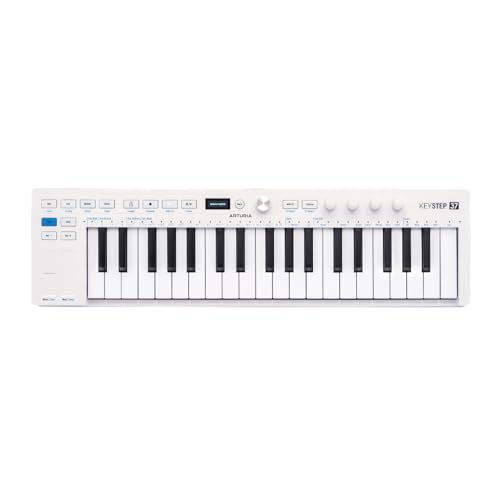
- 37-note Slimkey keyboard with aftertouch
- Polyphonic 64-step sequencer and 16-mode arpeggiator
- USB, MIDI DIN, sync, pedal, and configurable CV connections
Best For: Hardware, modular, and electronic music workflows
Best Weighted-Key Option
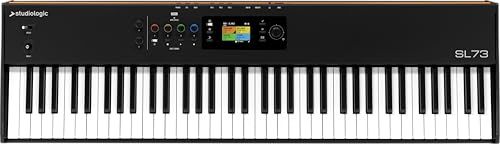
- 73 weighted hammer-action keys with aftertouch
- Color display, UX Logic, and DAW transport controls
- USB-C, MIDI 2.0 compatibility, and integrated audio interface
Best For: Piano-style playing and full-range studio control
Best Portable Pad Controller

- 16 RGB velocity-sensitive pads with aftertouch
- Bluetooth MIDI, USB MIDI, and up to 15-hour battery
- Three pad banks expandable to 48 pads
Best For: Wireless beat making and mobile performance
Best Weighted Option

- 88 graded hammer-action keys with aftertouch
- 16 pads, 9 faders, and 8 knobs
- Includes NKS support and production software
Best For: Pianists and producers wanting full-range weighted control
Best Compact Control Layout

- 49 semi-weighted keys with aftertouch
- 9 faders, 8 encoders, and 16 buttons
- Includes USB and traditional MIDI Out
Best For: Home studios needing tactile control in a 49-key format
Best Value Production Setup

- 49 full-size velocity-sensitive keys
- 16 pads, 8 knobs, and 9 faders
- Includes NKS support and bundled software
Best For: Beat makers and home producers building a USB studio setup
Best All-in-One Sequencer

- 37 aftertouch-enabled slimkeys with velocity sensitivity
- Polyphonic sequencing, arpeggiation, and drum sequencing
- CV, Gate, MIDI, and USB connectivity for hybrid setups
Best For: Live hardware rigs and complex sequencing
Best for DAW Production

- 49 semi-weighted keys with aftertouch and assignable zones
- 16 RGB pads, 8 knobs, and 9 faders
- Includes MIDI output, DAW controls, and production software
Best For: Computer-based music production and beat making
Best Piano-Style Option

- 88 weighted hammer-action keys with aftertouch
- Fatar keybed delivers a piano-feel playing experience
- Adds 16 pads, 9 faders, and 9 rotary knobs
Best For: Pianists and studio players seeking full-range weighted keys
Best All-in-One DAW Controller – Novation Launchkey Mini 37 MK4
The Novation Launchkey Mini 37 MK4 is a compact choice for musicians seeking midi controllers with aftertouch, especially those who want keyboard playing, pad performance, and DAW control in one unit. Its 37 mini synth-action keys, 16 pads with polyphonic aftertouch, scale and chord modes, and arpeggiator support a broad range of creative workflows.
Best For: Producers who want an integrated keyboard-and-pad controller for DAW production, clip launching, and expressive finger drumming.
Pros:
- 16 FSR pads provide polyphonic aftertouch for expressive drums, clips, chords, and sequencing.
- Works with major DAWs including Ableton Live, Logic, Cubase, Reason, Reaper, FL Studio, and Ardour.
- Scale Mode, Chord Mode, arpeggiator, OLED display, and NKS support add practical creative control.
Cons:
- Mini keys may be less suitable for players who prefer full-size key spacing.
- Its plastic construction and compact layout prioritize portability over a larger performance surface.
Choose this model when versatile DAW integration and expressive pad control matter more than full-size keys. It is a particularly balanced option for compact home studios and mobile setups.
Best Hardware Sequencer – Arturia KeyStep 37
The Arturia KeyStep mk2 combines a 37-note Slimkey keyboard with aftertouch and a deep sequencing toolkit. Among midi controllers with aftertouch, it stands out for connecting computer software, MIDI hardware, and modular equipment through USB-C MIDI, MIDI DIN, sync I/O, pedal input, and four configurable CV outputs.
Best For: Electronic musicians who build riffs and evolving patterns with hardware synthesizers, modular gear, or software instruments.
Pros:
- Velocity-sensitive 37-note Slimkey keyboard includes aftertouch for expressive playing.
- Polyphonic 64-step sequencer, 16-mode arpeggiator, chord and scale modes, and Mutate encourage experimentation.
- USB-C MIDI, MIDI DIN, sync, pedal input, and four CV outputs support flexible hardware setups.
Cons:
- The compact Slimkey design may not satisfy players seeking full-size piano-style keys.
- Its extensive sequencing and CV features may be more than needed for a simple keyboard controller.
The KeyStep is a strong fit for hands-on pattern creation and hybrid setups. Its aftertouch-equipped keyboard and configurable CV connectivity make it especially useful when a controller must do more than send basic MIDI notes.
Best Weighted-Key Option – Studiologic SL73 MK2
The Studiologic SL73 MK2 is the choice for players who want midi controllers with aftertouch in a full-sized, weighted format. Its 73-key TP/110 premium hammer-action keyboard is designed for dynamic piano-style playing, while the color display, zone management, DAW controls, USB-C connectivity, and integrated audio interface support production work.
Best For: Keyboardists and composers who prioritize weighted hammer action, expressive aftertouch, and a broad playing range.
Pros:
- 73 full-sized weighted keys with hammer action and aftertouch provide a piano-oriented playing experience.
- Color display and UX Logic simplify navigation and zone management.
- USB-C supports power, MIDI, Numa Player connectivity, and the integrated audio interface.
Cons:
- At 11.2 kg, it is considerably less portable than compact controllers.
- The larger weighted-key design requires more desk or stand space.
- It may be excessive for users who mainly need pads or a lightweight MIDI keyboard.
The SL73 MK2 is best evaluated as a serious performance keyboard that also handles studio control. Select it when key feel and range are more important than portability or pad-focused features.
Best Portable Pad Controller – Mini Wireless MIDI Controller
This mini wireless pad controller is a practical option for creators seeking midi controllers with aftertouch in a compact beat-making format. It provides 16 RGB velocity-sensitive pads with aftertouch, Bluetooth MIDI and USB MIDI, a rechargeable battery rated for up to 15 hours, and app-based customization for mobile, desktop, and live workflows.
Best For: Mobile producers, DJs, and beat makers who need expressive pads and wireless operation for travel, practice, or live performance.
Pros:
- Sixteen RGB velocity-sensitive pads with aftertouch support expressive finger drumming and sample triggering.
- Bluetooth MIDI and USB MIDI allow wireless or wired operation with computers, tablets, and smartphones.
- Up to 15 hours of battery life, three pad banks, and expandable access to 48 pads support portable workflows.
Cons:
- It is a pad controller rather than a keyboard, so it is not suited to traditional melodic keyboard playing.
- Advanced remapping requires the companion app or desktop software.
- The notes identify a compact plastic design, which may feel less substantial than larger controllers.
This controller makes the most sense when portability and wireless pad performance are priorities. Its aftertouch, RGB feedback, battery, and customizable banks give beat makers a flexible travel-friendly setup.
Best Weighted Option – M-AUDIO Hammer 88 Pro
For players who want piano-style response in a setup built around MIDI controllers with aftertouch, the M-AUDIO Hammer 88 Pro combines 88 graded hammer-action keys with extensive production controls. Its full-size layout is especially suited to virtual instruments, while the pads, faders, software mapping, and pedal inputs support broader studio workflows.
Best For: Pianists, composers, and producers who want a full 88-key weighted controller with aftertouch and hands-on DAW control.
Pros:
- 88 velocity-sensitive, graded hammer-action keys with aftertouch
- 16 RGB pads, 9 faders, 8 knobs, and assignable buttons
- Includes NKS integration, Smart Chord and Scale modes, arpeggiator, and production software
- Offers three footswitch inputs plus an expression-pedal input
Cons:
- Its 40.8-pound weight and 56-inch width make it less convenient to move
- Its large feature set may be more than a basic MIDI keyboard setup requires
The Hammer 88 Pro is the most piano-focused choice here, with the broadest key range and a strong collection of studio controls. Choose it when authentic weighted action and aftertouch matter more than portability.
Best Compact Control Layout – Samson Graphite 49
Samson Graphite 49 Key USB MIDI DJ Keyboard Controller w/Aftertouch/Fader/Pads
Check Price On AmazonThe Samson Graphite 49 is a practical mid-sized option for shoppers comparing MIDI controllers with aftertouch. Its 49-key semi-weighted keyboard provides expressive control, while the programmable faders, encoders, buttons, pads, LCD feedback, and traditional MIDI Out make it useful for both computer-based production and compatible MIDI hardware.
Best For: Home-studio musicians who want aftertouch, extensive physical controls, and a 49-key format.
Pros:
- 49-key semi-weighted keyboard with aftertouch
- Includes 9 programmable faders, 8 encoders, and 16 buttons
- Four velocity-sensitive trigger pads with two banks
- Provides both USB and traditional MIDI Out connections
Cons:
- Has fewer trigger pads than the M-AUDIO alternatives
- The supplied notes do not specify included components beyond the controller
With its 49-key footprint and unusually strong fader-and-encoder complement, the Graphite 49 suits users who prioritize tactile mixing and instrument control. Its LCD and MIDI Out add useful flexibility without requiring an 88-key chassis.
Best Value Production Setup – M-AUDIO Oxygen 49 MKV
The M-AUDIO Oxygen 49 MKV is a 49-key controller for producers who want a practical studio workflow and are specifically seeking MIDI controllers with aftertouch. Its full-size velocity-sensitive keys are paired with drum pads, assignable knobs and faders, smart performance modes, NKS integration, and bundled software for getting started quickly.
Best For: Beat makers and home producers who want a versatile 49-key USB controller with extensive DAW controls.
Pros:
- 49 velocity-sensitive, full-size piano-style keys
- Two banks of eight backlit pads with Note Repeat
- Includes 8 knobs, 9 faders, pitch and mod wheels, and sustain input
- Bundles NKS integration, Smart Chord and Scale modes, arpeggiator, and production software
Cons:
- The supplied details do not list an aftertouch feature explicitly, despite its relevance to this roundup
- Its connectivity is centered on USB rather than a listed traditional MIDI Out
The Oxygen 49 MKV offers a strong balance of keys, beat-making controls, and software-oriented features in a relatively manageable 49-key size. Verify the specific aftertouch implementation before buying if that capability is essential to your setup.
Best All-in-One Sequencer – KeyStep Pro 37
The Arturia KeyStep Pro 37 is a strong choice among midi controllers with aftertouch for performers who want sequencing, arpeggiation, and broad hardware connectivity in one unit. Its 37 velocity-sensitive slimkeys include aftertouch, while the controller adds polyphonic sequencing, a dedicated drum sequencer, and CV, Gate, MIDI, and USB connections.
Best For: Live performers and hardware-focused producers building complex setups with synths, Eurorack modules, drum machines, and software instruments.
Pros:
- Combines a keyboard, sequencer, arpeggiator, and drum sequencer.
- Offers 4 CV, Gate, and Mod outputs plus dedicated drum Gate outputs.
- Supports polyphonic sequencing, pattern chaining, Scenes mode, and Chord mode.
Cons:
- Its 37-key slimkey layout provides less range than larger controllers.
- The extensive feature set may require more setup time for beginners.
Choose the KeyStep Pro if hands-on sequencing and flexible hardware integration matter more than having a large piano-style keybed. It is particularly capable for live arrangements and evolving multi-device performances.
Best for DAW Production – Oxygen Pro 49
The M-Audio Oxygen Pro 49 combines aftertouch-enabled, semi-weighted keys with a practical set of pads, knobs, faders, and production features. As one of the more studio-oriented midi controllers with aftertouch, it is designed for controlling virtual instruments, effects, and DAW functions from a computer.
Best For: Computer-based producers who want a versatile 49-key controller for playing instruments, making beats, and mixing with hands-on controls.
Pros:
- Provides 49 velocity-sensitive, semi-weighted keys with aftertouch and assignable zones.
- Includes 16 RGB-backlit pads with Note Repeat for beat production and clip launching.
- Offers 8 knobs, 9 faders, pitch and modulation wheels, and a 5-pin MIDI output.
- Includes DAW and instrument software, plus NKS integration.
Cons:
- USB connectivity and the included features are geared toward computer-based production.
- The plastic construction may feel less substantial than heavier controllers.
For producers who need more than a basic keyboard, the Oxygen Pro 49 provides a balanced mix of playable range and tactile production controls. Its pads, faders, software mapping, and aftertouch make it a flexible centerpiece for a computer-based setup.
Best Piano-Style Option – KeyLab 88 MkII
The Arturia KeyLab 88 MkII is aimed at players who want a full piano-style range from their midi controllers with aftertouch. Its 88-note Fatar TP/100LR hammer-action keybed provides a weighted, piano-feel playing experience, complemented by performance pads, faders, knobs, and included software.
Best For: Pianists, composers, and studio players who prioritize weighted hammer-action keys and extensive hands-on control.
Pros:
- Features an 88-note Fatar TP/100LR hammer-action keybed with aftertouch.
- Provides a full piano range with velocity-sensitive keys.
- Includes 16 RGB-backlit pads, 9 faders, and 9 rotary knobs.
- Comes with Analog Lab V-related software and additional instrument software.
Cons:
- At 15 kg, it is substantially heavier than compact controllers.
- Its large 88-key footprint requires considerable desk or stand space.
- A stand is not included.
The KeyLab 88 MkII is the most suitable pick here when authentic piano-style key response and maximum range are priorities. Its size and weight make it less portable, but the weighted keybed and control surface are well suited to a permanent studio setup.
How We Picked These Midi Controllers with Aftertouch
We looked for controllers that offer meaningful expressive control, not just a long feature list. The selection covers different playing styles and budgets, including compact 37-key models, full-size 49-key controllers, weighted 73- and 88-key instruments, pad-based options, and hardware-friendly sequencers.
We also considered keyboard feel, aftertouch implementation, pads and knobs, DAW integration, USB and traditional MIDI connectivity, portability, sequencing features, and suitability for live use. Because no single controller fits every setup, the goal is to show useful alternatives rather than rank every product by one standard.
Quick Comparison
| Best For | Look For | Recommended Type |
|---|---|---|
| Portable production | Compact dimensions, USB power, useful controls | Mini or 37-key controller |
| Expressive synth parts | Aftertouch, pads, knobs, responsive keys | 37- or 49-key controller |
| Piano-style playing | Weighted hammer action and full range | 73- or 88-key model |
| Hardware sequencing | Polyphonic sequencing, CV, MIDI, track controls | Dedicated sequencer controller |
| Beat making | Velocity-sensitive RGB pads and pad aftertouch | Pad controller |
Key Buying Factors for Midi Controllers with Aftertouch
Aftertouch Type and Feel
Check whether aftertouch is available on the keys, pads, or both. Channel aftertouch applies one pressure value across the instrument, while polyphonic aftertouch can give each note independent pressure control. The latter can be especially useful for chords and layered synth sounds, but it is less common and may require compatible software or hardware.
Key Count and Keyboard Action
Choose 25 to 37 keys for portability and basslines, 49 keys for a versatile studio setup, and 73 or 88 keys for broad piano parts and two-handed performance. Weighted hammer-action keys feel more like a piano but add considerable weight and size; synth-action keys are usually faster for leads, pads, and sequencing.
Controls, Pads, and Workflow
Knobs, faders, transport controls, pads, and displays can save time when shaping instruments or mixing. A compact controller may be ideal if you already have a keyboard, while a larger model can become the central control surface for a DAW. Dedicated sequencers are worth considering if you want to work without constantly looking at a computer.
Connections and Software Compatibility
USB is standard for computer use, but five-pin MIDI, Bluetooth, CV, and clock connections matter when integrating synths, drum machines, or modular gear. Confirm that your DAW and virtual instruments respond correctly to aftertouch, and check included software before treating it as a deciding factor.
Who Should Buy Which Midi Controllers with Aftertouch?
Choose a Compact Controller for Travel
Pick a mini or 37-key model if desk space, portability, and quick idea capture matter most. These controllers work well for laptop production, mobile rigs, and producers who do not need a full piano range.
Choose a 49-Key Model for an All-Purpose Studio
A 49-key controller is the practical middle ground for most producers. It provides enough range for bass, chords, and melodies while leaving room for pads, knobs, and faders.
Choose a Weighted Model for Piano-Focused Playing
Choose a 73- or 88-key weighted controller if realistic piano response and two-handed performance are priorities. These are best for a permanent studio or stage setup rather than frequent transport.
Choose a Sequencer or Pad Controller for Hardware and Beats
Hardware-focused musicians should prioritize MIDI, CV, sequencing, and synchronization options. Beat makers may prefer velocity-sensitive RGB pads with aftertouch, especially when finger drumming and triggering expressive samples are central to the workflow.