The best compact MIDI controllers give you hands-on control without taking over your desk or travel bag. This lineup covers mini keyboards, pad controllers, sequencers, and slim control surfaces for different production styles.
Whether you prioritize playable keys, expressive pads, software integration, or minimal footprint, the right controller should match both your workflow and available connections.
Best 10 Compact Midi Controllers Picks for 2026
Best Overall

- 25 mini keys, eight MPC pads, and eight assignable knobs
- Arpeggiator, Chord, and Scale modes for creative performance
- USB-C, MIDI Out, display, and broad included software
Best For: Producers seeking an all-in-one portable controller
Best for Simplicity

- Responsive upgraded 25-key slim keybed
- USB-powered, lightweight, and easy to carry
- Includes 500 presets and Ableton Live Lite
Best For: Beginners and mobile musicians wanting simple key control
Best Slim Mixer Control

- Low-profile surface for compact setups
- Track select, marker advance, and mute controls
- Designed for DAW and software control, not key playing
Best For: DAW users needing lightweight track controls
Best for Hardware Sequencing
Arturia BeatStep MIDI Controller
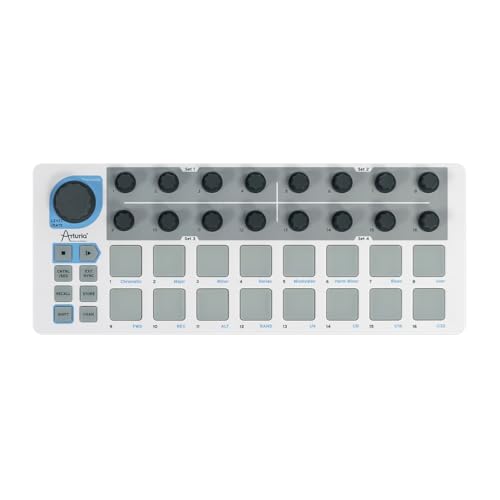
- 16 pads and 16 encoders for performance and sequencing
- Controller and sequencer modes can operate simultaneously
- USB, MIDI, and CV connectivity for varied gear
Best For: Electronic musicians working with sequences and hardware
Best All-Around Controller
Novation Launchkey Mini 37 MK4

- 37 mini keys with 16 polyphonic-aftertouch pads
- Scale, Chord, Arp, OLED, and DAW integration
- Includes selected software, sounds, and lessons
Best For: Creators needing keys, pads, and DAW control in one compact unit
Best Slim Control Surface

- Low-profile USB control surface
- Track select and marker advance controls
- Supports major DAW software titles
Best For: Small desks and mobile setups needing basic DAW control
Best for Beat Making

- Eight RGB-backlit MPC-style pads
- Eight assignable Q-Link knobs
- Four presets and USB-powered portability
Best For: Beat makers needing pads and tactile software control on the go
Portable Piano Feel
M-AUDIO Keystation Mini 32 MK3

- 32 velocity-sensitive miniature keys
- USB plug-and-play for Mac and Windows
- Includes MPC Beats and Melodics lessons
Best For: Portable piano-style playing and beginner production
Travel-Ready Sequencing

- 25 velocity-sensitive mini keys
- Built-in arpeggiator and clock
- Eight programmable preset slots
Best For: Mobile songwriting and compact melodic control
All-in-One Beat Control
Akai Professional MPK Mini MK3

- 25 velocity-sensitive keys with pitch/mod thumbstick
- Eight MPC pads and eight assignable knobs
- Includes MPC Beats, instruments, and sound content
Best For: Beat making and hands-on home-studio production
Best Overall – Akai Professional MPK Mini IV
The Akai Professional MPK Mini IV is a versatile choice among compact midi controllers, combining 25 velocity-sensitive mini keys with pads, knobs, a display, and performance tools. Its USB-C connection, MIDI Out, and DAW integration make it suitable for both portable production and more complete studio workflows.
Best For: Producers and beat makers who want an all-in-one compact controller for keys, finger drumming, sound shaping, and songwriting.
Pros:
- Includes 25 velocity-sensitive keys, eight MPC pads, and eight assignable 360° knobs.
- Built-in arpeggiator, Chord mode, and Scale mode support quick musical idea generation.
- Offers a color display, DAW-mapped controls, USB-C, and full-size MIDI Out.
- Includes a broad virtual instrument collection, Ableton Live Lite, Melodics, and Splice trials.
Cons:
- The mini-key layout may not suit players who prefer full-size keys.
- Its many controls may be more than beginners need for basic note input.
Choose the MPK Mini IV when you want the widest range of hands-on controls in a portable format. It is especially compelling for users who switch between keyboard parts, beats, clips, and sound design.
Best for Simplicity – Arturia MicroLab Mk3
The Arturia MicroLab Mk3 keeps compact midi controllers straightforward, with a slim 25-key keybed, two touch strips, and four buttons in a lightweight USB-powered design. It is built for quick setup and portable music-making without a large control surface.
Best For: Beginners and mobile producers who prioritize a responsive keybed, minimal controls, and plug-and-play operation.
Pros:
- Upgraded slim keybed is designed to provide a responsive playing experience.
- Small, lightweight, and USB-powered for mobile setups.
- Includes 500 Analog Lab Intro presets and Ableton Live Lite.
- USB-C connectivity and simple controls support quick setup.
Cons:
- It has fewer physical controls than more feature-heavy controllers.
- The slim keys may not provide the feel of a full-size keyboard.
The MicroLab Mk3 is a good fit when portability and ease of use matter more than extensive beat pads, knobs, or sequencing features. Its focused design makes it easy to add playable keys to a compact setup.
Best Slim Mixer Control – Korg nanoKONTROL2 Slim-Line
The Korg nanoKONTROL2 takes a different approach to compact midi controllers: it is a slim control surface rather than a traditional keyboard. Its low-profile layout provides hands-on control for software projects, with track selection, marker advance, and mute functions in a very small footprint.
Best For: DAW users who need compact physical controls for software mixing and track navigation rather than playing keys.
Pros:
- Low-profile design is easy to place in a crowded studio or portable setup.
- Supports track select and marker advance parameters.
- Provides mute controls and compatibility with numerous software titles.
- Weighs approximately 293 g according to the supplied details.
Cons:
- It does not provide a traditional keyboard layout for melodic playing.
- The supplied details list USB connectivity rather than USB-C.
- Its feature set is focused on control-surface duties instead of pads or sequencing.
The nanoKONTROL2 makes sense if your main goal is to operate DAW tracks without reaching for a mouse. It complements a separate keyboard or pad controller particularly well.
Best for Hardware Sequencing – Arturia BeatStep MIDI Controller
The Arturia BeatStep stands out among compact midi controllers by combining 16 velocity- and pressure-sensitive pads with 16 encoders and a step sequencer. USB, MIDI, and CV connectivity let it work with software instruments, MIDI hardware, and compatible analog gear.
Best For: Electronic musicians who want hands-on sequencing, clip triggering, beat performance, and connections to hardware or modular-style equipment.
Pros:
- Combines MIDI controller and step-sequencer modes, which can run at the same time.
- Includes 16 pressure-sensitive pads and 16 encoders for performance and sequence control.
- Provides MIDI, USB, and CV connectivity for varied studio setups.
- Offers 16 pattern memories, scale modes, playback options, and time-division controls.
Cons:
- Its pad-and-encoder layout is less suited to conventional keyboard playing.
- CV features may be unnecessary for users working only with computer-based instruments.
- The supplied details indicate a 2013-era product design, so it may feel less modern than newer controllers.
Pick the BeatStep when sequencing and hardware integration are central to your workflow. It delivers more rhythmic and pattern-oriented control than a compact keyboard controller, while remaining useful for DAW performance.
Best All-Around Controller – Novation Launchkey Mini 37 MK4
The Novation Launchkey Mini 37 MK4 is a versatile choice among compact midi controllers, combining 37 mini synth-action keys with pads, an arpeggiator, and hands-on DAW integration. It suits creators who want more melodic range and control without moving to a full-size keyboard.
Best For: Producers and performers who want an all-in-one compact keyboard controller for keys, drums, clips, chords, and DAW workflows.
Pros:
- 37 mini keys provide more playing range than smaller keyboards.
- Sixteen FSR pads support drumming, clip launching, step sequencing, and chord triggering.
- Scale Mode, Chord modes, arpeggiator, OLED display, and broad DAW support expand creative control.
- Includes Ableton Live Lite, Cubase LE, software instruments, sounds, and Melodics lessons.
Cons:
- The 21.38-inch width is less compact than pad-only controllers.
- USB connectivity is the primary listed hardware interface.
Choose the Launchkey Mini 37 MK4 if you need a compact setup that handles both keyboard performance and production tasks. Its wider key range and multifunction pads make it the most broadly capable option here.
Best Slim Control Surface – Korg nanoKONTROL2
The Korg nanoKONTROL2 takes a different approach to compact midi controllers, focusing on a low-profile control surface rather than piano keys or drum pads. Its slim design and track-focused controls make it practical for adding hands-on DAW operation to a small desk or mobile setup.
Best For: Computer-based producers who want compact track selection, marker advancement, and software control.
Pros:
- Low-profile, slim-line design takes up little workspace.
- Offers track select and marker advance parameters for DAW workflows.
- Supports numerous software titles, including major DAW programs.
- Works with computers and some tablets or smartphones with a USB port.
Cons:
- It has one listed key and is not designed for melodic keyboard playing.
- Its feature set is centered on control-surface tasks rather than pads or performance controls.
The nanoKONTROL2 is a sensible space-saving add-on when your priority is software and track navigation. Pick it over a keyboard or pad controller when a slim DAW control surface best matches your workflow.
Best for Beat Making – Akai Professional LPD8
The Akai Professional LPD8 is a focused option among compact midi controllers, pairing eight RGB-backlit MPC-style pads with eight assignable Q-Link knobs. Its lightweight USB-powered design is built for triggering samples and instruments while keeping hands-on parameter control close at hand.
Best For: Beat makers, producers, DJs, and mobile musicians who prioritize pads and assignable knobs over piano keys.
Pros:
- Eight responsive RGB-backlit pads handle samples, loops, and virtual instruments.
- Eight assignable knobs provide tactile control over DAW and plugin parameters.
- Four programmable preset slots support quick mapping changes.
- Compact, lightweight, USB-powered design works plug-and-play with Mac or PC.
Cons:
- It does not include piano-style keys for melodic playing.
- Its compact pad layout offers fewer triggers than larger pad controllers.
The LPD8 is a strong fit when sample triggering and knob-based control matter more than keyboard range. Its presets and broad DAW compatibility also make it easy to move between production setups.
Portable Piano Feel – M-AUDIO Keystation Mini 32 MK3
For musicians seeking compact midi controllers with a more piano-like layout, the M-AUDIO Keystation Mini 32 MK3 provides 32 velocity-sensitive miniature keys in a lightweight USB design. It is a practical choice for laptop-based songwriting, basic production, and expressive software-instrument playing.
Best For: Portable piano-style playing, beginners, and producers who want 32 keys without a full-size controller.
Pros:
- 32 velocity-sensitive mini keys offer more range than many smaller controllers.
- Plug-and-play USB connection works with Mac and Windows without external power.
- Includes pitch bend and modulation buttons, octave controls, a volume knob, and sustain button.
- Comes with MPC Beats and access to 60 interactive Melodics lessons.
Cons:
- It has fewer hands-on production controls than pad-and-knob-focused controllers.
- The miniature key format may feel less spacious than full-size keys.
The Keystation Mini 32 MK3 is a straightforward compact midi controller for players who prioritize keyboard range and a familiar piano-style response. Its bundled software and lessons also make it approachable for new producers.
Travel-Ready Sequencing – Akai Professional LPK25
The Akai Professional LPK25 is one of the most space-conscious compact midi controllers for melody lines, bass parts, and songwriting on a laptop. Its 25 velocity-sensitive keys are paired with an arpeggiator, octave controls, and programmable presets for a flexible mobile setup.
Best For: Mobile producers, songwriters, and performers who want an arpeggiator in a compact keyboard.
Pros:
- Responsive velocity-sensitive keys support expressive playing.
- Built-in arpeggiator and clock add creative sequencing options.
- Eight programmable preset slots can recall mappings for DAWs and instruments.
- USB-powered plug-and-play setup works with Mac and PC and supports popular music software.
Cons:
- With 25 keys, it offers less playing range than a 32-key controller.
- It does not provide the MPK Mini’s dedicated drum pads and rotary knobs.
The LPK25 makes sense when desk space and portability matter more than extensive physical controls. Its arpeggiator and preset storage give this small keyboard useful creative flexibility beyond basic note input.
All-in-One Beat Control – Akai Professional MPK Mini MK3
The Akai Professional MPK Mini MK3 is a versatile pick among compact midi controllers for producers who need both keyboard input and beat-making controls. Alongside 25 velocity-sensitive keys, it includes MPC-style pads, assignable knobs, a pitch/modulation thumbstick, and a built-in arpeggiator.
Best For: Beat makers, home studios, and producers who want keyboard, drum-pad, and plugin control in one compact unit.
Pros:
- Eight velocity-sensitive MPC pads support drums, samples, Note Repeat, and Full Level.
- Eight 360-degree knobs provide hands-on control over software instruments and effects.
- Four-way thumbstick combines pitch and modulation control.
- Includes MPC Beats, virtual instruments, sound content, NKS support, and a Splice offer.
Cons:
- The 25-key layout provides limited range for two-handed parts.
- Its broader feature set may require mapping and editor setup for personalized workflows.
The MPK Mini MK3 is the strongest all-rounder here for beat-focused production because it combines keys, pads, knobs, and expressive controls. Choose it when hands-on arrangement and sound shaping are more important than the lightest possible keyboard.
How We Picked These Compact Midi Controllers
We selected these Compact Midi Controllers based on portability, control layout, connectivity, playing features, and suitability for common music-production tasks. The roundup includes several form factors rather than treating every mini controller as a keyboard. That makes it easier to compare devices designed for melodies, drum programming, mixing, sequencing, or hybrid setups.
We also considered practical details such as key count, pad and knob availability, USB compatibility, software-focused features, and how easily each model can fit into a small studio, live rig, or mobile setup. Product capabilities can vary by software and operating system, so confirm current compatibility before buying.
Quick Comparison
| Controller type | Best for | What to look for |
|---|---|---|
| Mini keyboard | Melodies, chords, and bass lines | Key count, velocity response, octave controls, and pitch/modulation options |
| Pad controller | Drums, samples, and clip launching | Pad sensitivity, pad count, banks, and software mapping |
| Control surface | Mixing and parameter control | Faders, knobs, transport controls, and layout |
| Sequencer | Pattern creation and hardware interaction | Step controls, connectivity, synchronization, and workflow |
Key Buying Factors for Compact Midi Controllers
Choose the Right Control Layout
A keyboard controller is the most versatile choice if you regularly play chords, melodies, or bass parts. A 25-key model is highly portable, while a 32- or 37-key design offers more room for two-handed phrases. If you mainly trigger drums and samples, pads may be more efficient than small keys. For mixing, a dedicated control surface can provide faster access to levels and parameters.
Check Portability and Connections
Measure your desk, stand, or travel bag before buying. Compact dimensions are useful only if the controller remains comfortable to use. Most options here connect over USB, but check whether the port is USB-C or USB Type-B and whether an adapter is required for your computer or tablet. If you plan to control hardware instruments, verify MIDI output and synchronization features rather than assuming USB alone will work.
Consider Software Integration
Preset mapping can save considerable setup time, especially with a frequently used DAW. Look for transport controls, assignable knobs, pads, or bundled software that fits your workflow. Deep integration is convenient, but standard MIDI learn support can be enough if you prefer customizing every control.
Think About Playing Feel
Mini keys save space but may feel cramped for players accustomed to full-size keyboards. Velocity sensitivity matters for expressive parts, while aftertouch and modulation controls can add further performance range when supported. For beat makers, pad response and spacing may matter more than keyboard action.
Who Should Buy Which Compact Midi Controllers?
- Choose a mini keyboard if you want one portable controller for chords, melodies, bass, and software instruments.
- Choose a pad controller if drum programming, sample triggering, or clip launching is your main priority.
- Choose a slim control surface if you need hands-on mixing, transport, and parameter adjustments without extra keys.
- Choose a sequencer-focused controller if you build patterns, control external gear, or prefer a step-based workflow.
- Choose a larger compact keyboard if portability still matters but you want more usable range for two-handed playing.
Before checkout, compare the controller’s physical layout with the tasks you perform most often. The smallest model is not automatically the best choice: a few extra keys, pads, or dedicated controls can make a meaningful difference when they match your production style.