The best capture cards with HDMI make it easier to stream console gameplay, record PC footage, or turn a camera into a high-quality webcam. The right model depends on more than resolution: passthrough refresh rate, connection speed, latency, audio handling, and software compatibility all matter.
We compare 10 options ranging from premium HDMI 2.1 hardware to affordable USB 3.0 devices, so you can choose a capture card that fits your setup, workflow, and budget.
Best 10 Capture Cards with Hdmi Picks for 2026
Premium HDMI 2.1 Pick

- 4K144 capture and passthrough
- HDMI 2.1 with VRR and HDR10
- Up to 1080p240 capture
Best For: High-refresh console and PC gaming
Professional Workhorse
Magewell USB Capture HDMI Gen 2

- 1080p60 HDMI capture
- On-device FPGA video processing
- Windows, macOS, Linux, and Chrome OS support
Best For: Reliable long-duration HDMI capture
Camera-to-Webcam Choice

- Streams up to 1080p60 or 4K60
- Connects cameras through HDMI to USB 3.0
- Low-latency PC, Mac, and iPad use
Best For: Camera-based streaming and video calls
Flexible Budget Option
UGREEN 4K HDMI Loop-Out Capture Card

- 2K30 or 1080p60 capture
- 4K30 input and HDMI loop-out
- USB-A and USB-C connectivity
Best For: Console streaming with real-time monitoring
Budget 4K-Input Starter

- 4K HDMI input at up to 30Hz
- 1080p capture with stereo audio
- Plug-and-play Windows, Mac, and Linux support
Best For: Beginners and basic streaming or recording
High-Frame-Rate Gaming Pick

- 4K 60Hz HDMI loop-out
- 1080p 60fps or 2K 30fps capture
- USB-A/USB-C and mic-in support
Best For: Console streaming and gaming commentary
Branded Streaming Upgrade

- 4K input with 1080p 60Hz output
- YUY2 and low-latency video support
- Built-in mic-in and plug-and-play setup
Best For: Gaming, classes, and creator streaming
Best Budget USB-C Pick
Compact 1080p60 HDMI Capture Card

- 1080p at 60 fps capture
- USB-C and USB connectivity
- Plug-and-play, portable design
Best For: Portable streaming, recording, and video meetings
Best for Console Streaming
Redragon VC321 4K Capture Card
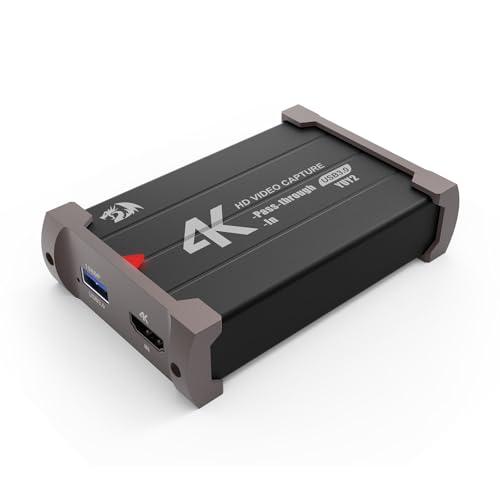
- 1080p60 video capture
- 4K HDMI pass-through
- Simultaneous audio and video capture
Best For: Console gaming and live streaming
Best Feature Set
4K60 HDMI Capture Card with Mic-In

- 4K60 HDMI loop-out
- 1080p60 capture
- 3.5mm microphone input
Best For: Feature-rich game streaming and commentary
Premium HDMI 2.1 Pick – Elgato 4K X
Among capture cards with HDMI, the Elgato 4K X stands out for next-generation consoles and high-refresh gaming. HDMI 2.1 input and output, VRR passthrough, and USB 3.2 Gen 2 connectivity support smooth, responsive capture and passthrough.
Best For: Gamers and streamers using PS5, Xbox Series X, or a high-refresh PC setup.
Pros:
- Supports 4K144 capture and passthrough.
- HDMI 2.1 supports up to 1080p240 capture.
- Includes VRR passthrough, HDR10, and ultra-low latency.
- Works with OBS, Streamlabs, Twitch Studio, Zoom, and more.
Cons:
- Requires compatible HDMI 2.1 hardware for its highest capabilities.
- USB 3.2 Gen 1 operation reduces capture resolution.
- System requirements include a relatively modern CPU, GPU, and operating system.
The 4K X is the most advanced option here for high-frame-rate gaming, although its feature set is best matched with a suitably equipped computer and display chain.
Professional Workhorse – Magewell USB Capture HDMI Gen 2
For buyers seeking dependable capture cards with HDMI, the Magewell USB Capture HDMI Gen 2 focuses on stable 1080p60 operation and broad computer compatibility. Its onboard processing handles several video adjustments without placing the full workload on the host computer.
Best For: Professional, educational, or production environments that need reliable HDMI capture for extended operation.
Pros:
- Captures HDMI video up to 1080p60, with input support up to 2048×1080 at 60fps.
- FPGA processing handles scaling, cropping, de-interlacing, and color conversion.
- Works with Windows, macOS, Linux, and Chrome OS.
- Compact design includes thermal protection, status LEDs, and a three-year warranty.
Cons:
- Limited to 1080p-class capture rather than 4K recording.
- Uses a USB Type-A connection.
- Requires a USB 3.1 interface for its stated operating requirements.
This is a practical choice when reliability, operating-system flexibility, and hardware-based processing matter more than ultra-high-resolution capture.
Camera-to-Webcam Choice – Elgato Cam Link 4K
The Elgato Cam Link 4K is a focused option among capture cards with HDMI for turning a compatible DSLR, mirrorless camera, camcorder, action camera, or iPhone into a computer camera. Its USB 3.0 connection supports sharp live video with low latency for streaming and conferencing.
Best For: Creators who want to use a dedicated camera for streaming, video calls, or live production.
Pros:
- Supports 1080p60 and up to 4K60 with compatible equipment.
- Works with DSLR, mirrorless, camcorder, action camera, and iPhone sources.
- Ultra-low latency helps keep video and audio synchronized.
- Compatible with OBS, Zoom, Discord, PC, Mac, and iPad.
Cons:
- Requires a compatible camera and HDMI output setup.
- Uses USB 3.0 rather than a newer USB standard.
- The supplied details list Windows as a system requirement while also identifying Mac and iPad compatibility.
Cam Link 4K makes sense for camera-first workflows, especially when image quality and a familiar webcam-style connection are more important than console-focused features.
Flexible Budget Option – UGREEN 4K HDMI Loop-Out Capture Card
For a flexible choice among capture cards with HDMI, the UGREEN 4K HDMI Loop-Out model combines 1080p60 or 2K30 recording with 4K30 input and loop-out. Its dual USB-A/USB-C interface and plug-and-play design suit console streaming, recording, and monitoring.
Best For: Gamers and casual creators who want loop-out monitoring, broad device support, and USB-A/USB-C flexibility.
Pros:
- Captures up to 2K30 or 1080p60 and accepts 4K30 input.
- 4K30 HDMI loop-out enables real-time, low-latency monitoring.
- Includes USB-A and USB-C connectivity with MJPEG and YUY2 support.
- Works with Windows, macOS, Linux, Android, and devices including Switch, PS5, Xbox Series X, and Meta Quest.
Cons:
- It does not support 4K capture; 4K is limited to input and loop-out at 30Hz.
- PS4 and PS5 require HDCP to be turned off.
- It is not compatible with Fire TV Stick, and iPhone cannot serve as a data-acquisition device.
The UGREEN offers a useful feature balance for everyday streaming, particularly if you need local HDMI passthrough and flexible USB connectivity rather than 4K recording.
Budget 4K-Input Starter – AXHDCAP USB 2.0 Capture Card
For shoppers comparing capture cards with hdmi, the Audio Express AXHDCAP is a straightforward option for recording HDMI sources through USB. It accepts up to 4K HDMI input at 30Hz and captures up to 1080p at 30Hz, with stereo audio and plug-and-play operation.
Best For: Beginners, teaching, video conferencing, and basic streaming setups using Windows, macOS, or Linux.
Pros:
- Supports HDMI input up to 3840×2160 at 30Hz.
- Captures video at up to 1920×1080 at 30Hz with stereo sound.
- Works with cameras, OBS, Twitch, YouTube, Zoom, VLC, and other listed platforms.
- Plug-and-play design requires no drivers or external power.
Cons:
- Uses USB 2.0, so it is not intended for USB 3.0 recording speeds.
- Maximum capture output is 1080p at 30Hz rather than 60Hz.
- It does not add HDMI output to a laptop or computer without HDMI out.
The AXHDCAP makes sense when ease of setup and broad software compatibility matter more than high-frame-rate capture. Its USB 2.0 connection and 30Hz capture ceiling make it less suitable for demanding gameplay recording.
High-Frame-Rate Gaming Pick – USB 3.0 HDMI Capture Card
If you need capture cards with hdmi for console streaming, this USB 3.0 model combines 4K 60Hz loop-out with 1080p 60fps or 2K 30fps capture. Its dual USB-A/USB-C connectivity and microphone input add flexibility for gaming, meetings, and live content.
Best For: Console gamers and streamers who want 4K passthrough, 1080p 60fps capture, and direct commentary input.
Pros:
- Supports 4K 60Hz HDMI input and 4K 60Hz loop-out.
- Captures up to 1080p at 60fps or 2K at 30fps through USB 3.0.
- Includes USB-A/USB-C connectivity and a 3.5mm mic-in for commentary.
- Compatible with major consoles, cameras, Windows, macOS, Linux, Android, and listed streaming software.
Cons:
- The microphone input does not record party chat.
- OBS may require a restart after audio setup to produce sound output.
- Its listed 2K capture mode is limited to 30fps.
This is the stronger fit for fast-moving gameplay among these options because it supports 1080p 60fps capture and 4K loop-out. The mic-in is useful for commentary, but party-chat recording limitations should be considered before purchase.
Branded Streaming Upgrade – Acer OCB5B0 HDMI Capture Card
Among capture cards with hdmi, the Acer OCB5B0 offers 4K input, 1080p at 60Hz output, and USB 3.0 connectivity in a compact plug-and-play design. YUY2 support, low-latency capture, and built-in mic-in make it suited to gaming, classes, calls, and creator workflows.
Best For: Gamers and creators who want a compact Acer-branded capture card with 1080p 60Hz output and direct microphone support.
Pros:
- Accepts 4K HDMI input and provides 1080p at 60Hz output.
- YUY2 support is positioned for richer colors than MJPEG.
- Includes mic-in for synced gaming commentary, classes, or vlog audio.
- Works with OBS, XSplit, VLC, YouTube, Facebook, consoles, cameras, PCs, macOS, and Android.
Cons:
- USB 3.0 is required for USB 3.0 operation.
- The listed capture resolutions are 1080p and 720p, so 4K is input rather than capture output.
- The supplied compatibility details emphasize Windows and Linux, while broader device support is described separately.
The OCB5B0 is a well-rounded choice when low-latency 1080p 60Hz output and a built-in microphone connection are priorities. It is especially practical for users who want simple setup across gaming, teaching, and streaming applications.
Best Budget USB-C Pick – Compact 1080p60 HDMI Capture Card
If you need capture cards with hdmi for basic streaming, recording, meetings, or online teaching, this compact USB 3.0 model offers 1080p at 60 fps and supports both USB-C and USB connections. It accepts up to 4K at 30Hz, but it is designed for capture rather than direct HDMI display output.
Best For: Portable streaming, game recording, video calls, and users who need flexible USB-C connectivity.
Pros:
- Captures up to 1080p at 60 fps and outputs up to 2K at 30Hz.
- Includes USB-C and USB 3.0 connection options.
- Plug-and-play design needs no additional drivers or external power.
- Works with Windows, macOS, Linux, Android, OBS, and major streaming platforms.
Cons:
- Does not directly cast to a monitor or TV.
- USB 3.0 is recommended for the best bandwidth and resolution.
- Audio setup in OBS may require restarting the software.
This is a practical, travel-friendly choice for straightforward HDMI capture. Its 1080p60 performance and broad software compatibility are useful, though the lack of direct display casting and the need for careful USB setup may matter to more demanding users.
Best for Console Streaming – Redragon VC321 4K Capture Card
Among capture cards with hdmi, the Redragon VC321 stands out for console-focused setups that benefit from 4K HDMI pass-through. It captures up to 1080p at 60 fps while allowing real-time gameplay through its advertised zero-latency pass-through feature.
Best For: Gamers and creators using PS5, Xbox, Switch, cameras, or DSLRs with Windows or Mac streaming systems.
Pros:
- Supports up to 4K 30 fps input and 1080p 60 fps capture.
- Provides zero-latency HDMI pass-through for real-time gameplay.
- Captures video and audio simultaneously.
- Works with Windows 7 and later, macOS 10.15 and newer, OBS, and multiple consoles.
Cons:
- Capture resolution is limited to 1080p.
- Compatibility details are specified for Windows and macOS rather than Linux or Android.
The VC321 is a strong fit when pass-through matters more than recording above Full HD. Its simple setup, console compatibility, and simultaneous audio-video capture make it a convenient option for live gameplay and streaming.
Best Feature Set – 4K60 HDMI Capture Card with Mic-In
For shoppers comparing capture cards with hdmi, this VIXLW model adds useful passthrough and audio features. It accepts 4K HDMI input at up to 60Hz, captures 1080p at 60 fps, and includes a 3.5mm microphone input for commentary during games or interviews.
Best For: Streamers who want 4K60 loop-out, Full HD capture, external microphone input, and broad console compatibility.
Pros:
- Supports 4K60 HDMI input and loop-out while capturing up to 1080p at 60 fps.
- Includes a 3.5mm microphone input for external commentary.
- Plug-and-play USB 3.0 design requires no driver or external power.
- Compatible with consoles, cameras, Windows, macOS, Linux, Android, OBS, and Streamlabs.
Cons:
- Does not support 4K120 or 4K144 input.
- The microphone input does not record party chats.
- Warranty coverage is listed as 60 days.
This is the most feature-rich option of the three for a streaming setup that needs HDMI loop-out and microphone support. It remains a 1080p capture device, so users seeking higher-resolution recordings should factor that limitation into their decision.
How We Picked the Best Capture Cards with Hdmi
We focused on Capture Cards with Hdmi that cover the most common streaming and recording setups, including game consoles, gaming PCs, DSLR and mirrorless cameras, camcorders, and action cameras. Our comparison considers advertised capture resolution, passthrough capabilities, interface speed, latency claims, audio support, compatibility, and overall usefulness for the price.
Specifications can vary by computer, HDMI source, application, and USB port. A card that supports 4K passthrough may capture at a lower resolution, while some models require USB 3.0 for their highest performance.
Quick Comparison
- Best for high-refresh gaming: Elgato 4K X, with HDMI 2.1 support and high-resolution passthrough.
- Best for camera input: Elgato Cam Link 4K, designed for compatible DSLR, camcorder, and action-camera sources.
- Best for professional reliability: Magewell USB Capture HDMI Gen 2, with a focused single-channel design and broad workflow compatibility.
- Best for affordable streaming: USB 3.0 models offering 1080p capture and 4K passthrough.
Key Buying Factors for Capture Cards with Hdmi
Capture Resolution and Frame Rate
Capture resolution is the quality sent to your recording or streaming software. For most live content, 1080p at 60 frames per second is a practical target. If you create higher-resolution recordings, check whether the card supports 1440p or 4K capture rather than only 4K passthrough.
Passthrough and Refresh Rate
Passthrough sends the HDMI signal to your monitor or TV while the card captures a copy. Look for 4K passthrough if you play at that resolution, and verify the supported refresh rate. Competitive gamers should pay close attention to 120Hz, 144Hz, or HDMI 2.1 support.
USB Connection and Latency
USB 3.0 or faster is generally preferable for high-quality capture. USB 2.0 models may work for basic streaming but can impose lower bandwidth limits. A low-latency preview is useful for monitoring, though playing through passthrough is usually better for responsive gameplay.
Audio and Compatibility
Confirm that the card handles your intended HDMI audio format and works with your operating system and streaming software. OBS Studio compatibility is common, but camera users should also check clean HDMI output, automatic sleep behavior, and whether overlays or menus appear in the feed.
Who Should Buy Which Capture Cards with Hdmi?
Choose a premium HDMI 2.1 model if you own a current-generation console or high-refresh gaming display and want to preserve advanced passthrough features. Pick a camera-focused device if your main goal is live video from a DSLR, camcorder, or action camera. A professional USB capture unit is worthwhile for dependable production work and broader device compatibility.
For casual streaming, tutorials, and console recording, a USB 3.0 card with 1080p60 capture and 4K passthrough is often the best balance. Budget models can be effective, but verify the real capture resolution, included cables, cooling, warranty, and return policy before buying.