The medieval church shaped politics, culture, learning, worship, and daily life across Europe for centuries. The best books on the medieval church help you understand that world without getting lost in dates and jargon.
Whether you want a broad survey, a focused academic study, or a book that explains lived religion on the ground, this roundup highlights strong options for different reading goals.
Best 10 Books on the Medieval Church Picks for 2026
Broad Medieval Christianity Survey
Medieval Christianity: A New History

- Covers medieval Christianity from 500 to 1500 CE
- Adds women, parish life, art, and interfaith context
- Includes 40+ photographs of physical remains
Best For: Readers wanting a broad, updated survey of the medieval church
Major Christendom Reinterpretation
Christendom: The Triumph of a Religion, AD 300-1300

- Tracks Christianity’s rise from Constantine to medieval Europe
- Explains the growth of papal and institutional authority
- A large, reinterpretive history from a leading scholar
Best For: Readers seeking a sweeping history of Christendom’s rise and power
Accessible Church History Overview
The Medieval Church: From the Dawn of the Middle Ages to the Eve of the Reformation

- Accessible 260-page overview of medieval church history
- Covers worship, doctrine, mysticism, and church-state relations
- Emphasizes the church’s impact on modern Europe
Best For: Readers wanting a concise, approachable introduction to the medieval church
Material Devotion in Late Medieval Europe

- Studies relics, images, pilgrimage, and Eucharistic objects
- Covers the late medieval period, 1150 to 1550
- Explains tensions between outward devotion and inward piety
Best For: Readers focused on late medieval devotional objects and sacred art
Medieval Church History Reframed
The Church and the Middle Ages
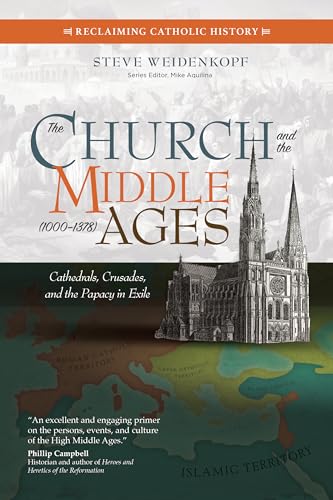
- Reclaims the Middle Ages from the usual negative stereotypes.
- Covers crusades, the papacy in exile, and Christian civilization.
- Compact 192-page overview with Catholic historical focus.
Best For: Readers who want a Catholic-leaning, myth-correcting introduction to the medieval Church.
Parish Life and Worship
Going to Church in Medieval England

- Focuses on parish churches and everyday worship in England.
- Shows how churches shaped life events and seasonal observance.
- Richly illustrated and deeply researched, but very England-specific.
Best For: Readers who want a richly detailed study of parish churches, worship, and daily religious life in medieval England.
Broad Survey of the Western Church
A History of the Church in the Middle Ages

- Covers the Western Church from early conversion to the New World.
- Highlights Latin worship and the Church’s unifying role in Europe.
- Readable scholarly survey with updated scholarship.
Best For: Readers who want a readable scholarly overview of the Western Church across the entire Middle Ages.
Classic Survey
A History of the Medieval Church

- Covers Gregory the Great to the Reformation
- 292 pages in a compact survey format
- Good starting point for medieval church history
Best For: Readers who want a concise, classic overview of medieval church history.
Major Scholarly Overview
Western Society and the Church in the Middle Ages

- Covers the eighth through sixteenth centuries
- Links church history with medieval society
- Includes papacy, bishops, and religious orders
Best For: Readers who want a substantial, society-focused history of the medieval church.
Reissued Classic Reference
A History Of The Medieval Church 590-1500
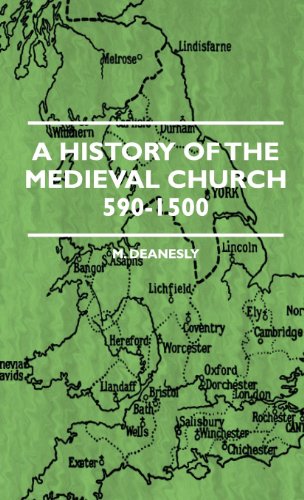
- Covers 590 to 1500 with detailed themes
- Includes clergy, missions, crusades, and heresy
- Reprint of a scarce 1925 classic
Best For: Readers who want a detailed, topic-rich reprint of an older medieval church history.
Broad Medieval Christianity Survey – Medieval Christianity: A New History
If you want books on the medieval church that go well beyond a simple doctrinal timeline, this wide-ranging history is a strong place to start. It covers the full sweep of medieval Christianity from 500 to 1500 CE while bringing in women, ordinary parishioners, Christians’ relations with Jews and Muslims, pilgrimage, worship, art, architecture, heresy, papal power, and the break with reformers.
Best For: Readers who want a full-picture medieval church history with attention to social, devotional, and cultural life.
Pros:
- Spans the entire medieval period from 500 to 1500 CE
- Includes fresh emphasis on women and everyday parish life
- Connects theology with art, architecture, drama, and pilgrimage
- Uses more than forty photographs of physical remains
Cons:
- Broad scope may feel less focused than a narrower church study
- Best suited to readers comfortable with an academic narrative history
This is a practical choice if you want one volume that integrates the medieval church’s institutions with lived religion and material culture. Its main strength is how it ties familiar church history themes to newer questions about gender, interfaith relations, and ordinary devotion.
Major Christendom Reinterpretation – Christendom: The Triumph of a Religion, AD 300-1300
Among books on the medieval church, this is the one to choose if you want a big-picture argument about how Christianity became a dominant European power. It traces the rise of Christendom from Constantine through the post-Roman crisis and the eleventh-century transformation, explaining how the church developed from scattered congregations into a centralized institution with authority across medieval Europe.
Best For: Readers who want a large-scale reinterpretation of how medieval Christendom rose and organized power.
Pros:
- Offers a major reinterpretation of Christendom’s rise
- Connects late antiquity, the post-Roman world, and the high Middle Ages
- Explains the growth of papal power and institutional authority
- Filled with new insights and written by a leading medieval historian
Cons:
- Lengthy at 752 pages
- Focuses more on large institutions than on devotional or parish-level detail
This book is especially useful if you want the medieval church framed as a transforming political and religious system rather than a simple chronology. Its strength is in showing how Christendom adapted over time to survive, expand, and govern.
Accessible Church History Overview – The Medieval Church: From the Dawn of the Middle Ages to the Eve of the Reformation
The Medieval Church: From the Dawn of the Middle Ages to the Eve of the Reformation
Check Price On AmazonIf you want books on the medieval church that are straightforward and readable, this compact overview fits the bill. It surveys evangelization, worship, piety, church-state relations, doctrinal development, mysticism, and the medieval church’s long influence on modern beliefs and practice.
Best For: Readers who want an accessible introduction to medieval church history and its lasting impact.
Pros:
- Written in an easily accessible style
- Explains worship, piety, doctrine, and mysticism
- Highlights the church’s influence on modern Europe and practice
- Provides a concise 260-page introduction
Cons:
- Older publication date may feel dated to some readers
- Much shorter and less expansive than larger survey histories
This is a solid choice if you want a clear, compact foundation before moving to more specialized studies. It works well as a general guide to the medieval church’s beliefs, conflicts, and legacy.
Material Devotion in Late Medieval Europe – Christian Materiality
Christian Materiality: An Essay on Religion in Late Medieval Europe (Zone Books)
Check Price On AmazonFor readers comparing books on the medieval church, this title stands out if you want a deeper look at devotion, objects, and religious practice in late medieval Europe. It examines pilgrimage, relics, images, Eucharistic wafers, and other material objects that were believed to move, bleed, weep, or walk, while also exploring the growing tension between outward devotion and inward piety.
Best For: Readers interested in late medieval devotion, relics, sacred art, and material culture.
Pros:
- Focuses on 1150 to 1550, a crucial late medieval period
- Strong treatment of relics, images, pilgrimage, and Eucharistic devotion
- Connects church practice to changing ideas about matter and the body
- Offers a major analysis of religious art and iconoclasm
Cons:
- More specialized than a general church history
- Best suited to readers already interested in material culture and late medieval debates
This is the most focused option here for understanding how medieval Christians encountered the sacred through objects and art. It is especially valuable if you want a book that explains the background to later Protestant and Catholic reformations through late medieval religious practice.
Medieval Church History Reframed – The Church and the Middle Ages
If you want books on the medieval church that push back against the usual “dark ages” narrative, this title offers a clear, readable defense of the Church’s role from 1000 to 1378. Steve Weidenkopf focuses on crusades, the Avignon papacy, universities, cathedrals, and religious orders, making it useful for readers who want a concise overview grounded in Catholic history.
Best For: Readers who want a Catholic-leaning, myth-correcting introduction to the medieval Church.
Pros:
- Explains the Middle Ages as a period of faith, unity, and achievement.
- Covers major themes like the Crusades, the papacy in exile, and Christian civilization.
- Includes stories of figures such as St. Bruno, St. Anthony of Padua, and St. Bridget of Sweden.
- Short length makes it approachable at 192 pages.
Cons:
- Focused on a Catholic interpretation, so it may not suit readers seeking a neutral survey.
- Its scope is narrower than a full millennium-long church history.
This is a strong pick if you want a compact, argument-driven entry in books on the medieval church. It is especially helpful for readers interested in how medieval Christianity shaped institutions and culture.
Parish Life and Worship – Going to Church in Medieval England
Among books on the medieval church, this one stands out for its practical focus on how parish religion actually worked in England. Nicholas Orme looks closely at who attended church, how people behaved, how services changed through the year, and how churches shaped everyday life from the Anglo-Saxon era to the mid-sixteenth century.
Best For: Readers who want a richly detailed study of parish churches, worship, and daily religious life in medieval England.
Pros:
- Detailed look at parish churches as centers of religious and social life.
- Covers church attendance, behavior, and the staging of worship.
- Explains seasonal observances and life events such as birth, marriage, sickness, and death.
- Includes a final chapter on the English Reformation and continuity with the past.
Cons:
- Highly specific to England, so it is less useful for broader European church history.
- At 496 pages, it is a substantial read.
This is the best choice if you want a grounded, research-rich look at how medieval church life functioned at the parish level. It balances institutions, ritual, and ordinary experience in a way that makes the medieval church feel concrete.
Broad Survey of the Western Church – A History of the Church in the Middle Ages
If you need books on the medieval church that cover the big picture, F. Donald Logan’s survey is a strong academic choice. It traces the Western Church from the conversion of Celtic and Germanic peoples through the discovery of the New World, showing how shared liturgy, Latin, and church institutions unified medieval Europe.
Best For: Readers who want a readable scholarly overview of the Western Church across the entire Middle Ages.
Pros:
- Spans a millennium of church history in a single readable volume.
- Explains the Church’s unifying role in Western Europe.
- Moves from rural parishes to urban cathedrals with clear organization.
- Updated edition includes newer scholarship and expanded coverage of Judaism and Islam.
Cons:
- Its sweeping scope may feel less detailed than specialized studies.
- Best suited to readers comfortable with a more academic approach.
This book is a solid all-purpose option for readers who want a broad, well-organized foundation in medieval church history. It works especially well as a survey before moving into narrower topics.
Classic Survey – A History of the Medieval Church
If you want books on the medieval church that give you a clear, broad historical arc, this classic survey is a strong starting point. It follows the church from Gregory the Great to the Reformation, making it useful for readers who want a single-volume overview of the period.
Best For: Readers who want a concise, classic overview of medieval church history from late antiquity into the Reformation.
Pros:
- Covers the church from Gregory the Great to the Reformation.
- Compact 292-page format makes it approachable.
- A long-standing Routledge edition with a focused historical scope.
- Useful as a foundation before moving to more specialized studies.
Cons:
- First published in 1969, so the perspective is older.
- Not the most detailed option for readers seeking extensive specialization.
- Paperback-size format may feel brief for deep research needs.
This is a practical pick if you want an established overview rather than a heavily specialized monograph. It works best as a survey text and a reference point for the major turning points in medieval church history.
Major Scholarly Overview – Western Society and the Church in the Middle Ages
Western Society and the Church in the Middle Ages (The Penguin History of the Church) (v. 2)
Check Price On AmazonFor buyers comparing books on the medieval church, this Penguin volume stands out for tying church history directly to medieval society. It covers the eighth through the sixteenth century and adds useful attention to the Papacy, Constantinople, bishops, archbishops, and religious orders.
Best For: Readers who want a substantial, society-focused history of the medieval church across the long Middle Ages.
Pros:
- Covers the period from the eighth to the sixteenth century.
- Connects the church closely with medieval society and politics.
- Includes detailed discussion of the Papacy, bishops, archbishops, and religious orders.
- 376 pages offers a fuller treatment than a brief survey.
Cons:
- Best suited to readers comfortable with an academic, interpretive approach.
- Focuses on the West, so it may not serve as a universal church history.
- Part of a series, which may make it less self-contained than some standalone titles.
This is a strong choice if you want a more analytical book that places the medieval church inside the wider social order. It is especially appealing for readers who want both institutional history and broader context in one volume.
Reissued Classic Reference – A History Of The Medieval Church 590-1500
If you are looking for books on the medieval church with strong topical coverage, this reissued classic offers a detailed contents list that spans major themes from Gregory the Great through the Conciliar Movement. It also emphasizes both social and personal aspects of church history, which can be useful if you want a broader historical lens.
Best For: Readers who want a detailed, topic-rich reprint of an older medieval church history.
Pros:
- Tracks major themes from 590 to 1500.
- Detailed contents include clergy, missions, papal power, crusades, and heresy.
- Includes two maps, adding helpful visual context.
- Reissued as an affordable modern edition of a scarce classic.
Cons:
- Originally published in 1925, so the scholarship is dated.
- Digital edition may not suit readers who prefer a print reference copy.
- Best for topic coverage rather than a modern interpretive framework.
This edition is most attractive if you want a broad, chapter-by-chapter map of medieval church topics in one place. It is a practical choice for readers who value classic structure and wide thematic coverage over recent scholarship.
How We Picked These Books on the Medieval Church
We prioritized books that are well-regarded for historical accuracy, clarity, and usefulness to different kinds of readers. That means looking for reliable coverage of major themes such as church structure, papal power, monastic life, reform, liturgy, crusading, and the relationship between Christianity and medieval society.
We also favored a mix of accessibility levels. Some readers want a broad introduction; others need a more academic monograph or a detailed reference work. The best Books on the Medieval Church should serve both purposes depending on your background and purpose.
Quick Comparison: What Kind of Reader Each Book Fits
Broad histories are the safest choice if you want an overview of the entire medieval period. More specialized titles work better if you are studying worship, material culture, church institutions, or a specific region such as England. If you are building a reading list for coursework or research, pairing one survey text with one narrower study is often the smartest approach.
Key Buying Factors for Books on the Medieval Church
Scope
Check whether the book covers the early, high, and late Middle Ages, or only a narrower window. Some titles focus on the entire medieval church, while others concentrate on a specific era or theme.
Depth Versus Readability
General readers usually do best with clear narrative histories. Students and researchers may prefer books with denser argumentation, notes, and bibliographies.
Geographic Focus
Not every book on the medieval church treats Europe the same way. Some emphasize western Christendom as a whole, while others focus on England or on papal institutions. Choose the lens that matches your interest.
Topic Focus
If you care about architecture, pilgrimage, ritual, or everyday devotion, look for books that address material and devotional practice rather than only church politics. That difference matters a lot in Books on the Medieval Church.
Who Should Buy Which Books on the Medieval Church?
If you want a strong general introduction, choose a broad survey with a balanced structure and readable prose. If you are an advanced student or scholar, a more specialized academic title will usually offer better insight into debate and evidence. Readers interested in church life as experienced by ordinary people should look for books centered on worship, practice, and material religion rather than institutional history alone.
In short, the right pick depends on whether you want overview, specialization, or a bridge between the two. Start with your reading goal, then match the book’s scope and style to it.