Clear, consistent speech is one of the foundations of a polished podcast. The right compressor can tame sudden volume changes, improve intelligibility, and help voices sit comfortably in a mix without sounding flattened or unnatural.
This roundup covers 10 audio compressors for podcasting, from dedicated rack processors and channel strips to podcast mixers and USB interfaces with built-in dynamics. Use the buying guide below to match the right format, controls, and workflow to your recording setup.
Best 10 Audio Compressors for Podcasting Picks for 2026
Studio Dynamics Control

- Two-channel VCA compression
- Built-in noise gate and LED metering
- XLR/TRS I/O with sidechain insert
Best For: Rack-based podcast and streaming setups
All-in-One Podcast Production

- Four mic inputs with studio-grade preamps
- APHEX processing and programmable sound pads
- Records to microSD or computer via USB
Best For: Multi-mic podcasts and live production
Clean Front-End Gain

- Up to 60 dB of low-noise gain
- Variable-frequency low-cut filter
- 500 Series module with EQ and pad
Best For: Modular studios needing pre-compression signal control
Vocal Control and De-Essing

- Two-channel compressor, limiter, and gate
- Integrated de-esser for vocal processing
- Designed for production, mixing, and mastering
Best For: Hardware podcast vocal chains needing de-essing
Flexible Podcast Interface

- Two XMAX-L mic preamps with phantom power
- Stereo loopback and Stream Mix routing
- Presets, effects, and reverb for streaming
Best For: Computer-based podcasts and streaming setups
Compact Analog Compression

- Compact studio-compressor pedal format
- Ten LEDs show gain reduction
- True bypass and analog signal format
Best For: Hardware recording chains needing pedal-format compression
Portable Multiguest Recorder

- Four XLR inputs with phantom power
- Four headphone outputs with individual volume
- Mix-minus for phone and remote interviews
Best For: Portable multihost and interview podcast recording
Tube Tone Control
- Tube preamp, compressor, and EQ in one channel
- Selectable optical or tube compression
- Selectable VU metering and flexible analog connections
Best For: Podcasters wanting integrated tube-based voice processing
Rackmount Dynamics Guard

- Dual-channel compression and peak limiting
- Built-in noise gate and feedback suppression
- XLR/TRS connectivity for studio or live routing
Best For: Hybrid podcast, streaming, and live audio setups
Vocal Presence Processor
Dual-Channel Rackmount Compressor

- VCA compression with OverEasy behavior
- Noise gate, LED metering, and sidechain insert
- Dual-channel XLR/TRS rackmount design
Best For: Detailed vocal processing in studio or broadcast-style podcast rigs
Studio Dynamics Control – Dual-Channel Audio Compressor
For creators comparing audio compressors for podcasting, this 1U rackmount processor offers two channels for shaping microphones and other sources. Its VCA circuitry, automatic attack and release settings, noise gate, and visual metering provide practical control for studio, streaming, and live setups.
Best For: Podcasters using XLR/TRS rack equipment who want independent dynamics control for multiple sources.
Pros:
- Dual-channel design supports separate processing for multiple sources.
- Built-in noise gate can help reduce unwanted background noise.
- Sidechain insert, LED monitoring, and XLR/TRS connectivity support flexible routing.
Cons:
- Its 1U rackmount format may be more equipment than a simple solo podcast setup needs.
- It requires corded power and external microphones or other audio gear.
This is a versatile choice when a podcasting rig needs hardware-based compression, gating, and routing options rather than a compact software-only workflow.
All-in-One Podcast Production – RØDECaster Pro
The RØDECaster Pro is more than one of the audio compressors for podcasting: it is an integrated production console with onboard processing. Four microphone inputs, remote-guest connectivity, sound pads, and APHEX effects make it suited to podcasts that need recording and broadcast-style control in one unit.
Best For: Beginners and professionals producing multi-mic podcasts, live streams, or shows with remote guests and sound effects.
Pros:
- Four microphone inputs include studio-grade preamps.
- USB, smartphone, and Bluetooth channels support remote integrations.
- Onboard APHEX processing, one-touch recording, and programmable sound pads streamline production.
Cons:
- It is an all-in-one production console rather than a dedicated standalone compressor.
- The first-generation unit is larger and heavier than a minimal desktop interface.
Choose this when workflow convenience matters as much as compression-style processing. Its broad feature set can reduce the need for several separate podcasting devices.
Clean Front-End Gain – DBX 580 Mic Preamp
The DBX 580 is a compact 500 Series microphone preamp for podcasters building a modular signal chain. While it is not a compressor itself, its low-noise gain, low-cut filter, equalization, pad, and polarity controls can help prepare a microphone signal before it reaches dedicated audio compressors for podcasting.
Best For: Podcasters with a compatible 500 Series chassis who need flexible, low-noise microphone preamplification.
Pros:
- Provides up to 60 dB of microphone gain.
- Variable-frequency low-cut filtering helps manage low-end content.
- Includes low and high detail EQ, a 20 dB pad, and polarity invert.
Cons:
- It does not provide compression, limiting, or de-essing.
- A 500 Series chassis is required for use.
This is best viewed as a front-end companion to a compressor, not a replacement for one. It suits modular podcast studios where signal preparation and clean gain are priorities.
Vocal Control and De-Essing – Composer Pro-XL MDX2600
The Behringer Composer Pro-XL MDX2600 combines two-channel compression, limiting, gating, and de-essing in a single processor. For buyers evaluating audio compressors for podcasting, that combination is useful when spoken-word tracks need dynamics control alongside tools for managing sibilance and unwanted noise.
Best For: Podcast studios seeking two-channel compression with integrated de-essing and gating for vocal production.
Pros:
- Combines a compressor, limiter, and gate across two channels.
- Integrated de-esser is useful for spoken-word vocal processing.
- Rack-style hardware is designed for audio production, mixing, and mastering.
Cons:
- The supplied notes provide limited control and connectivity details.
- It is corded hardware rather than a portable or software-based solution.
Its strongest advantage for podcasting is the combination of vocal dynamics processing and de-essing. It is a practical fit for a hardware-based rack chain where several corrective functions are preferred in one unit.
Flexible Podcast Interface – PreSonus Revelator io24
The PreSonus Revelator io24 is a flexible choice for podcasters who want audio compressors for podcasting alongside microphone preamps, effects, and routing tools. Its two XMAX mic preamps support professional XLR microphones, while the integrated mixer handles loopback audio and streaming workflows.
Best For: Podcasters and streamers who need XLR microphone support, effects, and flexible computer-audio routing.
Pros:
- Two XMAX-L mic preamps with +48V phantom power support professional XLR microphones.
- Two stereo loopback streams can mix audio from Zoom, Skype, backing tracks, and more.
- Stream Mix mode combines hardware inputs, effects, loopback audio, and reverb for streaming.
- Includes presets plus the ability to create, save, and share custom settings.
Cons:
- Its two-channel design may be limiting for larger, multi-microphone productions.
- It is an audio interface and mixer rather than a dedicated standalone recorder.
Choose the Revelator io24 if your podcast setup centers on a computer and benefits from integrated effects and loopback mixing. It is especially practical for live streams, remote calls, and flexible studio-style routing.
Compact Analog Compression – MXR Studio Compressor
The MXR Studio Compressor brings studio-style compression to a compact pedal format. For creators comparing audio compressors for podcasting, its analog signal path, gain-reduction LEDs, and constant-headroom design may suit a compatible hardware signal chain, though it uses a 1/4-inch audio interface rather than USB.
Best For: Hardware-based audio users who want a compact analog compressor with visual gain-reduction monitoring.
Pros:
- Studio compressor design in a compact Phase 90-sized pedal enclosure.
- Constant Headroom Technology is designed for clear, clean performance.
- Ten gain-reduction status LEDs provide visual feedback during operation.
- True bypass preserves the signal path when the effect is disengaged.
Cons:
- It is not a USB audio interface or standalone podcast recorder.
- Its 1/4-inch analog connection requires compatible external equipment and cabling.
- The supplied notes do not identify dedicated voice-podcast controls or presets.
The MXR is best considered a specialized hardware compressor rather than an all-in-one podcast solution. It makes the most sense when you already use an analog recording chain and want compact compression with clear status indication.
Portable Multiguest Recorder – Zoom PodTrak P4
The Zoom PodTrak P4 is built for podcast production with four XLR microphone inputs, four individually controlled headphone outputs, and phone or USB connectivity. While it is not described as a dedicated compressor, it is a practical companion for creators evaluating audio compressors for podcasting who also need portable recording and multiguest support.
Best For: Multihost podcasts, in-person interviews, and remote call-in productions requiring several microphones and headphone feeds.
Pros:
- Four microphone inputs include phantom power for compatible microphones.
- Four headphone outputs provide individual volume control.
- Automatic mix-minus supports phone and remote interviews through TRRS and USB.
- Four programmable Sound Pads and multitrack recording add production flexibility.
Cons:
- Battery operation lasts up to 3.5 hours on two AA batteries.
- It does not replace a dedicated compressor when compression-specific processing is required.
- Its built-in storage specification may be more than some simple podcast workflows need.
The PodTrak P4 is a strong choice when recording logistics matter more than studio processing. Its multiple inputs, headphone feeds, mix-minus support, and battery operation make it well suited to interviews and group shows on the move.
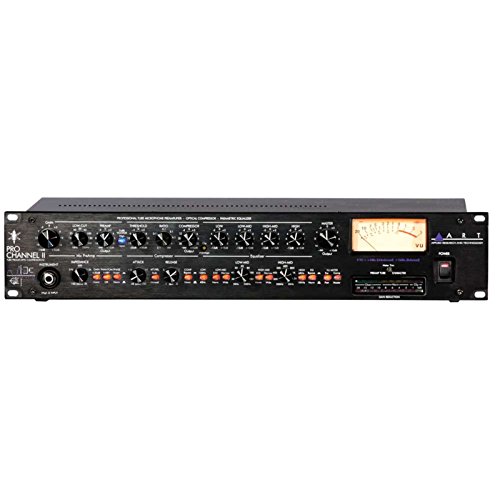
Tube Tone Control – ART Pro Channel II
ART Pro Channel II Microphone Preamp/Compressor/EQ Professional Tube Based Selectable VU Metering
Check Price On AmazonFor podcasters who want more than basic dynamics control, the ART Pro Channel II combines a tube microphone preamp, selectable optical/tube compressor, and tube EQ in one channel. Its warm, smooth character and selectable VU metering make it a practical front end for shaping spoken-word recordings before they reach your interface.
Best For: Podcasters seeking an all-in-one tube preamp, compressor, and EQ channel for voice recording or streaming.
Pros:
- Combines microphone preamp, compressor, and EQ modules in one unit.
- Offers selectable optical or tube compression.
- Provides selectable VU metering for mic pre, compressor, or main output.
- Uses XLR, 1/4-inch TRS, and 1/4-inch TS connectivity.
Cons:
- Provides one channel, so it is not suited to dual-microphone processing without additional equipment.
- Its 13.4-pound, 22.3-inch-wide chassis is less compact than a software or desktop solution.
The Pro Channel II is a strong choice when you want hands-on control and integrated tone shaping for a podcast microphone. It is best suited to a more permanent recording setup rather than a highly portable rig.
Rackmount Dynamics Guard – Dual-Channel Audio Compressor
This dual-channel rackmount processor is aimed at users who need consistent vocal levels and protection against overload. Along with compression and peak limiting, it includes a noise gate, feedback suppression, DSP reverb processing, and XLR/TRS connectivity, making it one of the more feature-heavy audio compressors for podcasting and live speech setups.
Best For: Studio, streaming, or live podcast environments that need two-channel dynamics control and built-in noise management.
Pros:
- Provides dual-channel compression and limiting for consistent output.
- Includes a noise gate to help reduce unwanted background sound.
- Offers feedback suppression, anti-howling processing, electronic crossover, and DSP reverb.
- Uses XLR and 1/4-inch TRS inputs and outputs for flexible routing.
Cons:
- The supplied notes do not specify detailed attack, release, or ratio controls.
- Its broad stage- and venue-oriented feature set may be more than a simple one-microphone podcast requires.
This unit makes sense when a podcast setup also handles live events, multiple sources, or challenging acoustic environments. For straightforward studio speech, its additional processing may require more setup than a dedicated vocal compressor.
Vocal Presence Processor – Dual-Channel Rackmount Compressor
Designed with vocal applications in mind, this dual-channel rackmount compressor combines VCA dynamics control, OverEasy compression, a noise gate, LED metering, and a sidechain insert. For audio compressors for podcasting, its adjustable attack and release controls can help keep speech level and controlled while retaining a natural transition into gain reduction.
Best For: Podcasters, voiceover creators, and streamers who want detailed vocal compression with clear metering and rack integration.
Pros:
- Provides two channels with adjustable attack and release controls.
- OverEasy compression is designed for a smoother, more natural transition into gain reduction.
- Includes a noise gate and LED indicators for compression and gate setup.
- Offers XLR/TRS connections and a sidechain insert for frequency-based control.
Cons:
- Its 19-inch rackmount format is less convenient for portable podcasting.
- The sidechain features may be unnecessary for users seeking only basic speech leveling.
This is the most directly voice-focused option of the three, particularly if you value adjustable dynamics, visual feedback, and two-channel flexibility. It is a better fit for a dedicated studio or broadcast-style rack than a minimal desktop setup.
How We Picked the Best Audio Compressors for Podcasting
We focused on products that can realistically support spoken-word recording, whether used for a single-host desk, a multi-microphone studio, live streaming, or remote interviews. The selection includes dedicated compressors, preamp-and-compressor channel strips, podcast production consoles, and interfaces with integrated processing.
We considered the controls available for voice work, input and output connectivity, channel count, monitoring options, portability, and ease of integration with common podcast setups. Because these products serve different roles, the best choice depends on whether you need hardware dynamics, recording connectivity, or an all-in-one production workflow.
Quick Comparison
- Dedicated rack compressors: Best for mixers, studio preamps, and permanent multi-mic installations.
- Channel strips: Useful when you want microphone preamplification, compression, and tone shaping in one unit.
- Podcast consoles and recorders: Better for multiple guests, headphone monitoring, remote calls, and sound pads.
- USB audio interfaces: A practical choice for computer-based recording, streaming, and compact desktop setups.
- Single-channel pedals or compact processors: Suitable for targeted vocal or instrument processing when space and simplicity matter.
Key Buying Factors for Audio Compressors for Podcasting
Compressor Controls
Look for threshold, ratio, attack, release, and makeup gain controls if you want detailed control. A soft-knee option, automatic timing, or simple preset-style controls can be more approachable for beginners. For natural speech, moderate compression is usually preferable to aggressive leveling.
Inputs, Outputs, and Connectivity
Check whether the unit accepts microphone-level, line-level, XLR, or TRS connections. A rack compressor may require a separate preamp or mixer, while a USB interface can connect directly to a computer. Podcast consoles and recorders may also add phone, Bluetooth, USB, or remote-call inputs.
Channel Count and Routing
One channel can be enough for a solo host, but two or more channels are valuable for interviews and co-hosted shows. Sidechain inserts, loopback routing, independent headphone outputs, and mix-minus features can matter more than extra processing controls in a multi-person workflow.
Noise Management and Headroom
Noise gates, de-essers, peak limiters, and clean preamps can help maintain usable speech levels. These features should complement good microphone technique rather than compensate for excessive room noise or poor gain staging.
Who Should Buy Which Audio Compressors for Podcasting?
Choose a dedicated dual-channel compressor if you already own a mixer or interface and need consistent hardware control for multiple microphones. Choose a channel strip if you want preamp gain, compression, and EQ in one signal path. Choose a podcast recorder or production console for guest-heavy shows, standalone recording, multiple headphones, remote interviews, or live sound effects.
Choose a USB interface with integrated effects for a compact computer-based studio or streaming setup. A smaller standalone compressor can suit creators who want simple vocal leveling without replacing their existing interface. Before buying, confirm the required connections, available rack or desk space, and whether you want compression recorded into the signal or applied later in software.