Wireless video transmitters can simplify live production by moving camera feeds to an encoder, switcher, monitor, or streaming computer without long cable runs. The right system depends on your resolution, range, latency, connection type, and receiver requirements.
We selected 10 options covering affordable plug-and-play HDMI kits, UVC streaming transmitters, camera-focused systems, and professional HDMI/SDI workflows. Use the guide below to match the features to your setup before buying.
Best 10 Video Transmitters for Live Streaming Picks for 2026
Best Professional Streaming Pick

- Dual-band 1,200-foot transmission
- UVC output for computer streaming
- Supports up to four receiving devices
Best For: Professional events and multi-person production monitoring
Best Multi-Screen HDMI Value

- Supports up to six receiving screens
- 165-foot open-area transmission range
- Includes HDMI and USB-C adapters
Best For: Classrooms, venues, offices, and home theaters
Best 4K Production System
Hollyland Pyro H Wireless HDMI

- 4K30 and 1080p60 HDMI transmission
- Up to 1,300 feet with 60ms latency
- UVC streaming and support for four receivers
Best For: Film production and professional live broadcasting
Best Plug-and-Play Display Kit
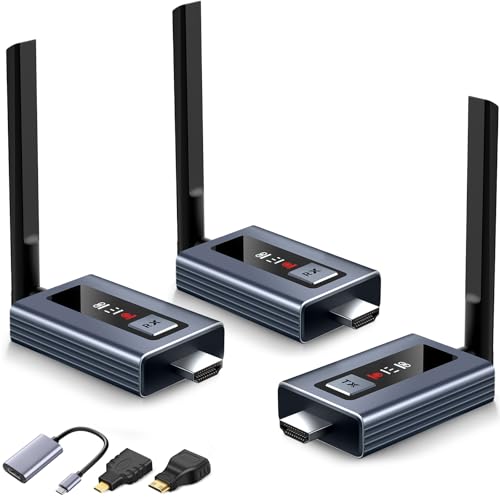
- Five-second plug-and-play setup
- LED status and signal display
- Supports up to six 1080p screens
Best For: Presentations, classrooms, venues, and simple camera displays
Direct-Stream Production Pick

- 400-foot LOS range with 0.08-second latency
- RTSP output for OBS, vMix, and VLC
- SDI/HDMI inputs with flexible power options
Best For: Live productions needing direct streaming and multi-device monitoring
Pocket 3 Creator Pick
Wireless HDMI/UVC Transmitter Kit

- Direct USB-C connection for DJI Osmo Pocket 3
- UVC and HDMI outputs for streaming or monitoring
- 1,640-foot LOS range with 0.05-second latency
Best For: Pocket 3 creators and mobile streaming setups
Multi-Viewer Monitoring Pick
Wireless HDMI Kit With 7-Inch Monitor
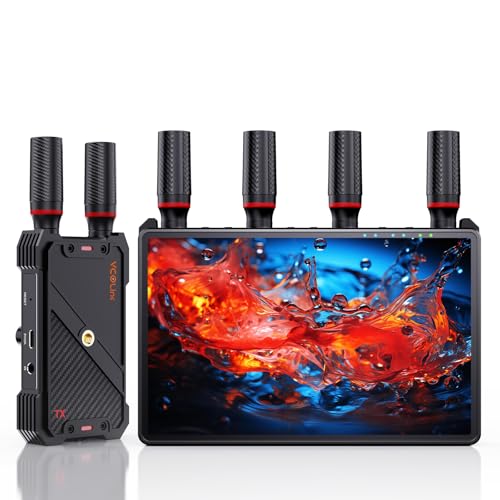
- Built-in 7-inch receiver monitor
- One transmitter supports up to five receivers
- 1,312-foot LOS range with under 0.05-second latency
Best For: Crews and live events needing shared camera monitoring
Best Plug-and-Play Pick
Long-Range UVC HDMI Transmitter

- UVC output needs no capture card or drivers
- 1080p60 transmission with under 50 ms latency
- HDMI loop-out and up to five receivers
Best For: Simple camera-to-computer live streaming
Best for Osmo Pocket 3
Pocket 3 Wireless Streaming System

- Built-in Type-C transmitter connection
- 1080p60 UVC output for computer streaming
- 20 channels and LCD status display
Best For: DJI Osmo Pocket 3 live broadcasts
Best Professional Upgrade
Hollyland Pyro Ultra 4K60 System

- 4K60 HDMI with HDMI and SDI connectivity
- Supports up to 20 receivers in Broadcast Mode
- UVC capture and RTMP streaming built in
Best For: Professional film and live-production workflows
Best Professional Streaming Pick – Accsoon CineView HE
For demanding video transmitters for live streaming, the Accsoon CineView HE combines dual-band stability, low latency, and a useful UVC output. It supports 1080p60 transmission, reaches up to 1,200 feet, and can send one feed to as many as four receivers or mobile devices.
Best For: Professional live streams, event production, weddings, and multi-person on-set monitoring.
Pros:
- 2.4GHz and 5GHz dual-band transmission helps resist interference.
- UVC output enables computer streaming through platforms such as OBS without a separate capture device.
- HDMI loop-out, multiple power options, and up to 12 hours of operation with an NP-F970 battery.
Cons:
- Battery and charging cables are not included.
- UVC streaming requires a user-provided USB-C cable.
The CineView HE is a strong choice when reliable wireless monitoring and direct computer streaming matter more than a basic plug-and-play setup. Its professional connectivity and multi-device support make it especially practical for production crews.
Best Multi-Screen HDMI Value – Wireless HDMI 2RX Kit
This wireless HDMI kit is a flexible option for video transmitters for live streaming when the main goal is sending one source to multiple displays. It uses 2.4GHz and 5.8GHz transmission, supports up to six receivers, and offers a stated range of up to 165 feet in open environments.
Best For: Churches, classrooms, conference rooms, restaurants, home theaters, and multi-screen presentations.
Pros:
- Can expand from the included two receivers to as many as six screens.
- Supports HDMI and USB-C source connections with included adapters.
- Plug-and-play design with dual-band transmission and dual antennas.
Cons:
- Range may fall to about 50 feet through walls.
- It cannot transmit from one TV to another.
- The phone app does not currently control laptops or iPads as transmitters.
This system is better suited to distributing content around a venue than to advanced camera-production workflows. Its expandable receiver design makes it useful when several displays need the same feed.
Best 4K Production System – Hollyland Pyro H Wireless HDMI
The Hollyland Pyro H is one of the more capable video transmitters for live streaming in this group, supporting HDMI video up to 4K30 and 1080p60. It combines dual-band transmission, a 1,300-foot range, 60ms latency, and UVC streaming for direct computer broadcasts.
Best For: Film sets, live broadcasts, ENG/EFP work, and crews needing 4K monitoring with multiple receivers.
Pros:
- Supports up to 3840×2160 at 24, 25, or 30 fps through HDMI.
- Smart Channel Scan selects an appropriate frequency across the 2.4GHz and 5GHz bands.
- Can feed up to four receivers and supports UVC live streaming.
Cons:
- The listed 4K transmission frame rates top out at 30 fps.
- The 1TX+1RX package requires additional receivers for larger monitoring teams.
Choose the Pyro H when image quality and production flexibility are priorities. Its loop-out, receiver expansion, app support, and UVC capability make it adaptable for both field monitoring and live broadcast setups.
Best Plug-and-Play Display Kit – Upgraded Wireless HDMI System
For buyers who want straightforward video transmitters for live streaming and presentations, this upgraded wireless HDMI system emphasizes easy setup. Its LED screens show connection and signal information, while dual-band transmission reaches up to 165 feet in line-of-sight conditions and outputs 1080p at 60Hz.
Best For: Presentations, classrooms, live sports displays, restaurants, home theaters, and simple camera-to-screen setups.
Pros:
- Plug-and-play connection is designed to establish in about five seconds.
- LED displays show connection status, signal strength, output, and power information.
- Supports up to six screens and includes HDMI, mini-HDMI, and micro-HDMI connection options.
Cons:
- Output is limited to 1080p at 60Hz, despite supporting 4K input.
- Transmission performance can be affected by solid walls.
This is a practical choice for users who value visible status information and minimal configuration. It is less focused on advanced production features, but its simple setup and expandable multi-screen design suit everyday venue and presentation use.
Direct-Stream Production Pick – Hollyland Mars 400S Pro
The Hollyland Mars 400S Pro is a flexible choice among video transmitters for live streaming, especially if you need SDI/HDMI connectivity, app monitoring, and a direct network workflow. It supports RTSP streaming through a USB-C-to-RJ45 connection, letting you send the receiver’s video feed to OBS, vMix, or VLC without a capture device.
Best For: Live broadcasts, indie filmmaking, weddings, sports, education recording, and corporate events that need flexible power and monitoring options.
Pros:
- Supports up to 400 feet of line-of-sight transmission with 0.08-second low latency.
- Can connect with up to two receivers or up to four monitoring apps in supported configurations.
- Offers RTSP streaming to OBS, vMix, or VLC through a wired Ethernet connection.
- Accepts DC, USB-C, or L-series battery power and includes selectable scene and fan modes.
Cons:
- App transmission range is listed at 300 feet line of sight, shorter than the receiver range.
- The direct streaming setup requires a Type-C-to-RJ45 connector and Ethernet cable.
- Its 1.87-pound weight and multi-device configuration may be more than a simple single-camera setup needs.
Choose this model when direct RTSP streaming and flexible monitoring matter more than minimal equipment. Its multiple power options and configurable transmission modes make it suitable for varied production environments.
Pocket 3 Creator Pick – Wireless HDMI/UVC Transmitter Kit
Designed around the DJI Osmo Pocket 3, this kit is a specialized option among video transmitters for live streaming. Its direct USB-C connection can turn the Pocket 3 into a wireless webcam, while the receiver provides both UVC output for computers and HDMI output for displays, switchers, and production equipment.
Best For: Pocket 3 creators, mobile productions, events, churches, educators, and streamers using OBS or other UVC-compatible platforms.
Pros:
- Plugs directly into the DJI Osmo Pocket 3 without separate cables or adapters.
- Provides both USB UVC and HDMI outputs, with no capture card required for supported workflows.
- Offers up to 1,640 feet of line-of-sight range and 0.05-second latency at 1080p/60fps.
- Includes HDMI input with loop-out, 20 selectable 5GHz channels, and reverse charging for the Pocket 3.
Cons:
- It is designed for horizontal video and does not support vertical video according to the supplied notes.
- The direct plug-in design is specifically intended for the DJI Osmo Pocket 3.
- Walls, brick, metal, and glass can reduce the stated transmission range or cause signal loss.
This is a strong fit if the Pocket 3 is central to your setup and you want both computer streaming and HDMI production outputs. Buyers using other cameras should focus on the included HDMI input rather than the direct Pocket 3 connection.
Multi-Viewer Monitoring Pick – Wireless HDMI Kit With 7-Inch Monitor
This wireless HDMI system stands out among video transmitters for live streaming when several people need to view the same camera feed. The receiver includes a built-in 7-inch monitor, while its HDMI output can feed a larger display, and one transmitter can broadcast to as many as five receivers.
Best For: Film crews, studios, live events, and productions requiring shared monitoring without adding a separate screen to every receiver.
Pros:
- Transmits 1080p at 60Hz up to 1,312 feet line of sight with less than 0.05-second latency.
- Supports one transmitter broadcasting to up to five receivers.
- Each receiver includes a built-in 7-inch HD screen plus HDMI output for an external monitor.
- Includes HDMI loop-out, IR remote control, headphone monitoring, and NP-F, USB-C, or power-bank options.
Cons:
- An HDMI cable for the external monitor is not included.
- Smartphone or tablet compatibility requires a Type-C-to-HDMI cable.
- The multi-receiver and monitor-focused design may be unnecessary for basic single-viewer streaming.
Consider this system when on-set collaboration is a priority. Its built-in display reduces the need for extra monitoring gear, while the expandable receiver setup supports larger teams and live-event workflows.
Best Plug-and-Play Pick – Long-Range UVC HDMI Transmitter
This wireless HDMI kit is a practical choice among video transmitters for live streaming when you want to connect a camera or laptop to a computer without a separate capture card. Its receiver provides UVC output over USB-C, while 1080p60 transmission, HDMI loop-out, and a claimed 1,312-foot line-of-sight range support live production and monitoring.
Best For: Streamers, event crews, educators, and corporate teams needing straightforward UVC streaming from HDMI sources.
Pros:
- Built-in UVC output works with PCs and Macs without drivers or additional capture hardware.
- Supports 1080p60 transmission with under 50 ms latency and 5GHz channel selection.
- HDMI loop-out and IR control add useful local-monitoring and remote-operation options.
- Can support up to five receivers for shared viewing.
Cons:
- The 1,312-foot range applies with one receiver; range drops to about 330 feet with five.
- NP-F batteries and portable power banks are not included.
Its strongest advantage is simplicity: connect the receiver to a computer and stream through compatible UVC software. Consider the receiver-count range reduction and extra power requirements when planning a larger production.
Best for Osmo Pocket 3 – Pocket 3 Wireless Streaming System
Designed around the DJI Osmo Pocket 3, this system is one of the more specialized video transmitters for live streaming. The transmitter uses a built-in Type-C connector, while the receiver offers UVC output for 1080p60 computer streaming through software such as OBS.
Best For: Osmo Pocket 3 users who want wireless monitoring, multi-screen distribution, and direct computer streaming.
Pros:
- Built-in Type-C connection is optimized for the Osmo Pocket 3.
- UVC output supports up to 1080p60 streaming without additional capture equipment.
- Twenty selectable channels and an LCD status screen help with setup and signal monitoring.
- Supports one transmitter with up to five receivers and includes transmitter HDMI loop-out.
Cons:
- Walls, glass, brick, and metal obstacles can significantly reduce coverage.
- NP-F batteries must be purchased separately.
- Its built-in Type-C design is especially tailored to the Osmo Pocket 3.
This is a focused solution rather than a general-purpose wireless kit. The channel display, mounting thread, reverse charging, and UVC output make it useful for mobile production, provided your setup matches its Pocket 3-oriented design.
Best Professional Upgrade – Hollyland Pyro Ultra 4K60 System
For film crews and higher-end productions, the Hollyland Pyro Ultra is a professional option among video transmitters for live streaming. It combines HDMI and SDI connectivity, 4K60 transmission, UVC capture, RTMP streaming, and multi-receiver support for demanding monitoring and broadcast workflows.
Best For: Film production teams, directors, focus operators, and live events requiring 4K connectivity and scalable wireless monitoring.
Pros:
- Supports 4K60 video over HDMI with HDMI and SDI inputs and outputs.
- Broadcast Mode can distribute video to up to 20 receivers, with a claimed 4,900-foot line-of-sight range in standard mode.
- Built-in UVC supports up to 4K60 capture, while RTMP supports streaming up to 1080p60.
- Focus Mode provides approximately 20 ms latency at 1080p25/30 and 45 ms at 4K60.
Cons:
- Its 7.35-pound listed weight may be substantial for lightweight or mobile rigs.
- RTMP streaming is limited to 1080p60, despite 4K60 transmission support.
- Advanced production features may be more than casual streamers need.
The Pyro Ultra stands out when professional inputs, long-distance distribution, and focus-pulling responsiveness matter more than compactness. It is best suited to crews that can take advantage of HDMI/SDI flexibility, multi-receiver workflows, and direct UVC or RTMP output.
How We Picked These Video Transmitters for Live Streaming
We compared the selected systems by looking at the features that matter most during an actual broadcast: supported resolution and frame rate, HDMI or SDI compatibility, UVC output, stated transmission range, latency, receiver capacity, power options, and setup complexity. We also considered whether each transmitter is better suited to a compact creator setup, a multi-camera production, a classroom or event, or a professional field workflow.
Wireless range figures are generally measured in open conditions. Walls, other wireless networks, antenna placement, and local interference can reduce real-world performance, so buyers should treat advertised distance as a best-case reference rather than a guarantee.
Quick Comparison
- Best for compact live streaming: Choose a transmitter with UVC output if you want to connect directly to OBS, a laptop, or another USB video host.
- Best for multi-camera monitoring: Look for systems supporting multiple receivers, especially when directors, camera operators, or presenters need separate displays.
- Best for professional production: HDMI-and-SDI systems provide broader camera and switcher compatibility, along with more flexibility for field and studio work.
- Best for high-resolution capture: 4K-capable models are useful when the production chain supports 4K, while 1080p systems may be more practical for streaming bandwidth and compatibility.
Key Buying Factors for Video Transmitters for Live Streaming
Output and Device Compatibility
Check the connectors on both the camera and receiving device. HDMI is common on mirrorless cameras, camcorders, monitors, and switchers, while SDI is preferred for many professional cameras and longer cable runs. UVC output can let a receiver appear as a webcam to compatible computers and streaming software, but confirm the required USB connection and operating-system support.
Resolution, Frame Rate, and Latency
Match the transmitter to your production format. A 1080p60 system is often sufficient for online broadcasts and may use less bandwidth than 4K. Low latency is important for interviews, live switching, remote direction, and monitoring because noticeable delay makes conversations and camera operation harder. Published latency can vary with distance, interference, and the selected mode.
Range, Reliability, and Receiver Count
Prioritize stable performance over the longest advertised range. Dual-band operation, channel selection, clear line of sight, and sensible antenna placement can help. If several people need the feed, verify the exact maximum number of receivers and whether additional receivers are sold separately.
Power and Portability
Battery-powered transmitters are useful for mobile shoots, but they add another charging requirement. For fixed installations, mains or USB power may be simpler. Also check mounting options, heat management, fan noise, and whether the unit can remain powered throughout your expected broadcast.
Who Should Buy Which Video Transmitters for Live Streaming?
Streamers and solo creators should favor a compact HDMI-to-UVC option with straightforward setup. Event and classroom producers may benefit from plug-and-play kits with multiple receivers for several screens. Camera crews and wedding videographers should consider dual-band systems with dependable range, low latency, and flexible monitoring. Studio and broadcast teams are better served by models supporting both HDMI and SDI, multiple receivers, higher resolutions, and professional workflow features.