The best video switcher with streaming encoder combines camera switching, audio handling, recording, and direct online broadcasting in one production tool. That can simplify a multi-camera setup while reducing the need for separate hardware and software.
Our 2026 roundup covers compact HDMI units, professional SDI/HDMI mixers, PTZ-focused systems, and encoder-equipped switchers for creators, churches, classrooms, events, and live production teams.
Best 10 Video Switcher with Streaming Encoder Picks for 2026
Compact All-in-One Pick

- Standalone switching, encoding, recording, and streaming
- HDMI, USB, IP-source, and mobile-input support
- Portable design with touchscreen and hot-swappable batteries
Best For: Mobile creators and compact live productions
Flexible Hybrid Mixer

- Four SDI and four HDMI inputs plus network sources
- Supports portrait and landscape production
- Streams to up to three platforms simultaneously
Best For: Mixed-input events and software-assisted streaming
Large-Touchscreen Production Hub

- 7-inch AMOLED touchscreen with dedicated HDMI program output
- Standalone switching, encoding, recording, and streaming
- Ethernet, Wi-Fi, integrated 4G modem, and battery support
Best For: Mobile or fixed productions needing direct program output
Professional ISO Recording Choice

- Four HDMI and four SDI inputs in one switcher
- Records eight ISO feeds plus the program output
- Built-in XLR audio processing and triple streaming
Best For: Events and productions needing ISO backups and professional audio
Best Overall

- Four HDMI inputs for multicamera production
- Built-in streaming, recording, and multiview
- Transitions, keyers, and audio mixing included
Best For: Education, presentations, esports, and multicamera livestreams
Best Dedicated Encoder

- Encodes HDMI video at 1080p60
- Supports RTMP, SRT, RTSP, HLS, and WebRTC
- Browser setup with compact 24/7-ready design
Best For: HDMI-to-IP streaming, IPTV, monitoring, and signage
Best for PTZ Production
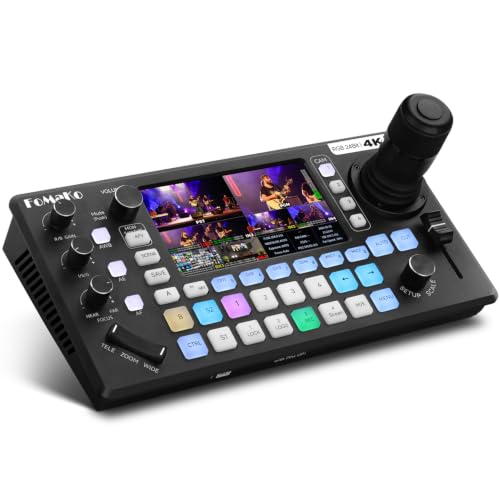
- Four 4K HDMI inputs with PTZ joystick control
- Six-channel audio mixer with XLR and phantom power
- Streams to three platforms and records to USB or SD
Best For: Churches, events, and solo-operated PTZ productions
Best All-in-One Control

- Four HDMI inputs with dual HDMI outputs
- Streams to up to three platforms via Ethernet
- Built-in audio, recording, playback, and overlays
Best For: Multi-camera events, podcasts, churches, and conferences
Best for Pro Hybrid Production

- Combines four HDMI and four SDI inputs
- Supports dual-platform IP streaming and UVC
- Adds PTZ control, NDI|HX3, and dual recording
Best For: Professional studios, venues, churches, and hybrid AV systems
Best for Direct Social Streaming

- Four HDMI inputs with two supporting 4K60
- Dual RTMP streaming without a computer
- PTZ control, UVC capture, audio mixing, and overlays
Best For: Creators, podcasts, events, and social-first live productions
Compact All-in-One Pick – Magewell Director Mini
The Magewell Director Mini is a practical video switcher with streaming encoder for creators who want switching, recording, encoding, monitoring, and streaming in one portable unit. Its HDMI, USB, IP-source, touchscreen, and battery options make it suitable for mobile or fixed productions without requiring an external PC.
Best For: Mobile creators, solo producers, and compact YouTube or Twitch setups.
Pros:
- Combines switching, encoding, recording, monitoring, and streaming in a standalone device.
- Supports HDMI, USB, SRT, RTMP, RTSP, NDI HX, media files, and mobile camera inputs.
- Offers H.264/H.265 encoding up to 1080p60 and simultaneous streaming and recording.
- Dual hot-swappable NP-F battery slots support field production.
Cons:
- Has a smaller 5.44-inch screen than the Director One.
- Cellular connectivity requires a separate USB modem.
- Limited to two HDMI inputs.
The Director Mini stands out when portability and an all-in-one workflow matter more than a larger control surface. It is a flexible choice for compact productions that need professional network-source support and recording.
Flexible Hybrid Mixer – Osee GoStream Duet
Osee GoStream Duet Multiple Camera SDI and HDMI Live Stream Video Mixer Switcher
Check Price On AmazonThe Osee GoStream Duet is a video switcher with streaming encoder designed for productions that need broad input flexibility and multiple control options. It accepts SDI, HDMI, USB-C, NDI HX, and playback sources, while supporting direct or software-assisted streaming workflows.
Best For: Event producers and teams combining SDI, HDMI, network, and playback sources.
Pros:
- Provides four SDI, four HDMI, USB-C, NDI HX, and SD/SSD playback source options.
- Supports landscape and portrait input and output formats.
- Offers built-in GUI, Mac and Windows software, and Bitfocus Companion control.
- Can stream to up to three platforms simultaneously or connect with OBS and vMix.
Cons:
- Advanced NDI HX support requires downloading the latest firmware.
- Its one-year warranty is shorter than the Magewell alternatives listed here.
- Requires additional software when using OBS or vMix-based workflows.
With extensive input selection and several control methods, the GoStream Duet is a versatile option for mixed-camera environments. Its keying, PIP, transitions, and multi-platform streaming features give it useful production depth at a compact size.
Large-Touchscreen Production Hub – Magewell Director One
The Magewell Director One is a video switcher with streaming encoder for producers who want a standalone system with a larger touch interface and dedicated HDMI program output. It combines multi-source switching, recording, encoding, monitoring, and streaming while supporting both wired and wireless connectivity.
Best For: Mobile and fixed productions needing a larger touchscreen and direct HDMI output.
Pros:
- Integrates switching, encoding, recording, monitoring, and streaming without a separate PC or HDMI switcher.
- Supports two HDMI, two USB-A, up to three IP sources, media files, and mobile cameras.
- Includes a dedicated HDMI program output for monitors, projectors, or downstream equipment.
- Offers a 7-inch AMOLED touchscreen, dual battery slots, Wi-Fi, Ethernet, and integrated 4G modem support.
Cons:
- 4G service is not included.
- Supports up to two HDMI inputs.
- Its larger feature set may be more than basic streaming setups require.
The Director One is the stronger Magewell choice when touchscreen workspace and direct program monitoring are priorities. Its network-source support, recording options, and mobile connectivity make it well suited to demanding standalone productions.
Professional ISO Recording Choice – Osee GoStream Duet 8 ISO
The Osee GoStream Duet 8 ISO is a video switcher with streaming encoder for larger productions that need HDMI and SDI connectivity, professional audio, and extensive recording. It combines eight camera inputs, ISO recording, network video support, graphics tools, and direct multi-destination streaming in one workflow.
Best For: Churches, event crews, podcasts, panels, and productions requiring ISO backups.
Pros:
- Combines four HDMI 2.0 inputs and four 3G-SDI inputs, with HDMI support up to 4K60.
- Records eight ISO feeds plus the program output using H.264 or H.265.
- Provides XLR and 3.5mm audio connections with phantom power and processing tools.
- Supports NDI HX, SRT, RTMP, UVC webcams, triple streaming, layers, keying, and browser-based graphics.
Cons:
- Program output is limited to 1080p even though HDMI input supports up to 4K60.
- Its advanced ISO, audio, and graphics features may be excessive for simple streams.
- It has a one-year warranty.
The GoStream Duet 8 ISO is the most production-focused option in this group. Its combination of hybrid inputs, ISO recording, XLR audio, and triple streaming is especially valuable when live coverage needs both flexibility and a reliable post-production safety net.
Best Overall – Blackmagic ATEM Mini Pro
The Blackmagic Design ATEM Mini Pro is a strong all-around video switcher with streaming encoder for creators who need four-camera HDMI production, built-in transitions, multiview, audio mixing, recording, and direct internet streaming in one compact unit.
Best For: Education, business presentations, esports, and multicamera livestreams.
Pros:
- Four HDMI inputs with 10-bit 4:2:2 video support.
- Built-in streaming, recording, multiview, and a six-input, two-channel audio mixer.
- Includes professional transitions, upstream keys, and a downstream keyer.
- Compact 1.2-pound design with USB-C and Ethernet connectivity.
Cons:
- Video inputs are HDMI-only.
- Its feature set may require time to learn for first-time operators.
Choose the ATEM Mini Pro when you want a proven, feature-rich production hub rather than a basic encoder. It is especially practical for setups built around several HDMI cameras and live switching.
Best Dedicated Encoder – 1080p60 H.265/H.264 Encoder
This compact video switcher with streaming encoder is designed primarily for turning an HDMI source into an IP stream. It supports 1080p60 hardware H.265/H.264 encoding and a broad range of protocols, with browser-based setup and no PC software required.
Best For: HDMI-to-IP streaming, IPTV, remote monitoring, digital signage, and networked video distribution.
Pros:
- Supports 1080p60 hardware H.265 and H.264 encoding.
- Works with SRT, RTMP(S), RTSP, HLS, WebRTC, UDP, and other protocols.
- Browser-based configuration avoids dedicated software and drivers.
- Compact form factor with HDMI audio support, external 3.5mm input, and OSD overlays.
Cons:
- Provides one HDMI port, so it is not a multicamera switcher.
- Advanced network streaming configurations require basic networking knowledge.
- The supplied specifications list no included power plug.
This is the better fit when reliable IP distribution matters more than live camera switching. Its protocol flexibility and small footprint make it suitable for fixed installations and remote workflows.
Best for PTZ Production – FoMaKo KC800 4K Switcher
The FoMaKo KC800 combines a video switcher with streaming encoder, PTZ controller, audio mixer, recorder, and monitoring screen. Its four 4K HDMI inputs, AI tracking, joystick control, and multichannel audio make it suited to demanding productions operated by one person or a small crew.
Best For: Churches, weddings, corporate events, live production, and PTZ-based multicamera streams.
Pros:
- Controls up to four PTZ cameras with VISCA/VISCA-over-IP and a built-in 4D joystick.
- Offers four 4K HDMI inputs, three HDMI outputs, and UVC connectivity.
- Includes six-channel audio mixing with XLR inputs, phantom power, and HDMI audio channels.
- Records to USB or SD card and can stream to three platforms plus one UVC feed.
Cons:
- Its extensive controls and production features may be more than a simple setup needs.
- PTZ automation depends on compatible cameras and configured control connections.
- The supplied notes mention a 30-day no-hassle policy but do not provide complete warranty details.
The KC800 stands out for operators who need switching, PTZ control, audio, recording, and streaming without assembling several separate devices. It is a particularly capable choice for live venues and multi-camera productions.
Best All-in-One Control – Osee GoStream Deck
The Osee GoStream Deck is a practical video switcher with streaming encoder for creators who want hardware-based control, recording, audio mixing, and multi-camera production in one compact unit. It combines four HDMI inputs with Ethernet streaming, USB connectivity, and landscape or portrait output modes.
Best For: Podcasts, churches, conferences, weddings, education, and live events that need flexible switching and direct streaming without relying entirely on a computer.
Pros:
- Four HDMI inputs, dual HDMI outputs, USB Type-C, Ethernet, audio connections, and SD card support.
- Can stream to up to three platforms through Ethernet and also output to OBS or vMix over USB.
- Includes audio effects, recording, playback, chroma key, picture-in-picture, graphics overlays, and auto-switching.
- Physical PVW/PGM buses, T-Bar, macros, and built-in controls support PC-free operation.
Cons:
- Its HDMI-focused connectivity may be less suitable for productions built around SDI cameras.
- The broad feature set may require time to learn before live use.
The GoStream Deck stands out when hands-on control and integrated production features matter more than a minimal setup. Its three-platform streaming support, recording, playback, and portrait mode give it useful flexibility for both traditional broadcasts and social-first content.
Best for Pro Hybrid Production – Tenveo PC500
The Tenveo PC500 is a professional video switcher with streaming encoder designed for larger or more complex productions. It combines HDMI and SDI inputs, PTZ and NDI support, hardware encoding, multi-channel streaming, recording, and a built-in 5.5-inch monitoring screen.
Best For: Churches, studios, stages, conferences, sports, government events, classrooms, and other productions using mixed HDMI, SDI, PTZ, or network video sources.
Pros:
- Supports four HDMI inputs, four SDI inputs, USB input, NDI|HX3, and up to 4K60 input on supported HDMI connections.
- Streams through UVC, SRT, RTMP, RTSP, or NDI|HX3 and can stream to two platforms simultaneously.
- Provides PTZ camera discovery and control, presets, cruise tracks, and camera parameter adjustments.
- Supports dual recording to SD card, USB disk, or HDD while streaming, with recorded media available as auxiliary sources.
Cons:
- Although it accepts 4K60 input, its stated output is up to 1080p60.
- The professional feature set and mixed-format workflow may be more than smaller creators need.
The PC500 is the strongest fit here for production teams that need SDI, HDMI, network video, PTZ control, and recording in one workflow. Its flexible signal routing and browser-based control make it particularly useful for installations and repeatable live productions.
Best for Direct Social Streaming – Neolive R5 4K Video Switcher
The Neolive R5 is a video switcher with streaming encoder aimed at multi-camera creators who want direct platform streaming without a separate computer. It offers four HDMI inputs, built-in RTMP and NDI workflows, dual HDMI outputs, PTZ control, USB capture, audio mixing, and recording.
Best For: Podcasts, worship services, conferences, sports broadcasts, online events, and creators producing landscape and portrait content for platforms such as YouTube, Facebook Live, Twitch, and TikTok.
Pros:
- Four HDMI inputs include two supporting 4K60 and two supporting 1080p60.
- Built-in encoder supports simultaneous dual RTMP streaming, plus SRT and NDI workflows.
- USB 3.0 provides lossless 1080p60 UVC output for OBS, Zoom, Teams, Streamlabs, and vMix.
- Includes PTZ control for up to five cameras, audio delay adjustment, chroma key, graphics, transitions, and recording.
Cons:
- Its HDMI-based input design may not suit productions that require native SDI connections.
- Many advanced controls and production features could add setup complexity for beginners.
The R5 is a compelling middle ground for users who want a hardware encoder but still need computer-based UVC flexibility. Direct dual-platform streaming, portrait support, PTZ control, and integrated graphics make it well suited to modern creator and event workflows.
How We Picked the Best Video Switcher with Streaming Encoder
We compared these models by looking at their input formats, maximum resolution and frame rates, built-in encoding protocols, audio connectivity, recording options, monitoring, control features, and overall suitability for real-world live production. We also considered whether each unit is better suited to a simple HDMI workflow, a mixed SDI and HDMI installation, or a more advanced setup with PTZ cameras and isolated recording.
Because specifications vary widely, the right choice depends less on having the most features and more on matching the switcher to your cameras, streaming platform, crew, and desired production quality.
Quick Comparison
| Best For | Prioritize | Look For |
|---|---|---|
| Solo creators | Simple operation | Touchscreen control, USB output, and direct streaming |
| Multi-camera events | Flexible connectivity | Multiple HDMI or SDI inputs and dependable encoding |
| PTZ productions | Remote camera control | Joystick control, presets, and tracking support |
| Professional workflows | Redundancy and monitoring | ISO recording, XLR audio, multiview, and robust protocols |
Key Buying Factors for a Video Switcher with Streaming Encoder
Inputs and Camera Compatibility
Start by listing the outputs from every camera. HDMI is common for mirrorless cameras and camcorders, while SDI is preferable for longer cable runs and professional installations. Mixed-input models are useful when upgrading gradually, but verify supported resolutions and frame rates before buying.
Encoding and Streaming Protocols
Check whether the unit supports the platform and delivery method you need. RTMP is widely used for services such as YouTube and Facebook, while RTSP, SRT, HLS, and WebRTC can be important for IPTV, remote contribution, or lower-latency workflows. Built-in encoding is most convenient when you want to stream without a separate computer.
Resolution, Recording, and Output
Some switchers accept 4K signals but switch, record, or stream at 1080p. Confirm the actual output resolution, frame rate, recording media, and whether the device can capture a program feed, isolated sources, or both. A clean USB output can also make the switcher useful with streaming software.
Audio and Control
For microphones and mixers, look for XLR inputs, phantom power where required, embedded HDMI or SDI audio, headphone monitoring, and independent audio controls. PTZ joystick control, touchscreen menus, multiview layouts, and physical buttons can make live operation faster and less error-prone.
Who Should Buy Which Video Switcher with Streaming Encoder?
Choose a compact HDMI model if you are a solo streamer, educator, presenter, or small production team that values quick setup. Select a switcher with SDI and HDMI inputs for venues, houses of worship, conferences, and productions using longer cable runs or mixed camera systems. PTZ-oriented models are a strong fit for installations where cameras must be controlled from one position. If you need backup recordings, advanced audio, or post-production flexibility, prioritize ISO recording and broader monitoring features. Finally, confirm network connectivity, firmware support, storage requirements, and power options before purchase so the selected unit fits your complete workflow.