The best MIDI keyboards with pads combine playable keys, responsive drum pads, and production controls in a compact setup. They can help you build beats, trigger samples, sketch melodies, and control software instruments without reaching for a full-size keyboard.
Our roundup includes compact 25-key models, larger 37-key options, wireless controllers, and units with useful extras such as OLED screens, arpeggiators, built-in speakers, and bundled accessories.
Best 10 Midi Keyboards with Pads Picks for 2026
Best Compact Beat-Making Pick

- 25 velocity-sensitive mini keys with eight MPC-style pads
- Eight assignable knobs and built-in arpeggiator
- Includes MPC Beats, instruments, sounds, and Splice access
Best For: Portable beat making and home-studio production
Best Software Bundle

- 25 velocity-sensitive keys and 16 backlit performance pads
- Eight encoders, four sliders, display, and browsing knob
- Includes instruments, Ableton Live Lite, cables, and accessories
Best For: Compact studios and beginners wanting an all-in-one bundle
Best Wireless Option

- Bluetooth, USB, and built-in 2,000 mAh battery
- Eight RGB pads, eight encoders, and touch strips
- Works with Windows, Mac, Android, iOS, and major DAWs
Best For: Mobile production and wireless music-making
Best Extended Keyboard

- 37 keys provide three octaves of playing range
- Eight RGB MPC pads with chords and scales modes
- 64-step sequencer plus CV/Gate and MIDI I/O
Best For: Producers needing more keys and external-hardware control
Best for Easy Setup
K32 32-Key MIDI Keyboard with Pads

- Built-in sounds and speakers
- Wireless BLE MIDI with rechargeable battery
- Eight drum pads and eight assignable knobs
Best For: Portable practice, teaching, and standalone music creation
Best for Ableton
Akai APC Key 25 MK2 MIDI Controller
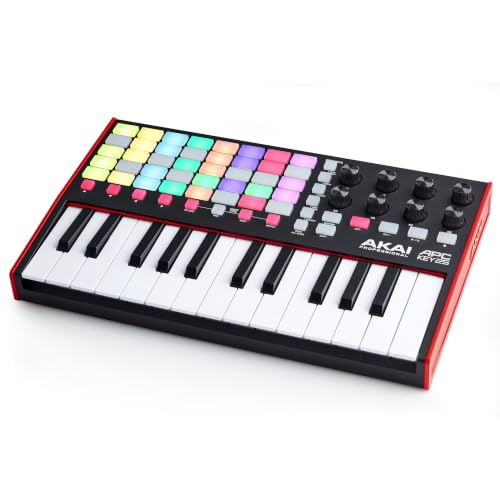
- 40 RGB pads for clip launching
- 1:1 Ableton Live mapping
- 25 velocity-sensitive mini keys and eight knobs
Best For: Ableton Live production and live clip performance
Best Learning Features
Donner DMK 25 Pro MIDI Keyboard

- Eight drum pads and OLED display
- Smart scales, arpeggio, note repeat, and chords
- Includes 40 teaching courses and four DAW software options
Best For: Beginners and mobile DAW production
Best Standalone Pick

- 25 keys with eight MPC pads and eight knobs
- Built-in speaker and over 100 internal sounds
- Battery-ready portable design with software bundle
Best For: Portable beat makers and songwriters
Best Wireless Value
DaierTek 25-Key Bluetooth MIDI Controller

- Wireless Bluetooth and USB MIDI connectivity
- Eight RGB pads with velocity sensitivity and aftertouch
- 16-hour battery and smart chord/scale functions
Best For: Mobile producers using computers, tablets, or phones
Best Control-Focused Pick
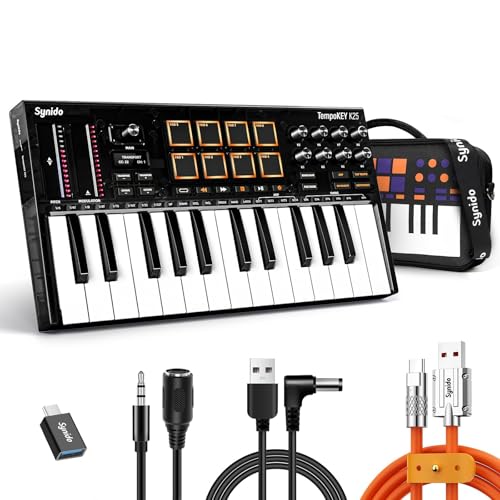
- Eight RGB pads with dual banks and note repeat
- OLED display, encoder, knobs, and transport controls
- MIDI Out, sustain input, and USB-C connectivity
Best For: Producers wanting extensive hands-on DAW control
Best Compact Beat-Making Pick – Akai MPK Mini MK3
The Akai MPK Mini MK3 is a practical choice for producers seeking MIDI keyboards with pads in a compact format. Its 25 velocity-sensitive mini keys, eight MPC-style pads, assignable knobs, arpeggiator, and included software make it well suited to beat production and home-studio work.
Best For: Beat makers, home-studio producers, and musicians who want a portable controller with dedicated drum pads.
Pros:
- Eight velocity-sensitive MPC-style pads include Note Repeat and Full Level.
- Eight assignable 360-degree knobs provide hands-on plugin and mix control.
- Includes MPC Beats, three virtual instruments, 2GB of sound content, and a two-month Splice offer.
- Built-in arpeggiator and four-way pitch/modulation thumbstick expand performance options.
Cons:
- The 25 mini-key layout offers less melodic range than larger controllers.
- It uses USB connectivity rather than the Bluetooth wireless connection found on some competing models.
The MPK Mini MK3 is especially compelling when pad-based beat programming matters as much as keyboard control. Its compact design and broad software bundle make it a strong all-around starting point for computer-based production.
Best Software Bundle – Arturia MiniLab 3
The Arturia MiniLab 3 is a well-equipped option among MIDI keyboards with pads, pairing 25 velocity-sensitive slim keys with two banks of eight backlit performance pads. Its browsing controls, sliders, arpeggiator, and bundled software make it useful for producers who want a streamlined setup.
Best For: Beginners and compact studio users who value performance pads, browsing controls, and a substantial software package.
Pros:
- Provides 16 backlit pads across two banks for performance and triggering.
- Includes eight rotary encoders, four sliders, a mini display, and a clickable browsing knob.
- Bundled software includes Analog Lab Intro, UVI Grand Piano Model D, The Gentleman, and Ableton Live Lite.
- Includes a six-foot MIDI cable, USB cable, cleaning cloth, and limited five-year manufacturer warranty.
Cons:
- The 25-key slim-key layout is compact but offers limited range for two-handed playing.
- This bundle’s extra accessories may be unnecessary if you already own a MIDI cable and cleaning supplies.
The MiniLab 3 stands out for its unusually complete bundle and flexible control layout. The two pad banks, display, and browsing knob make it a polished choice for users building a compact production workstation.
Best Wireless Option – M-VAVE K5 MIDI Controller
The M-VAVE K5 is a flexible pick for musicians comparing MIDI keyboards with pads and wanting wireless portability. It combines 25 velocity-sensitive keys, eight RGB backlit pads, eight assignable encoders, touch strips, and Bluetooth connectivity with a built-in battery.
Best For: Mobile producers and performers who need a compact controller that can work with computers and iOS or Android devices.
Pros:
- Bluetooth connectivity and a 2,000 mAh battery provide a claimed working time of about 16 hours.
- Eight RGB backlit velocity-sensitive pads support drum and sample triggering.
- Compatible with Windows, Mac OS, Android, and iOS, plus a range of major DAWs.
- Includes eight rotary encoders, two capacitive touch pitch strips, and smart chord and scale features.
Cons:
- The 25-key design provides less playing range than a larger controller.
- Wireless operation depends on device compatibility and battery charge.
The K5 is the most travel-oriented option in this group. Its Bluetooth support, rechargeable battery, and mobile-device compatibility make it appealing for composing away from a traditional studio, while the pads and touch controls preserve hands-on production capability.
Best Extended Keyboard – Akai MPK Mini Plus
The Akai MPK Mini Plus expands the typical compact controller with 37 keys while retaining eight RGB MPC pads. For shoppers seeking MIDI keyboards with pads, it adds a 64-step sequencer, CV/Gate and MIDI connections, chord and scale modes, and DAW transport controls.
Best For: Producers and performers who need more melodic range, pad control, sequencing, and connections for external hardware.
Pros:
- Thirty-seven keys provide three full octaves for broader melodic and harmonic performance.
- Eight RGB MPC pads support dynamic beat making and include chords and scales modes.
- Built-in 64-step sequencer supports separate drum and melody or chord tracks.
- CV/Gate and MIDI I/O enable connections to modular gear, synthesizers, and sound modules.
Cons:
- The larger 37-key format is less compact than 25-key alternatives.
- Its expanded controls and external-hardware connections may be more than beginners need.
The MPK Mini Plus is the strongest fit here for users who have outgrown 25 keys. Its additional range and standalone-style sequencing features make it a more capable centerpiece for both computer-based and hardware-focused setups.
Best for Easy Setup – K32 32-Key MIDI Keyboard with Pads
If you want midi keyboards with pads that can work beyond a computer-based setup, the K32 stands out with built-in sounds, speakers, wireless BLE MIDI, and a rechargeable battery. Its 32 keys provide more room for chords and melodies than many compact controllers, while the eight drum pads and assignable knobs support hands-on beat making and sound shaping.
Best For: Creators, teachers, performers, and beginners who want a portable wireless keyboard with onboard sounds and speakers.
Pros:
- Built-in sounds and speakers allow standalone playing without immediately connecting a computer.
- 32-key layout offers more playing space than a typical 25-key controller.
- Includes wireless BLE MIDI, up to six hours of battery life, eight assignable knobs, and eight drum pads.
- Dedicated sound buttons and an OLED display support quick control during performances or practice.
Cons:
- Its built-in speaker and sounds may be less suited to users who only need a traditional computer-based controller.
- Wireless setup uses compatible devices and may require the Synido BLE Connect app.
The K32 is a flexible choice if portability and immediate playability matter as much as DAW control. It is especially appealing for musicians who want a compact controller that can also function as a standalone sound source.
Best for Ableton – Akai APC Key 25 MK2 MIDI Controller
Among midi keyboards with pads, the Akai APC Key 25 MK2 is designed specifically for Ableton Live performance and clip launching. It combines 25 velocity-sensitive mini keys with a bright 5×8 matrix of 40 RGB pads, eight assignable knobs, and navigation buttons for controlling tracks, scenes, loops, and samples from one compact USB-powered unit.
Best For: Ableton Live users who prioritize clip launching, live performance control, and compact studio production.
Pros:
- 40 RGB pads provide visual feedback and direct clip-launching control in Ableton Live.
- Pre-mapped 1:1 integration supports Ableton Live 11.2.7 and later.
- 25 velocity-sensitive keys handle chords, basslines, leads, and software instruments.
- USB plug-and-play operation requires no batteries or power adapter, and Ableton Live Lite is included.
Cons:
- The controller is primarily tailored to Ableton Live rather than broad standalone use.
- It has 25 mini keys, which may feel limited for players who need a larger keyboard range.
The APC Key 25 MK2 makes the most sense when clip launching and Ableton workflow are central to your setup. Its pad matrix and track-navigation controls give it a stronger live-performance focus than a basic keyboard controller.
Best Learning Features – Donner DMK 25 Pro MIDI Keyboard
The Donner DMK 25 Pro is one of the more feature-packed midi keyboards with pads for mobile and computer-based production. It includes eight drum pads, an OLED display, smart scale modes, arpeggio, note repeat, chord functions, touch controls, and USB-C connectivity. It does not produce sound on its own, so it must be connected to a phone or computer running compatible DAW software.
Best For: Beginners and mobile producers who want guided learning tools alongside hands-on composition controls.
Pros:
- Eight drum pads, four assignable wheels, transport controls, and touch controls support detailed production workflows.
- Smart Dynamic Scale Mode offers 16 scale tones for bass lines, melodies, and leads.
- Arpeggio, note repeat, and chord functions expand performance possibilities.
- Includes four DAW software options and 40 keyboard-teaching courses.
Cons:
- It cannot produce sound without a connected phone or computer and DAW software.
- Mobile use may require a separately purchased adapter for interfaces other than the included USB-C setup.
- The 25-key format may not provide enough range for players seeking a larger keyboard.
The DMK 25 Pro is a strong fit for users who want more than basic keys and pads, particularly beginners who can benefit from its teaching courses and smart scale features. Confirm your device’s adapter and DAW compatibility before buying.
Best Standalone Pick – Akai MPK Mini Play MK3
The Akai MPK Mini Play MK3 is a strong choice for shoppers seeking midi keyboards with pads that can work both with a computer and away from a full studio setup. Its 25-key layout, eight MPC pads, built-in sounds, speaker, OLED display, and battery operation make it especially flexible for beat-making and songwriting on the go.
Best For: Portable beat makers and musicians who want built-in sounds and speaker playback.
Pros:
- Includes eight velocity-sensitive, backlit MPC pads and eight encoder knobs.
- Built-in speaker and more than 100 internal drum and instrument sounds support standalone use.
- Offers an arpeggiator, note repeat, OLED display, and battery-powered portability.
- Includes MPC Beats, AIR Music Tech instruments, Melodics lessons, and a Splice trial.
Cons:
- Only has 25 keys, which may feel limiting for two-handed playing.
- Batteries are not included for portable operation.
Choose this model if standalone convenience matters as much as computer control. It is less focused on extensive connectivity than some newer controllers, but its built-in sounds and speaker give it a practical edge for sketching ideas anywhere.
Best Wireless Value – DaierTek 25-Key Bluetooth MIDI Controller
The DaierTek 25-key controller is a versatile option for anyone comparing midi keyboards with pads for computer, tablet, or phone production. Bluetooth and USB connectivity, a built-in 2,000 mAh battery, RGB pads, touch controls, and beginner-friendly smart functions give it a broad feature set in a portable format.
Best For: Mobile producers who want wireless MIDI control across computers and smart devices.
Pros:
- Provides eight RGB backlit pads with velocity sensitivity and aftertouch.
- Supports Bluetooth and USB MIDI across Windows, Mac, Android, and iOS platforms.
- Built-in battery is rated for about 16 hours of operation.
- Includes arpeggio, smart chord, smart scale, eight assignable encoders, and two touch strips.
Cons:
- It produces no sound by itself and requires music software or a DAW.
- Bluetooth setup on Windows requires a MIDI driver, while Android pairing must occur inside a compatible app.
This is a practical pick when wireless flexibility is a priority. Its connection requirements are worth considering before purchase, but the long battery rating and mobile compatibility make it appealing for compact, app-based production setups.
Best Control-Focused Pick – Synido TempoKey K25
The Synido TempoKey K25 is designed for producers who want midi keyboards with pads and extensive hands-on DAW control. Along with eight RGB pads, it adds an OLED display, push encoder, touch bars, transport buttons, MIDI Out, sustain input, and an arpeggiator in a compact 25-key controller.
Best For: Home-studio producers and performers who want detailed physical control over beats, parameters, and transport.
Pros:
- Eight velocity-sensitive RGB pads offer dual drum banks, note repeat, and full MIDI mapping.
- OLED display and 360-degree push encoder provide direct parameter and MIDI control.
- Includes eight assignable knobs, six transport buttons, two touch bars, MIDI Out, and sustain input.
- Reinforced PC+ABS housing, deeper key travel, and a non-slip base support regular use.
Cons:
- The 25-key format may not suit players who need a larger keyboard range.
- It is a MIDI controller and does not generate standalone instrument sounds.
For a compact controller with an unusually broad set of physical controls, the TempoKey K25 is a compelling choice. Its wired, studio-oriented design favors users who value mapping and performance control over standalone operation or wireless portability.
How We Picked the Best Midi Keyboards with Pads
We focused on features that matter in real music-making setups: key count, pad layout, control options, portability, connectivity, and workflow tools. The selection covers established controllers from Akai Professional and Arturia alongside affordable alternatives from Donner, M-VAVE, DaierTek, and Synido.
We also considered whether each controller suits beat production, melodic playing, live triggering, or beginner use. Since software compatibility and personal workflow vary, verify your DAW support and the included software before buying.
Quick Comparison
| What to Compare | Why It Matters |
|---|---|
| Key count | 25 keys are highly portable; 32 or 37 keys provide more range for melodies and chords. |
| Pad count | Eight pads are useful for beats, clips, samples, and one-shot sounds. |
| Connectivity | USB is standard, while Bluetooth and wireless models can simplify mobile setups. |
| Extra controls | Knobs, displays, scales, arpeggiators, and transport controls can speed up production. |
| Standalone features | Built-in speakers or rechargeable batteries may be useful for practice and portability. |
Key Buying Factors for Midi Keyboards with Pads
Keys and Playing Range
A 25-key controller is a practical choice for travel, desk use, and beat-focused production. If you regularly play two-handed parts or want more room for bass lines and chords, a 32-key or 37-key model may be more comfortable. Also check whether the keys are velocity-sensitive and whether the action suits your playing style.
Pad Responsiveness and Layout
Pads should respond consistently to different playing strengths and reset quickly for repeated hits. Backlit pads make it easier to identify active clips or sounds in dim environments. Look for pad modes or bank switching if you plan to trigger more than eight sounds at once.
Controls, Software, and Compatibility
Assignable knobs are useful for filters, effects, and instrument parameters, while an OLED display can reduce the need to monitor every setting in your DAW. Confirm compatibility with your computer, tablet, or phone, and check whether the controller uses USB-C, standard USB, Bluetooth, or a separate wireless connection.
Portability and Power
Measure your available desk or travel space before choosing. Bus-powered models reduce cable clutter, while rechargeable or wireless controllers are convenient away from a computer. A built-in speaker can help with casual practice, but it is not a substitute for studio monitors or headphones.
Who Should Buy Which Midi Keyboards with Pads?
Choose a compact 25-key model if portability, beat making, and small workspaces are your priorities. Choose a 37-key controller if you want a broader playing range without moving to a full-size keyboard. Choose a model with wireless connectivity or a speaker for mobile practice and flexible setups. Choose a controller with an OLED display, scales, or an arpeggiator if you want more hands-on guidance while composing. For beginners, prioritize dependable pads, straightforward software setup, and controls you will actually use over a long list of extra features.